What Is the Best AI Deal Room for B2B Sales Teams? (A Practical 2025 Guide)
Quick look: An AI deal room (also called a digital sales room or DSR) is a secure, shared online workspace where B2B sellers and buyers collaborate throughout a deal. It centralizes content, proposals, and communication in one branded hub and uses AI to surface buyer intent signals, recommend next actions, and shorten the sales cycle.
You send the deck. The buyer forwards it to six people you have never heard of. Someone opens the pricing page eleven times and never replies. You follow up on a Friday. Nothing.
That is what selling without an AI deal room looks like. Scattered threads, invisible stakeholders, zero signal on what is resonating. The good news is that gap is fixable, and the tools to fix it have matured considerably. This guide covers what to look for in a deal room, which platforms are actually worth evaluating, and how to choose the one that fits how your team sells.
If you have ever wondered why your sales content management feels disjointed from your buyer conversations, the answer often starts here
What Is an AI Deal Room? (And What It Is Not)
An AI deal room is a secure, shared digital workspace where B2B sellers and buyers collaborate during a sales deal. It centralizes content, proposals, and communication in one branded hub. AI capabilities add buyer intent signals, content recommendations, and engagement analytics that help sellers know what to share, who to follow up with, and when.
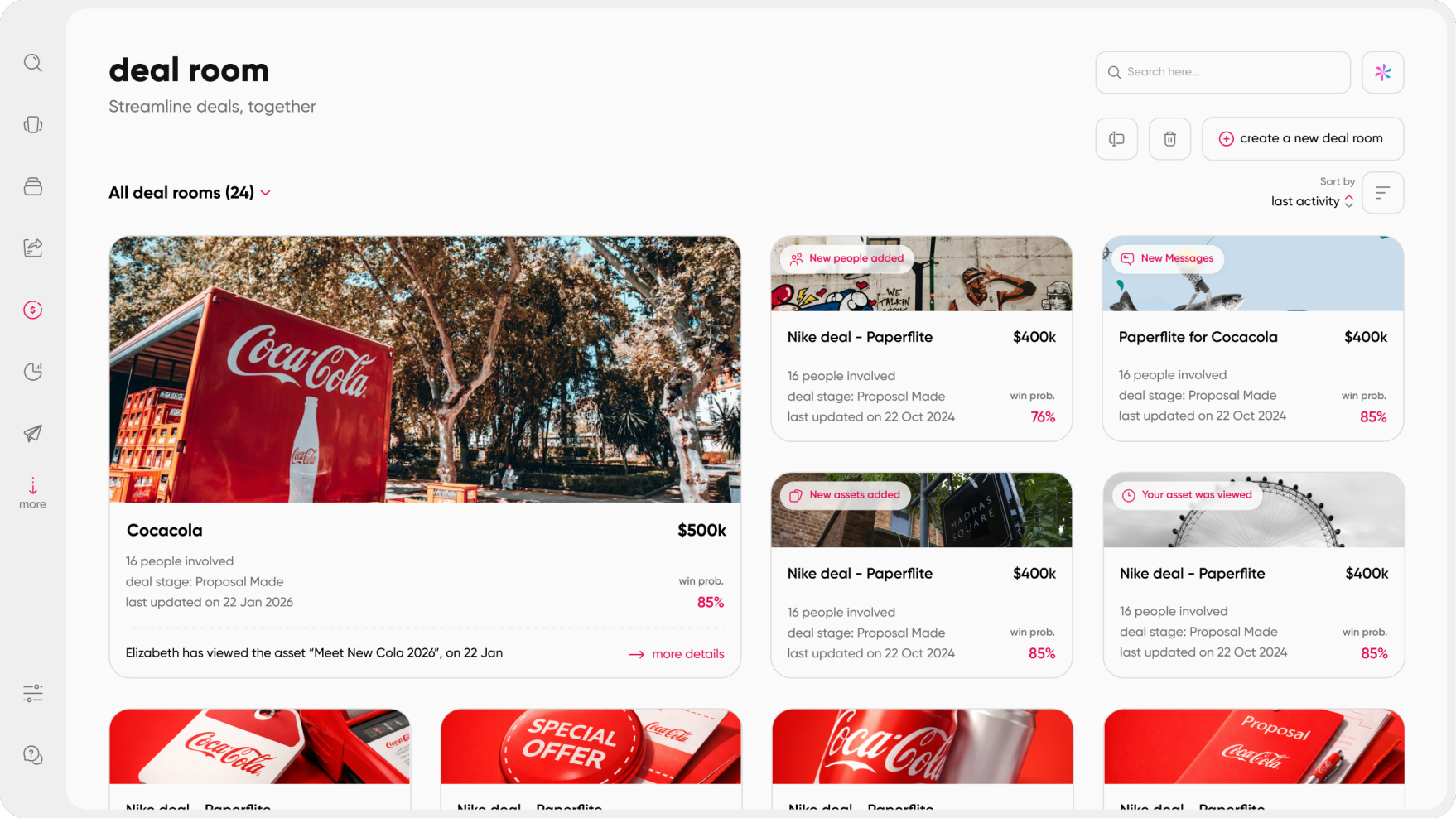
You may also hear it called a digital sales room, virtual deal room, or sales microsite. The terms are interchangeable. What they all describe is a single, persistent link your buyer can visit, revisit, and share with their team throughout the evaluation process. Paperflite calls it a deal room that drives decisions, not just engagement — a buyer-ready workspace where the entire deal lives: key assets, proof, pricing, and next steps, organised so buyers can move forward without five emails and ten links chasing them.
Deal Room vs. Data Room: Two Very Different Things
A virtual data room (VDR) is built for M&A due diligence: secure document sharing, granular access controls, and audit trails during financial transactions. Platforms like Datasite and Intralinks serve investment bankers, PE firms, and legal teams navigating complex transactions. A deal room in the B2B sales context is a buyer-facing workspace for sharing content, proposals, and communications during an active sales cycle. They serve different buyers and different moments entirely.
If you searched for the best AI deal room and landed on articles comparing Datasite, Intralinks, or Ansarada, you are in the wrong category. This guide is for sales teams, not M&A advisors. Paperflite's deal room is not a document vault it is a live, collaborative space where buyers and sellers build the deal together, both sides contributing content, tracking progress on a shared action plan, and staying aligned without ever leaving the room.
Where the AI Actually Lives
Early digital sales rooms were static file repositories. You sent a link, the buyer maybe opened a PDF, and you heard nothing. Modern AI deal rooms changed that in three specific places.
- What to share: AI recommends content based on deal stage, persona, and prior engagement patterns
- Who to follow up with: Stakeholder intent signals show which buying committee member is most active and which has gone dark
- When to act: Real-time alerts fire when high-intent behavior occurs, so you catch the buyer at the right moment, not days later
Why B2B Teams Are Moving Away From Email Threads
Gartner predicted that by 2026, 30% of B2B sales cycles will be managed through digital sales rooms. That prediction is landing. Highspot's State of Sales Enablement Report 2025 found 48% of B2B sales teams already use them for customer engagement. The reason is simple: the way buyers buy has changed faster than most sales process have.
AI deal rooms accelerate deal velocity by giving buyers a single, always-current hub for content, removing the back-and-forth that stalls decisions. Sellers gain per-person engagement signals across the buying committee, so they know which stakeholder is stuck, which is ready, and when to act. Mindtickle's 2025 State of Revenue Enablement report found teams using deal rooms closed deals 30% bigger in 10% shorter sales cycles. That is not a marginal improvement.
The Buying Committee Problem
The average B2B buying committee now has nine to eleven people. Most of them never speak to a sales rep. They get a forwarded link, evaluate the content on their own timeline, and make a significant portion of the decision before your champion has another call. Your champion cannot relay everything. They forward a PDF that is three versions old, and someone on the finance team raises a concern that could have been addressed with a one-pager you already had.
Email chains bury context. Version control breaks. Nobody knows who opened what. And you are following up blind, hoping the person you are emailing is the one who actually controls the deal.
What an AI Deal Room Fixes
The What is Sales Enablement? Tools, Functions and Resources framing applies directly here: a deal room is the buyer-facing side of enablement. It gives the buyer everything they need to move forward, and gives the seller the intelligence to know when and how to help.
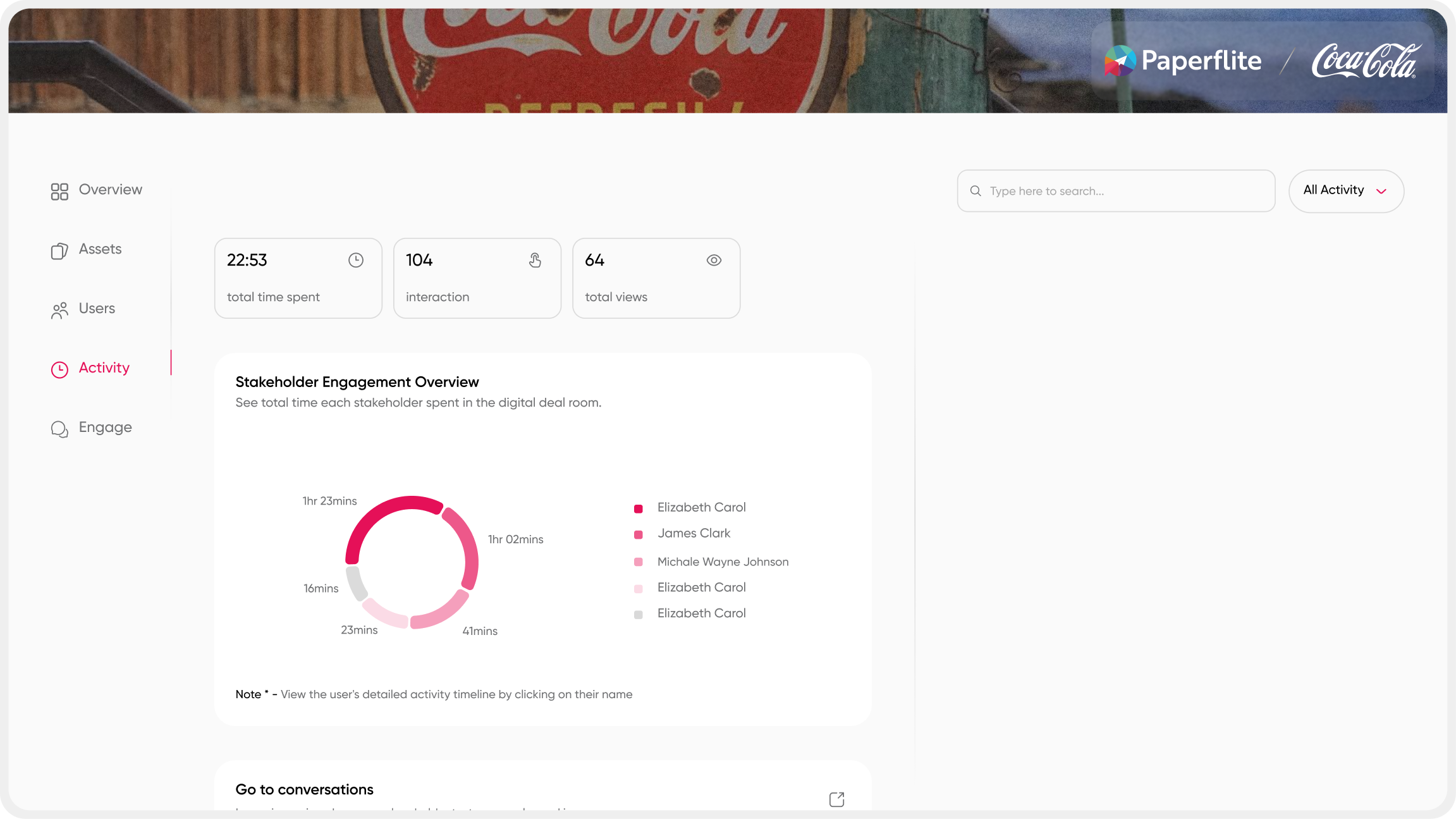
- Full buying committee visibility: who opened what, how long they stayed, which page stopped them
- One link, one source of truth, always current
- Real-time alerts when a stakeholder who went dark suddenly re-engages
- Live chat when the buyer is actively in the room, not hours after they have moved on
What Makes a Deal Room 'AI-Powered'? Features That Actually Matter
The AI label is overused in this category. Some platforms call themselves AI-powered because they summarize documents. Others because they have a chatbot. The features that actually change deal outcomes are more specific. Here is what to evaluate:
For a deeper look at how these map to content strategy, see What are important features of a digital sales room? for a platform-level breakdown.
1. Personalization and Content Structuring
The ability to create a branded, tailored microsite per deal, not a generic shared folder. Look for: custom logos, colors, backgrounds, and content ordering. Setup should take minutes, not a half-day of configuration.
2. Buyer Intent Signals and Per-Stakeholder Analytics
Page-level tracking is the baseline. What you actually need is multi-recipient tracking: not just 'the link was opened' but which specific person on the buying committee opened it, which page they spent time on, and when they came back. Real-time alerts when high-intent behavior occurs are what separate useful deal rooms from content dumps.
3. Live Interaction While the Buyer Is in the Room
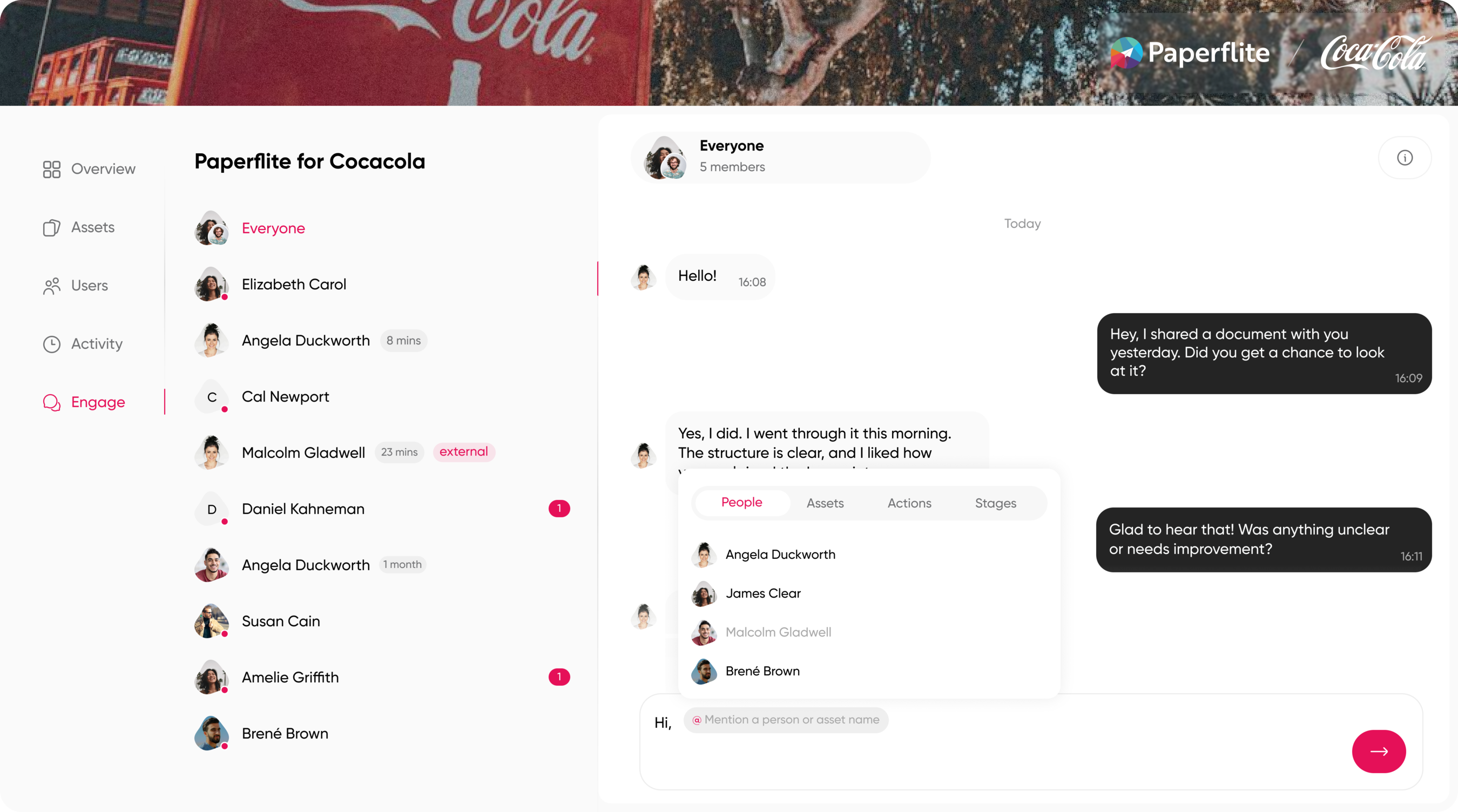
Real-time chat triggered by buyer activity. When a buyer is actively reviewing your pricing page or security documentation, you want the ability to start a conversation at that moment, while the content is still fresh. This turns passive sharing into active deal management.
4. AI-Powered Content Recommendations
The platform suggesting what content to add based on deal stage, persona, or prior engagement data. Not just a content library the rep has to navigate manually, but an intelligent layer that learns which assets correlate with closed-won deals and surfaces them at the right moment.
5. Predictive Deal Insights
AI that flags deal health signals, not just activity reports. Alerts on stalled engagement, gaps in buying committee coverage, or assets that historically precede churn in late-stage deals. The difference between a dashboard and a recommendation is whether you still have to figure out what to do next.
6. Live Collections: Real-Time Content Updates
When you update a document, the buyer's room reflects it immediately. No resending links. No email thread where someone is working from version three while you are on version seven. The buyer always sees the current version, automatically.
7. CRM and Ecosystem Integrations
Native sync with Salesforce, HubSpot, and Marketo. Deal room engagement data flowing into your CRM without manual data entry. The room should not be a separate island of information. Engagement data flows into the CRM automatically, no manual logging required.
8. Enterprise-Grade Security
SOC 2 Type II certification, role-based access controls, password protection, and access expiry. Especially important when the room contains sensitive pricing, legal terms, or proposal specifics. Always verify security certifications before sharing confidential commercial documents.
The Landscape: AI Deal Room Platforms Worth Knowing
A sales enablement platform manages content internally for reps, covering how they find, learn from, and use materials. A digital sales room is buyer-facing: it is where deals actually happen, with the buyer present. The two categories complement each other. Some platforms now offer both.
The market context matters before you evaluate any of these. Two major consolidations have reshaped the competitive landscape since late 2025.
The Enterprise-Tier Platforms
Seismic (now incorporating Highspot) The largest combined entity in revenue enablement following their February 2026 merger, valued at approximately $6 billion. Deep content governance, AI coaching at scale, and the broadest installed base in the category. Typical annual contracts run $70K to $180K+, with implementations measured in months. Buyers evaluating today are evaluating a platform actively mid-integration. Roadmap priorities will be shaped by merger consolidation, not new feature development, for the foreseeable near-term.
Showpad (now incorporating Bigtincan) Merged under Vector Capital in October 2025. Strong fit for field sales teams in manufacturing, medical devices, and life sciences, particularly for offline mobile access and 3D/AR content capabilities that the Bigtincan acquisition added. Pricing typically $42K to $108K annually. Post-merger integration is still underway. For desk-based SaaS and tech sales teams, the field-first positioning is less directly relevant.
Mid-Market Deal Room Point Solutions
GetAccept Strong combination of digital deal rooms, proposals, and e-signatures. Paid DSR plans from $49/user/month. Best for mid-market teams that prioritize a polished buyer-facing experience with integrated contract workflows.
Flowla AI-powered digital sales rooms with strong automation for deal execution and onboarding handoffs. Plans from $49/user/month. Best for teams that want workflow automation layered on top of content sharing, particularly for the sales-to-CS transition.
Aligned Buyer-first design with an in-room AI assistant for buyers and engagement analytics for sellers. Free plan available. Paid plans start at $29/seat/month. Strong for teams that want AI to help buyers self-serve information inside the room.
Mindtickle Enterprise revenue enablement platform where digital sales rooms are part of a broader coaching, training, and content system. Their 2025 research found DSR users saw a 26% increase in win rate. Pricing is customized for enterprise deployments.
Smaller teams benefit from platforms that deploy in days with transparent per-user pricing rather than six-figure annual contracts. SaaS and tech teams with complex multi-stakeholder sales cycles benefit most from content intelligence paired with deal rooms, a combination that fewer platforms deliver well.
Content-First Platforms With Deal Room Functionality
Paperflite: A content intelligence and deal room platform built specifically for sales and marketing alignment. Rather than treating the deal room as a standalone feature, Paperflite connects content management, buyer engagement tracking, and revenue intelligence in one system. Pricing starts at $30/month. Deal rooms and predictive deal insights are available on the Advanced tier. SOC 2 Type II certified. Implementation measured in days, not months.
How Paperflite Deal Rooms Work
Paperflite sits at the intersection of content management and deal room functionality. The deal room is not a bolt-on feature. It is built on the same content intelligence layer that tracks asset performance across your entire library, which means the AI has context about what content works before it makes a recommendation for your deal.
For a full walkthrough of what the platform can do end-to-end, see What can a digital sales room do for you?.
Set Up in Under Two Minutes
From within Paperflite's Collections, choose the Deal Room experience. Add content, set branding (logo, colors, background), structure it however the deal needs. One link goes to the buyer. No logins required. No app to download. Most enterprise alternatives require four months or more of onboarding before the first deal room goes live. Paperflite's is live the same day.
- Log into Paperflite and navigate to Collections
- Select 'Create New Collection' and choose the Deal Room experience
- Add content, set branding, and share the link
Branded, Personalized Buyer Experience
The buyer opens the link and enters a branded space that feels built for their deal, not a generic file share. The Overview section shows the deal context. Content is organized clearly, with everything accessible in one place: case studies, proposals, demos, security documentation, pricing. Whatever the deal requires.
Live Collections: Always Current, Never Stale
When you update a document, the buyer's room reflects it immediately. No resending links. No version confusion. The buyer always sees the current version of every asset, automatically.
Revenue Intelligence at the Deal Level
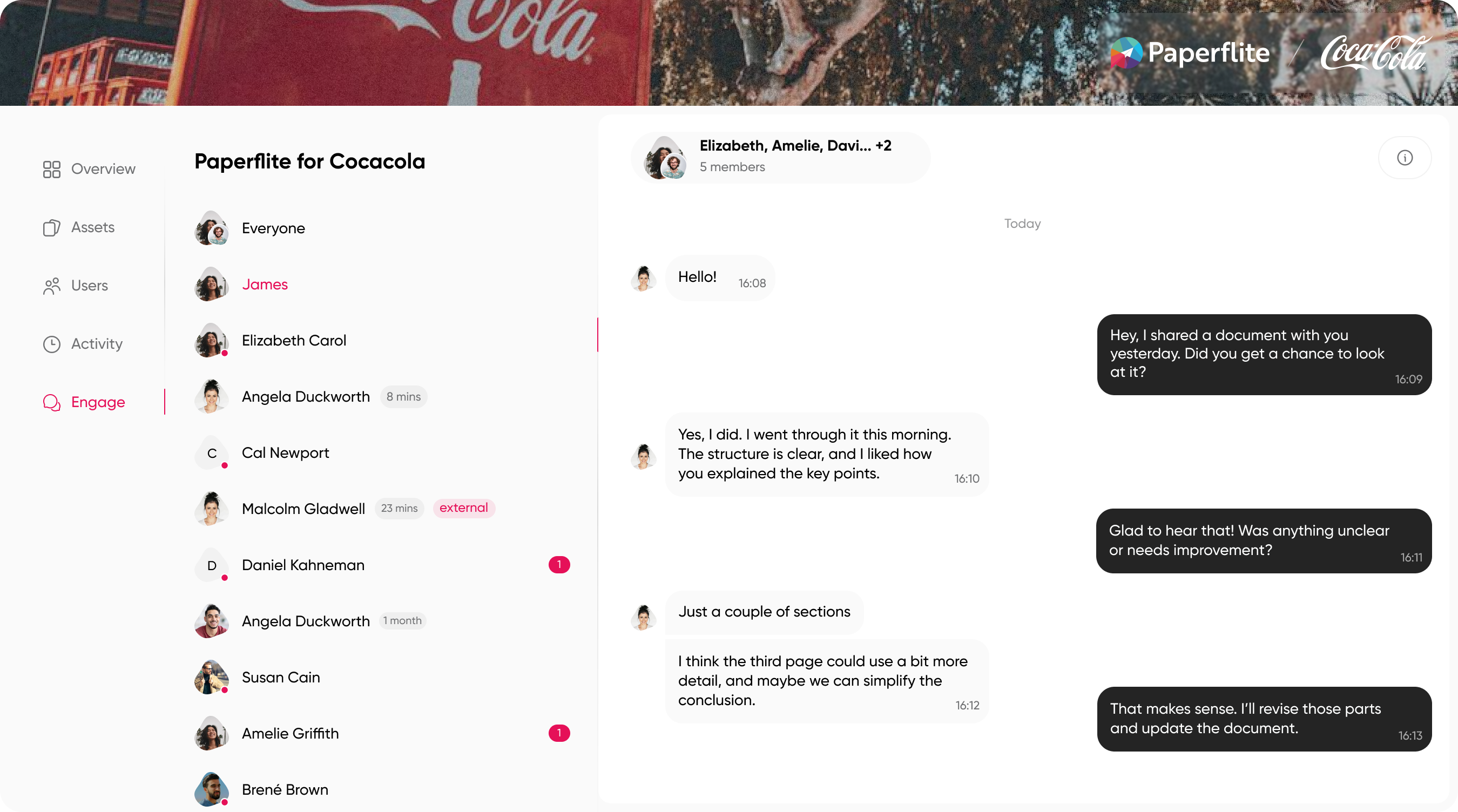
Paperflite's multi-recipient tracking shows not just that someone opened the room, but which stakeholder on the buying committee engaged, with which asset, for how long, and down to which page. These are the signals that tell you who your champion is and who your blocker is.
For a breakdown of how content performance connects to sales outcomes, see How AI Drives Sales Enablement. For the foundational content strategy behind it, see Sales Enablement Collateral.
Real-Time Chat When It Matters
When a buyer is in the room actively reviewing content, Paperflite lets you start a real-time conversation. No waiting for an email reply that may not come for two days. You catch the buyer while the content is still fresh, address the question they had not yet formed into an email, and keep the deal moving.
CRM Integration Without the Manual Work
Engagement data flows into Salesforce, HubSpot, and Marketo automatically. No manual logging. No copy-paste between systems. The deal room activity updates the CRM record, so your pipeline is always current.
How to Choose the Right AI Deal Room for Your Team
Choose a digital sales room based on where deals actually stall for your team. If buyers ghost after demos, prioritize engagement tracking and intent signals. If proposals slow things down, look for integrated CPQ and e-signature capability. If complex buying committees are the issue, focus on per-stakeholder visibility and stakeholder mapping. Also factor real deployment time: a platform live in days outperforms a six-month enterprise implementation for most mid-market teams.
Not sure what your 13 Most Important Types of Sales Enablement Content should be? That gap in your content library often becomes the gap in your deal room. Fix the library first.
Four Questions to Anchor Your Evaluation
1. Where does your biggest friction actually live?
If deals stall because buyers cannot find the right content or you lose track of stakeholders between calls, you need content intelligence and engagement tracking first. If deals stall at proposal and contract stage, you need CPQ and e-signature capability first. Do not buy a deal room to solve the wrong problem.
2. Do you need a point solution or a platform?
A point solution like Flowla, GetAccept, or Aligned deploys fast and solves one thing well. A platform like Paperflite or Mindtickle connects deal rooms to broader content management, analytics, and enablement infrastructure. Neither is wrong. It depends on what is already in your stack and what problem is most urgent.
3. What does your buying committee look like?
Simple deals with one or two stakeholders need a clean content-sharing experience with basic tracking. Complex deals with nine to eleven committee members need per-person engagement tracking, stakeholder mapping, and alerts when a key decision-maker goes quiet. Make sure the platform you choose can see every person in the room, not just the link opener.
4. What is the real cost of implementation?
A $70K+ enterprise contract that takes four months to deploy is a different decision than a platform that is live in days at $30 per month. Both are legitimate choices for different team profiles. See sales reps as a useful read on why fast deployment and adoption go together: if it takes months to set up, reps will route around it.
Conclusion
You do not need the biggest platform. You need the one that tells you what is happening inside your deals and helps you act on it faster than your competitors.
The best AI deal room for a B2B sales team centralizes content, surfaces buyer intent, and makes it easy to follow up at the right moment, not days after the signal disappears. For teams that also want their deal room connected to a full content management and revenue intelligence system, Paperflite brings all of that in one place, at a fraction of the cost of enterprise alternatives currently navigating post-merger uncertainty.
A deal room is also only as good as the strategy behind it. If you have not yet built a formal How to Build a Sales Enablement Strategy? with Template, that is the right next step before or alongside a deal room deployment.
Frequently Asked Questions
What is an AI deal room?
An AI deal room, also called a digital sales room or DSR, is a secure, branded online workspace where B2B sellers and buyers collaborate during a deal. AI capabilities add engagement tracking, content recommendations, and buyer intent signals, helping sales teams know what is happening inside a deal and what to do next.
What is the difference between a deal room and a data room?
A data room (or virtual data room) is designed for M&A due diligence, secure document sharing during transactions, and regulatory compliance. A deal room in the sales context is a buyer-facing workspace used to share content, proposals, and communications during a B2B sales cycle. They are built for different buyers and solve completely different problems.
How does a digital sales room help close deals faster?
Deal rooms reduce friction by giving buyers one place to access all deal content. Sellers gain visibility into which stakeholders are engaging, which content resonates, and when to follow up, replacing the guesswork between calls with actual intent data. Mindtickle's 2025 State of Revenue Enablement report found teams using DSRs closed deals 30% bigger in 10% shorter sales cycles.
What features should a good AI deal room have?
The core features to look for are: personalized content spaces per deal, multi-recipient engagement tracking, real-time buyer activity alerts, live content updates without resending links, CRM integration, AI-powered content recommendations, and enterprise-grade security including SOC 2 Type II certification. The AI layer should surface actionable signals, not just page-view counts.
How is Paperflite different from Highspot or Seismic?
Paperflite focuses on content intelligence and deal rooms for sales and marketing teams, with deployment measured in days, transparent pricing starting at $30/month, and buyer engagement analytics connected to content performance. Highspot and Seismic target large enterprises with contracts typically $70K to $180K+ annually. Both are currently mid-merger as of 2026, which introduces roadmap uncertainty for prospective buyers.
Are AI deal rooms secure enough for sensitive proposals and pricing?
Yes. Enterprise-grade platforms use role-based access controls, password protection, access expiry settings, and encryption. Paperflite is SOC 2 Type II certified. Always verify the security certifications of any platform before sharing sensitive commercial documents, pricing, or legal terms.
Do I need a separate tool for deal rooms, or can my sales enablement platform handle it?
Some sales enablement platforms, including Paperflite, include deal rooms as part of a broader content management and analytics system. Others offer deal rooms as a standalone point solution. If your team already struggles with content findability and rep adoption, a platform approach tends to deliver more lasting value than adding another disconnected tool to the stack
What is the average cost of a digital sales room platform?
Pricing varies widely. Point solutions like GetAccept and Flowla start around $49/user/month. Paperflite's Advanced tier, which includes deal rooms and predictive deal insights, starts at $30/month with a minimum of five users. Enterprise platforms like Seismic and Showpad typically require $42K to $180K+ annually depending on team size and features. Always request a vendor quote for your specific use case, as enterprise pricing is rarely published.