How to Recommend the Next-Best Sales Content, Every Time
Next-best content recommendation is the process of using deal stage, buyer persona, and past engagement data to automatically suggest the most relevant sales asset for a rep to send at that exact moment. Instead of reps guessing or digging through a shared drive, the system scores available content against the situation and surfaces the best match. It replaces manual content hunting with a data-informed shortlist.
It’s 2:47 in the afternoon. Your rep has a call at 3. Somewhere in a shared drive, buried under six folders and at least two files named "Final_v2_USE_THIS," is the exact case study that would make this call land. By 3:04, the rep gives up, grabs whatever deck happens to be pinned to their desktop, and hopes for the best.
Sound familiar? (We hear you.) That thirty seconds of searching, multiplied across every rep on your team, every single week, is exactly what next-best content recommendation exists to fix. If you're trying to figure out how to recommend next-best sales content instead of leaving it to luck, muscle memory, and whoever updated the shared drive last, you're in the right place.
This piece breaks down what the term actually means, why most teams still get it wrong even with a decent content library, and how to set up recommendation logic without hiring a data science team to pull it off. No jargon for the sake of jargon. Just the mechanics, in plain English, with a few honest examples of what goes sideways when nobody's watching.
Buyers, for what it's worth, aren't waiting around for reps to catch up. Fifty-five percent of B2B tech buyers already consume at least three pieces of content before they ever talk to a salesperson. So what does that mean in practice? By the time your rep dials in, the buyer has usually already formed an opinion, built from whatever content they found on their own. The next asset your rep sends either confirms that opinion or quietly undoes it. Getting that choice right, every time, is the whole point of this article.
What "Next-Best Content" Actually Means
Next-best content recommendation is the practice of matching a specific sales asset to a specific moment in the buyer's journey, using signals like funnel stage, industry, and what similar buyers have actually engaged with before. It is the difference between a content library that just stores files and one that actively tells a rep which file to grab next, and when.
Think of it less like a filing cabinet and more like the "up next" queue on a music app. Spotify does not hand you a randomized library and wish you luck. It looks at what you, and people with similar taste, have played before, then queues up whatever track is most likely to keep you listening. Next-best content recommendation runs the same logic for a rep’s send folder: instead of scrolling forever, the system quietly narrows the options down to the two or three assets most likely to land.
It's worth separating this from next-best-action, a related but broader idea you might have run into elsewhere. Next-best-action covers the entire menu of things a rep could do next: place a call, send an email, log a task, book a meeting. Next-best content recommendation is the narrower slice focused specifically on which asset to send. A next-best-action system might tell a rep to follow up today. A next-best content system tells them exactly what to attach when they do.
Here's a concrete example. An SDR working an early-stage manufacturing prospect gets a broad industry overview deck surfaced automatically, because the account just entered the pipeline and hasn't shown a specific pain point yet. Two weeks later, once that same account has downloaded a pricing page and watched most of a product demo video, the recommendation shifts. Now the system surfaces a manufacturing-specific case study and an ROI calculator instead, because the engagement data shows the buyer has moved from browsing to evaluating. Nobody manually reassigned that content. The stage and the engagement history did it.
The Three Inputs Every Recommendation Engine Needs
Every recommendation engine, however sophisticated, is really running on three inputs.
- Deal or funnel stage. Where the buyer actually sits in the pipeline matters more than almost anything else. Early-stage prospects want context and credibility. Late-stage prospects want proof and specifics.
- Buyer persona or industry. Who they are and what they care about shapes which case study, which stat, and which framing actually lands. A healthcare buyer and a logistics buyer read the same feature list very differently.
- Historical engagement data. What similar buyers actually opened, read all the way through, or forwarded internally tells you far more than what marketing assumed would resonate when the asset was built.
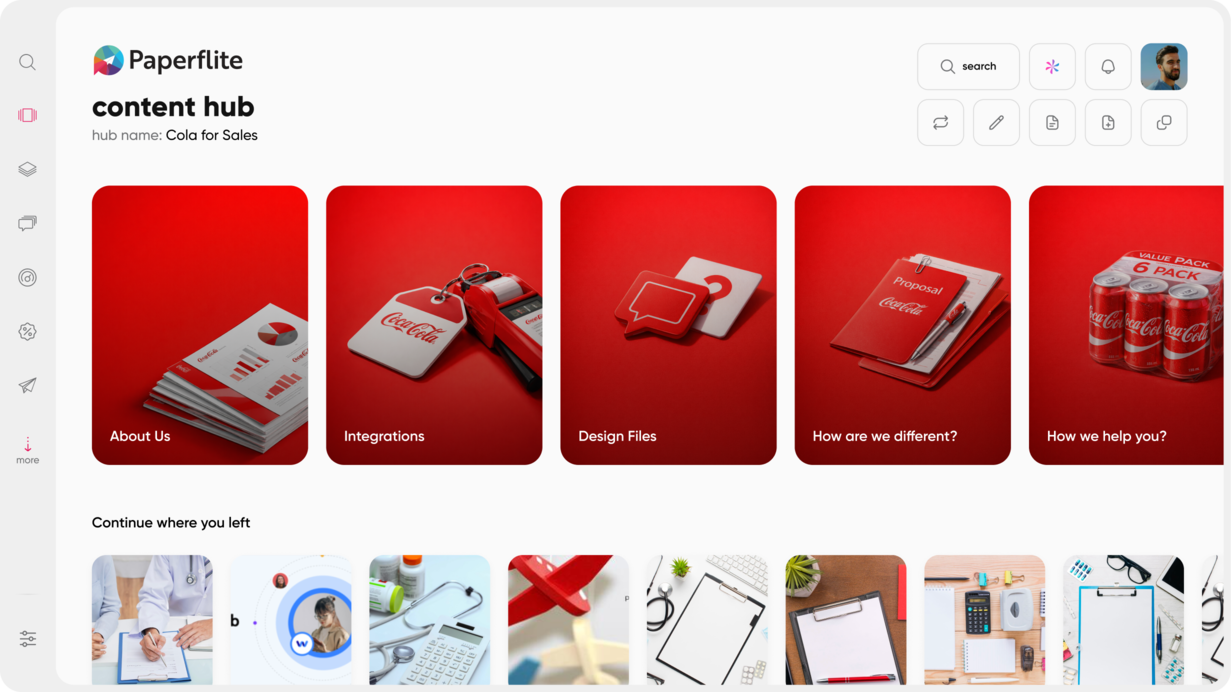
Get this right and you've effectively solved what's sometimes called content discovery, which is really just a fancier way of saying reps can find the right thing without digging for it, and buyers get sent things that are actually relevant to where they are.
Why Reps Still Send the Wrong Content
Reps without a proper content system spend an average of 10 hours a week searching for content, according to Seismic's Value of Enablement research. So what does a quarter of a working week spent digging through folders actually cost you? It's a full day, every single week, that isn't spent on calls, follow-ups, or actual selling.
Why do sales teams struggle with content in the first place? Mostly because content sprawls faster than anyone tags it. New decks pile onto shared drives, old ones never get properly archived, and nobody's entirely sure which version is the current one. A few root causes show up again and again.
- Content sprawl across shared drives, inboxes, and half-remembered Slack threads, with no single source of truth
- No consistent tagging taxonomy, or none at all, which means search is really just guessing at file names
- Outdated assets still floating around in circulation long after the pricing or positioning changed
- Zero visibility into what reps actually use, let alone what performs, which means gaps in the library go unnoticed until a deal stalls
Picture the case study that won three deals last quarter, still buried on page four of a shared drive search, right next to a two-year-old pricing deck nobody remembered to delete. Multiply that across every rep's version of the same folder, and the ten hours a week starts to make sense.
There's a useful benchmark worth borrowing here. A healthy content library runs roughly sixty percent buyer-facing material (case studies, ROI calculators, comparison sheets) against forty percent internal enablement (battlecards, talk tracks, objection handling). If your library skews ninety percent brochures, your reps are underequipped for the actual conversation, recommendation engine or not. No amount of clever scoring logic fixes a library that's missing the right assets to begin with.
This matters more now than it used to, because 83 percent of the B2B buying journey happens without a rep in the room at all, according to Gartner's research on the topic. So what does that shift mean? Content is no longer a supporting player that backs up a rep's pitch. For most of the deal, it is the only rep the buyer actually has access to.
If you haven't audited your library recently, start with the basics: what types of sales enablement content you actually have, sorted honestly rather than by what marketing wishes were true. Pair that against a checklist of must-have sales collateral so the gaps are obvious instead of assumed, and you'll usually find the problem isn't a shortage of content. It's that nobody can find the good stuff, and the mediocre stuff never gets retired.
How AI-Driven Content Recommendation Actually Works
To recommend the next-best piece of sales content to a rep, tag every asset with metadata such as persona, funnel stage, industry, and format, feed in engagement signals from past shares, and let a scoring system match the available content against the deal sitting in front of the rep right now. The strongest setups surface that recommendation inside the tool the rep already lives in, whether that's a CRM, an email client, or the content hub itself, instead of a separate login they have to remember to check.
Eighty-four percent of sales organizations say their systems already provide some form of next-best-action guidance today, according to Gartner's 2023 Technology's Impact on Seller Productivity Survey. So what does that number tell you? AI-assisted recommendation has quietly stopped being an edge case. For most teams, it's closer to a baseline expectation than a competitive advantage.
Here's how the mechanics actually break down, step by step.
1. Tag every asset with metadata. Persona, funnel stage, industry, and format all need to live as structured fields, not buried in a filename. This is unglamorous work, and it's also the entire foundation everything else sits on.
2. Feed in engagement signals from past shares. Opens, time spent, forwards, and downloads all tell you something about how a piece of content actually performed, not just how marketing hoped it would.
3. Let the system score available assets against the current deal's attributes. Funnel stage, persona, and engagement history combine here into a ranked shortlist instead of a flat, alphabetical file list.
4. Surface the top two or three matches inside the rep's existing workflow. A recommendation nobody sees because it's sitting in a tool reps don't open is not a recommendation. It's a wasted setup.
5. Track what gets used and what gets ignored, then feed that back into the scoring model. This closes the loop and is the step most teams skip, which is exactly why their recommendations stop improving after the first few months.
If you're wondering how AI recommends the right sales content, the short version is that it doesn't guess. It scores every available asset against the current deal's stage, industry, and what performed well for similar buyers, then ranks them, so the top recommendation is a probability, not a hunch.
Deal stage matters more than it might seem at first glance, because a discovery-stage prospect and a contract-stage prospect need fundamentally different things. One wants a wide-lens introduction to the problem you solve. The other wants a security one-pager and a customer reference who looks a lot like them. Weighting deal stage into the score is what turns a recommendation from “here's our most popular content” into “here's the right content for exactly where you are.”
Rules-Based vs Machine-Learning Recommendations
Not every recommendation engine works the same way, and the distinction matters when you're evaluating options.
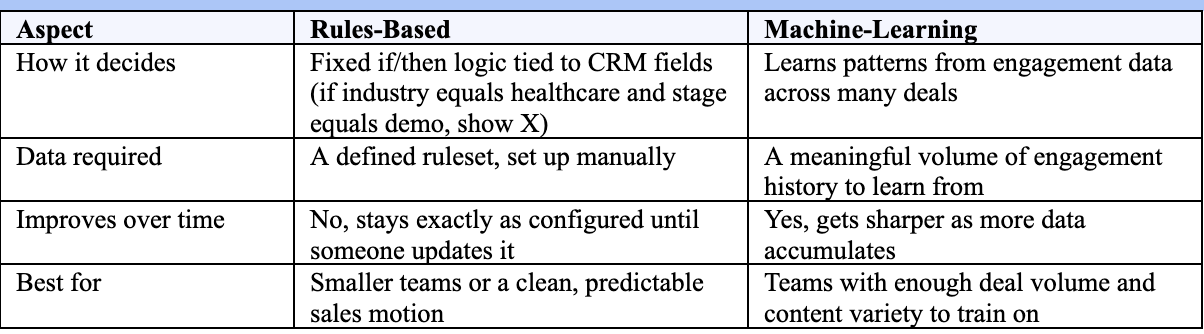
Rules-based systems are easier to reason about and faster to stand up, since you can see exactly why an asset was recommended. Machine-learning systems take longer to get useful, but they can surface non-obvious matches that a hand-written rule would never think to include, the kind of pairing a human admin simply wouldn't have guessed.
For a broader look at where this fits into the wider shift, see How AI Drives Sales Enablement across content, coaching, and forecasting more generally, not just recommendation logic on its own.
Setting This Up Without a Data Science Team
Setting this up does not require a data science hire. It requires tagging discipline first, and a platform that can turn existing engagement analytics into a scoring signal second. Most teams already have that second part sitting mostly unused inside whatever content platform they're already paying for.
Start with tagging discipline before AI. A clean taxonomy, applied consistently, is the actual prerequisite here, not a bigger model. If your assets aren't tagged by persona, stage, and industry, no amount of machine learning has anything reliable to learn from. Garbage in, confused recommendations out.
Use existing engagement analytics as the training signal, rather than trying to build a model from scratch. Most content platforms already track opens, time spent, and shares. That history is more valuable as a starting point than any external dataset, because it reflects how your specific buyers actually behave, not a generic benchmark.
Pilot with one persona or one industry vertical before rolling this out broadly. Pick a segment where you have decent content coverage and a reasonable volume of past deals, get the tagging and scoring right there, and expand once it's clearly working. Trying to solve this for every persona and every product line on day one is how these projects stall out.
There's a common mistake worth naming directly: teams try to solve this with a spreadsheet, or a shared drive folder structure with really good naming conventions. (Don't ask us how we know that one hits a little too close to home.) It scales to about twenty assets, maybe thirty if the team is disciplined, and then it collapses under its own weight. Folder structures cannot score anything. They can only be searched, and only by someone who already knows roughly what they're looking for.
This is usually the point where teams realize a shared drive was never going to cut it, and a proper content hub is what actually makes tagging and scoring possible at any real scale. Once the hub exists and the tagging is consistent, layering recommendation logic on top becomes a configuration problem, not an engineering project.
None of this needs to happen overnight. A tagging cleanup that takes two focused weeks, followed by a single-persona pilot that runs for a month, gets most teams further than a six-month platform evaluation followed by a rushed rollout.
One more thing worth flagging before the pilot starts: assign an owner. Not a committee, one person whose job includes checking that new assets get tagged the moment they're uploaded, not three months later during a frantic pre-audit scramble. Recommendation quality decays fast the moment tagging discipline slips, and it's much easier to protect a habit than to rebuild one after it's gone stale.
How Paperflite Handles Next-Best Content
If tagging discipline and engagement data are the two ingredients that actually make next-best content recommendation work, Paperflite is built around handling both without turning your content team into part-time data analysts.
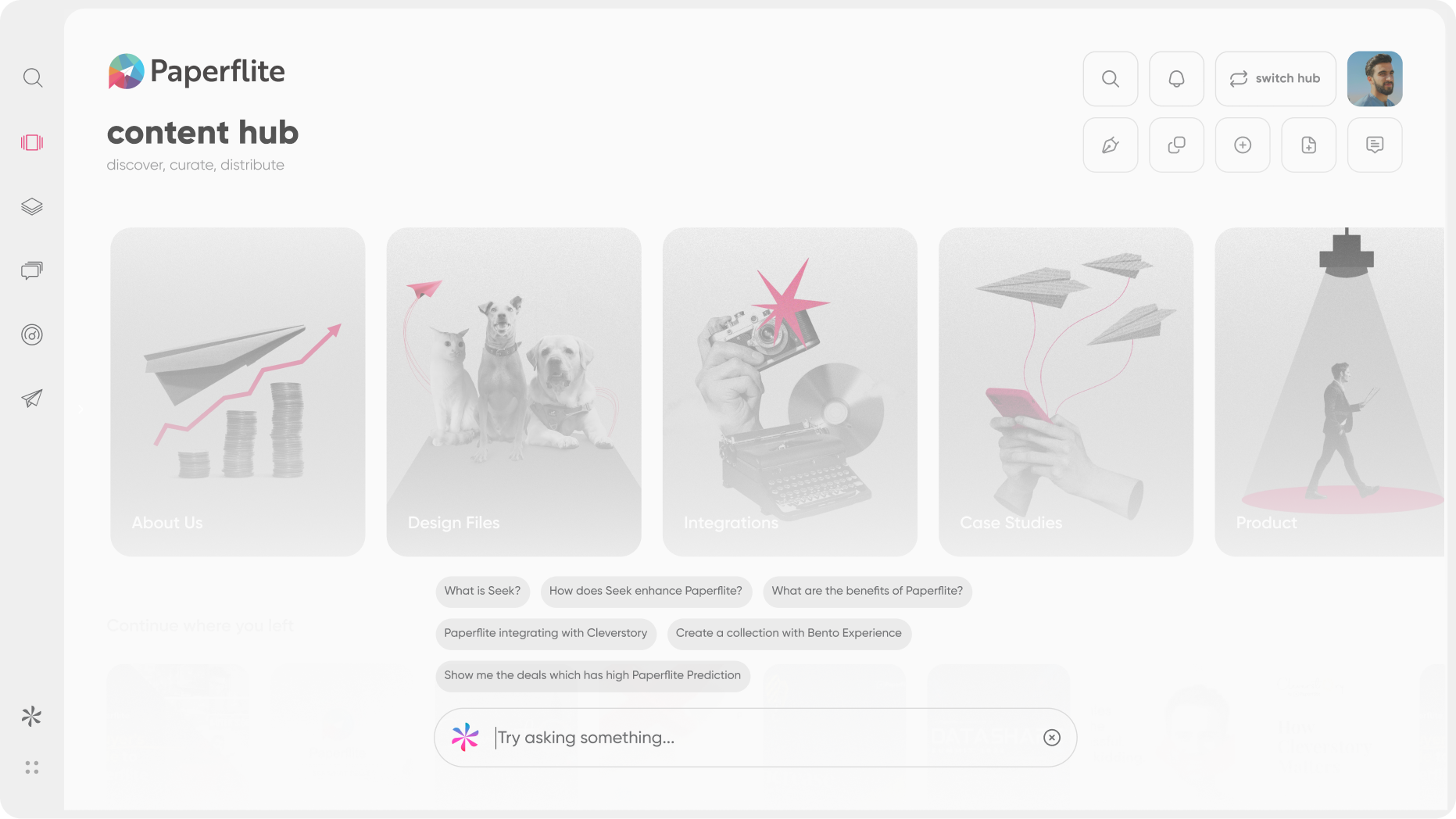
AI-Powered Content Discovery, available from the Starter plan, surfaces relevant assets as reps search or browse the content hub, instead of leaving them to scroll through folders hoping to recognize the right file by its name. SEEK, Paperflite’s LLM-powered search, takes this further by letting reps type or ask for what they need in plain language, something closer to "case study for a mid-market healthcare prospect" than a string of keywords they have to guess at.
On the Advanced plan, AI-powered content recommendations layer deal-stage and engagement signals directly on top of the content hub, alongside content personalization at scale and predictive deal insights, so the scoring logic described earlier in this piece runs automatically in the background rather than requiring manual setup for every persona and stage combination.
Content Intelligence closes the loop by surfacing what reps actually search for and share most, which is exactly the feedback signal that keeps a recommendation engine improving instead of going stale after the first quarter. Even something as specific as video engagement analytics feeds into this: if a rep can see exactly which section of a video a buyer rewatched, that's a far stronger signal than a simple open or download ever was.
None of this requires reps to change how they work day to day. The recommendation shows up inside the same content hub and the same CRM view they're already using, which is really the whole point: the right content should feel like it found the rep, not the other way around.
The payoff shows up in places that are easy to overlook until you're measuring for them: shorter time-to-first-touch on new leads, fewer stale decks getting reused out of habit, and a content team that spends less time fielding “where's the latest version of X” messages in Slack. None of that requires a rebuild. It requires the tagging and feedback loop this article has been walking through, applied consistently inside a platform built to run it.
Conclusion
Next-best content recommendation sounds like an AI problem. In practice, it's a metadata and engagement-data problem wearing an AI costume. Get the tagging right, get the engagement tracking right, and the recommendations follow almost on their own, with far less complexity than most teams expect going in.
Start small. Audit what you actually have, tag it honestly instead of aspirationally, and let the engagement data tell you what's working before you worry about scoring models or machine learning. The rep digging through six folders at 2:47 in the afternoon doesn't need a smarter algorithm nearly as much as they need a system that already knows what to hand them.
Learning how to recommend next-best sales content isn’t really about chasing the most sophisticated engine on the market. It’s about building the tagging habits and the engagement visibility that make any recommendation, rules-based or machine-learned, actually useful. Once that foundation exists, the "next-best" part takes care of itself.
Book a demo of Paperflite's AI-powered content recommendations
Frequently Asked Questions
What is next-best content recommendation in sales enablement?
It's the practice of using deal stage, persona, and engagement data to automatically suggest the most relevant sales asset for a rep to send, instead of relying on manual search through a shared drive or content library.
How is next-best content different from next-best-action?
Next-best-action is the broader concept and can include calls, emails, or tasks a rep should take next. Next-best content recommendation is the narrower slice focused specifically on which sales asset to send at that moment.
Do I need a data science team to set this up?
No. The real prerequisite is clean, consistent content tagging. Most modern content platforms already build recommendation logic into the content hub itself, so a dedicated data science hire usually isn't necessary to get started.
Can next-best content recommendations work without a CRM?
Yes, though CRM integration adds valuable deal-stage context that sharpens recommendations considerably. A content hub with good tagging and engagement tracking can still surface strong recommendations on its own.
How often should I audit my content library for this to work well?
A quarterly review of your top-performing assets, paired with a full library audit every six months, keeps outdated content from skewing recommendations and quietly dragging down rep trust in the system.
What data actually drives a good recommendation?
Three things matter most: funnel stage, buyer persona or industry, and historical engagement, meaning what similar buyers actually opened, read to the end, or shared internally rather than what marketing assumed would resonate.
Does this replace the need for a content taxonomy?
No, it depends entirely on one. Tagging and categorization are the foundation any recommendation logic sits on top of. Skip the taxonomy, and even the smartest scoring model has nothing reliable to work with.