The Best Interactive Content Platforms for B2B Teams (2026 Edition)
An interactive content platform is a tool that lets marketing and sales teams build content experiences, quizzes, calculators, microsites, sales decks that audiences actively engage with rather than passively read. The best platforms pair content creation with engagement analytics and sales workflow integrations so teams can see exactly what buyers do with their content.
Picture this. Your sales rep sends a deck to a prospect who seemed ready to move. A PDF. Professionally designed, right messaging, good timing. The prospect opens it, maybe. Your rep has no idea what happened next. Did they read it? Did they share it? Did they spend four minutes on the pricing slide and bail on the intro? Nobody knows. The deck just sits there, doing nothing.
That's not a content problem. It's a platform problem. And it's one reason more B2B teams are switching from static files to interactive content that actually gives you visibility into what your buyers care about.
The best interactive content platform for your team depends on what you're creating and what you need to happen after someone reads it. Design-heavy campaigns have different requirements from daily sales follow-ups. Lead-gen funnels are different from late-stage deal rooms. This guide covers the top platforms in 2026, what each one does well, how to evaluate them, and where Cleverstory by Paperflite fits into the picture.
What is an Interactive Content Platform?
Most content your team produces today is static. A PDF brochure. A PowerPoint deck. A whitepaper attached to an email. Your buyer downloads it, and you lose the thread. You have no idea if they read it, what resonated, or whether it moved them closer to a decision.
An interactive content platform changes that equation. It gives you tools to build content experiences people actively engage with: quizzes, calculators, personalized microsites, interactive sales decks, digital proposals, and buyer portals. More importantly, it tracks what happens. Which pages did your prospect read? How long did they spend on the
pricing section? Did they forward it to someone else?
The category spans a wide range of tools. Some are built for creative teams who want to produce visually stunning campaigns. Others are optimized for marketers running lead-generation funnels. And some, like Interactive Content - Types and Design Principles, are designed specifically for the B2B sales motion, connecting content engagement to pipeline visibility and CRM data.
What good platforms share: they make it possible for a non-technical team member to build something engaging without a developer, and they show you what your audience actually did with it. Those two things together creation simplicity and post-send visibility are what separate a genuinely useful interactive content platform from a prettier way to produce the same static content.
If you want a deeper look at content experience strategy, the linked guide covers how to architect interactive journeys from awareness through close.
What Types of Interactive Content Actually Drive Engagement?
Not all interactive formats do the same job. Choosing the right type for the right moment in your buyer's journey makes a bigger difference than which platform you pick. Here's how the main formats break down for B2B teams.
Interactive microsites and buyer portals
These are personalized environments built for a specific prospect or account, a dedicated space that contains everything relevant to their situation, organized for their buying stage. They're most effective in late-stage deals and ABM plays, where a rep needs to show "we understand your world" without generic slide decks. You can see Making a Case for Interactive Content in 2021 for the engagement data behind why these outperform standard outreach.
Interactive sales decks and proposals
A sales deck that tracks what your buyer actually reads, which slide they spent six minutes on, and which they skipped, gives your rep information that changes the next conversation. Traditional slide attachments tell you nothing. Interactive decks built on platforms like Cleverstory show you exactly what the buyer cared about before you get on a call. The difference shows up clearly when you look at interactive presentation engagement data compared to static PowerPoint send rates.
Calculators and ROI tools
Calculators work because they make the buyer do the math themselves. An ROI calculator that outputs a number personalized to their business is more persuasive than any claim you make in a brochure. These are particularly strong for mid-funnel qualification: a prospect who builds their own ROI estimate is a prospect who has mentally started to commit. Interactive sales presentations that engages and converts covers how to embed these tools inside a broader sales narrative.
Quizzes, assessments, and guided tours
Quizzes and assessments are your top-of-funnel workhorses, great for lead capture and qualification because they deliver a result the buyer actually wants. Product demos and guided tours live at the opposite end, reducing the distance between "what does this do?" and "I want to try this." The right format depends entirely on where your buyer is in the journey, and choosing the wrong one for the wrong stage is a common reason interactive content underperforms.
How to Choose the Right Interactive Content Platform
The honest answer is that no single platform is best for everyone. The right choice depends on what you're building, who's building it, and what you need to happen after someone engages with your content. Six criteria separate the platforms that work from the ones that just look good in demos.
1. Use case fit creative or commercial?
Are you creating lead-gen content, quizzes, calculators, and conversion funnels? Or are you building buyer-facing sales content, proposals, deal rooms, personalized decks? The platforms optimized for one rarely handle the other well. Knowing your primary use case before you evaluate saves you from a painful six-month mistake.
2. Engagement analytics: surface-level or buyer-level?
Some platforms tell you that 47 people viewed a piece of content. Others tell you that Sarah from Acme Corp spent four minutes on section three and forwarded it to two colleagues. If you're in B2B sales, you want the second kind. Surface-level view counts don't inform a follow-up conversation. Buyer-level engagement signals do. Your prospects deserve a your prospects deserve content experience that's actually tracked and responded to.
3. CRM and sales tool integration: connected or siloed?
Engagement data that lives inside the content platform and doesn't flow into Salesforce or HubSpot is data your sales team will never use. The best platforms push engagement signals directly into your CRM so reps can see buyer behavior in the tools they already work in. Check the integration documentation before committing; some connections are tier-gated.
4. No-code creation: Can marketing own it?
Your content team shouldn't need to open a ticket to update a deck. If the platform requires design or dev support for routine changes, the bottleneck will kill adoption. No-code drag-and-drop is the baseline expectation now, not a premium feature.
5. Content personalization at scale
Can you create one template and deploy it in multiple variants for different accounts, industries, or buyer personas without rebuilding from scratch each time? Personalization at scale is what turns a content platform into a sales asset.
6. Security and compliance
SOC 2 Type II certification, GDPR compliance, SSO, and role-based access controls are non-negotiable for enterprise buyers. Always verify the security documentation directly with the vendor before procurement. For sales content that goes to external prospects, security is as much a trust signal as a compliance requirement.
The right interactive content platform depends on what you're creating and what happens after the content is consumed. Design-first platforms excel at visual storytelling. Lead-gen platforms are optimized for conversion and qualification. B2B sales-focused platforms connect content engagement directly to pipeline visibility so your reps know exactly what to follow up on and when.
The Best Interactive Content Platforms in 2026
(Compared by Use Case)
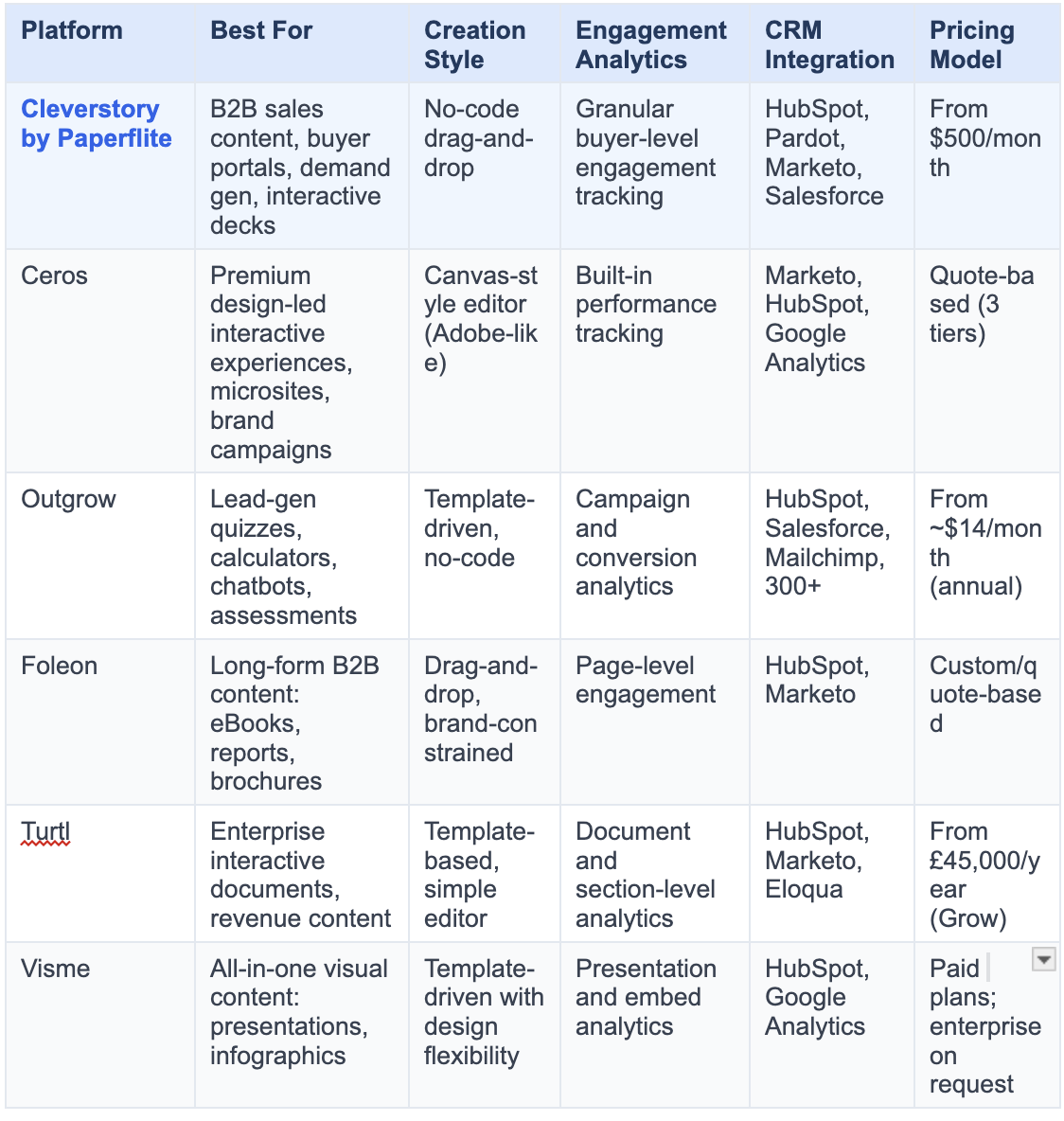
There is no universally "best" interactive content platform. There is best for your use case. The six platforms below cover the major categories, each with a distinct strength, a distinct audience, and a distinct trade-off. The comparison is organized by what each platform is actually designed to do, not by price or popularity.
Cleverstory by Paperflite
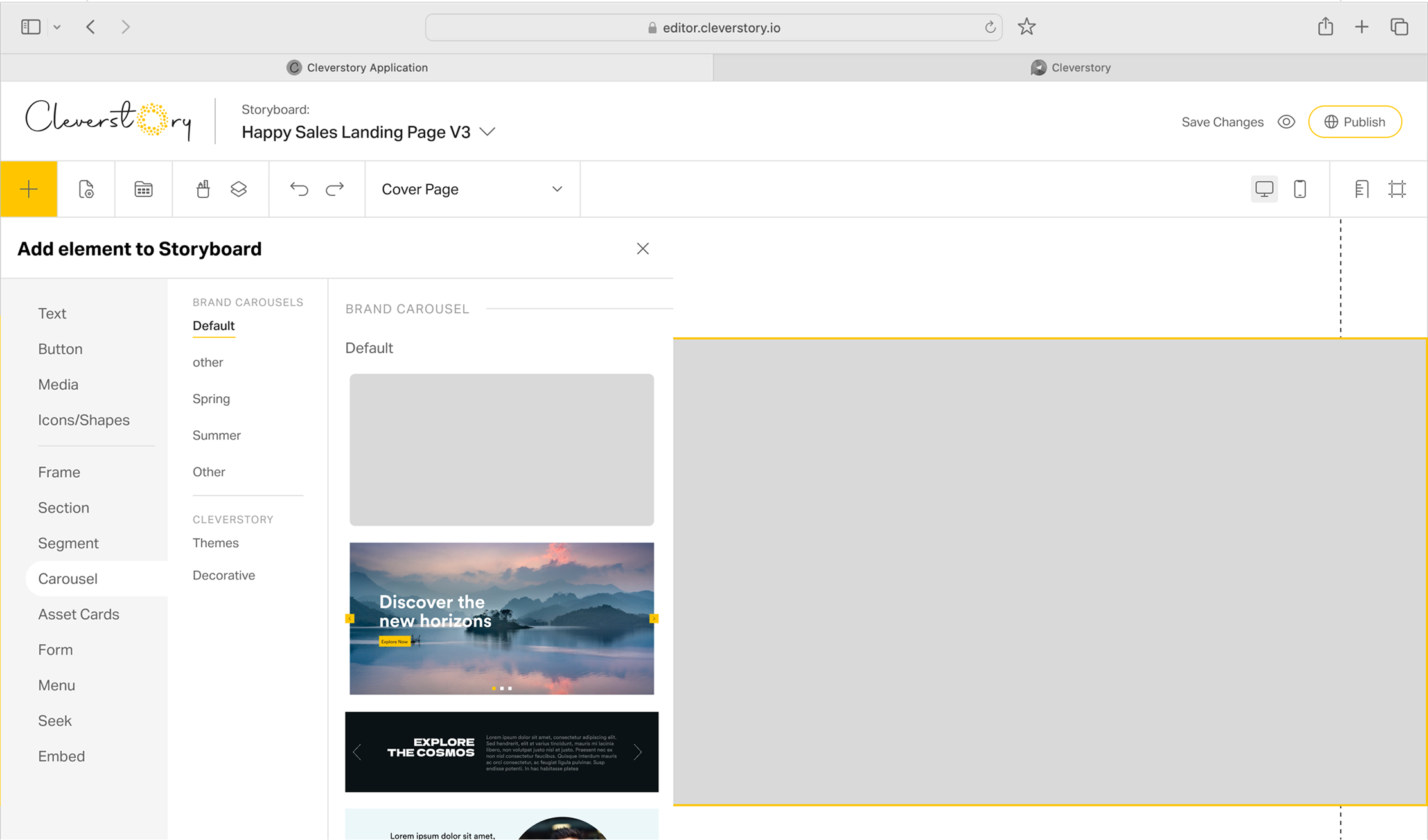
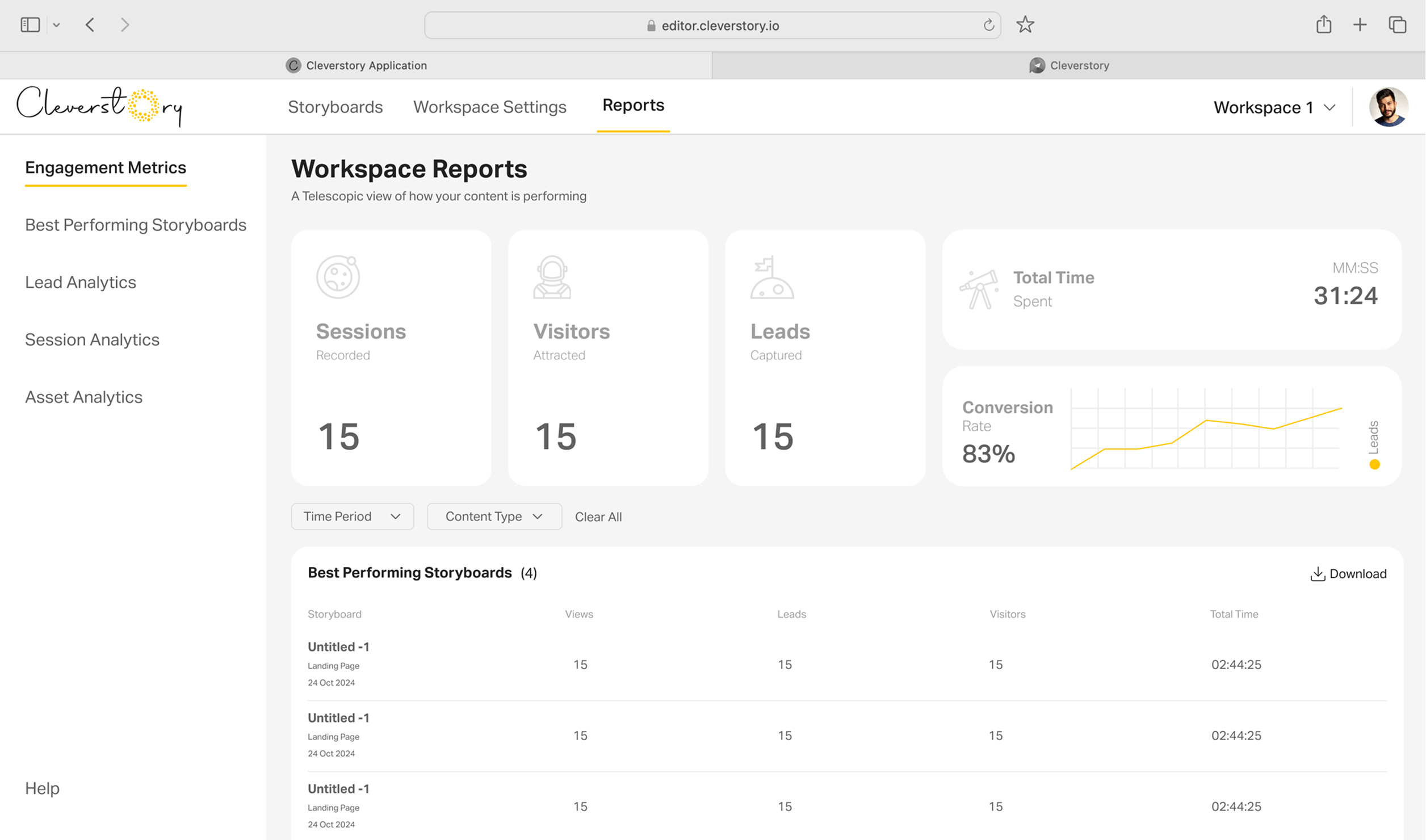
Built specifically for B2B marketing and sales teams, Cleverstory sits at the intersection of content creation and revenue intelligence. You build interactive experiences, sales decks, campaign pages, buyer portals, and product stories without touching a line of code. What makes it different is what happens after someone reads your content. Cleverstory tracks engagement at the section level, surfaces anonymous buyer intent, and connects directly to your CRM and marketing automation tools. Your sales team isn't just sharing content; they're getting signals about who's reading it, what they care about, and when to reach out. The platform is part of the Paperflite ecosystem, which means the digital sales room and content hub are built into the same system, not bolted on.
Ceros
If your team creates premium, design-heavy experiences digital magazines, interactive infographics, brand campaign microsites Ceros is a serious option. The editor feels closest to Adobe Illustrator: total creative control, no code required. The trade-off is that the creation process takes longer, and the platform is less native to the sales workflow. It works well for creative teams who need to produce visually stunning content at scale. It's less suited for reps who need to share personalized buyer portals on a daily basis. Ceros does not publish transparent pricing; all plans are quote-based.
Outgrow
Outgrow is purpose-built for one thing: converting visitors into leads through interactive experiences. Quizzes, calculators, ROI assessors, product recommendation tools it handles all of these with templates and logic flows that non-developers can configure in minutes. Strong on CRM integrations and conversion tracking. Less suited for managing and distributing sales collateral across a team or tracking how individual buyers engage with complex multi-format content. The Freelancer plan starts at approximately $14/month billed annually, with team plans at higher tiers.
Foleon
Foleon solves a specific and common B2B problem: static PDFs and slide decks that sales sends to prospects look flat. Foleon replaces them with interactive, branded documents: eBooks, proposals, reports that render beautifully on any device. The audience engagement data (time on page, scroll depth, click-through) integrates with Marketo and HubSpot. For teams focused on content-led demand generation and branded publishing, it's a solid choice. For teams that need deep deal-level analytics or a full content management and distribution layer, it's usually paired with a separate tool. Pricing is custom and quote-based.
Turtl
Turtl positions itself as a revenue content platform built to connect document engagement directly to pipeline and revenue metrics. The format is distinctive: a digital scroll-style reading experience rather than a traditional slide or page layout. It integrates with HubSpot, Marketo, and Eloqua, and offers A/B testing for content optimization. At an entry price of £45,000/year for the Grow plan, it's built for enterprise marketing teams with structured content programs and formal content ROI requirements.
For a deeper dive into what the buyer collaboration layer looks like, the guide on digital sales room and how digital sales rooms work alongside interactive content is worth reading before you evaluate platforms at the enterprise level.
What Makes Interactive Content Effective for Sales Enablement?
Buyers are self-educating long before they talk to a rep. The content your team sends the deck, the one-pager, the proposal is doing sales work on your behalf. You're just not in the room to watch it happen.
Interactive content changes the feedback loop. A prospect who reads page six of a personalized deck before page two is telling you something about their priorities. That behavioral signal is completely invisible when you send a PDF attachment. Tracking 13 Most Important Types of Sales Enablement Content and knowing which ones actually get read is the difference between guessing at follow-up angles and entering a conversation with real context.
Sales reps who know which sections a buyer spent the most time on can calibrate their next call before it starts. They're not guessing what the prospect cares about; they have engagement data that points directly to it. And that changes the quality of every conversation downstream.
Marketing and sales alignment also improves when both teams can see, in the same system, which content is actually moving deals. Not which content got the most downloads, which content showed up in deals that closed. That distinction matters for what content teams invest in and what they retire.
Interactive content improves buyer engagement because it gives buyers control over how they consume information and gives sellers visibility into what those buyers actually care about. When someone spends three minutes on your pricing page and skips past the overview, that behavioral signal shapes a better follow-up conversation. That loop between content consumption and sales action is what separates effective enablement from content that just gets shared.
How Cleverstory Fits Into Your Existing Marketing Stack
Cleverstory isn't a tool you plug in alongside your other systems and hope it syncs. It's the creation layer of an end-to-end revenue enablement setup. The interactive experiences you build here connect directly to Paperflite's content hub, analytics, and digital sales room in one connected system.
For your tech stack, Cleverstory integrates natively with HubSpot, Pardot, Marketo, and Salesforce. Engagement data from every experience who read it, which sections, for how long flows directly into your CRM so reps have buyer signals inside the tools they already work in. No exports, no manual syncing, no data that lives in a silo and never gets acted on.
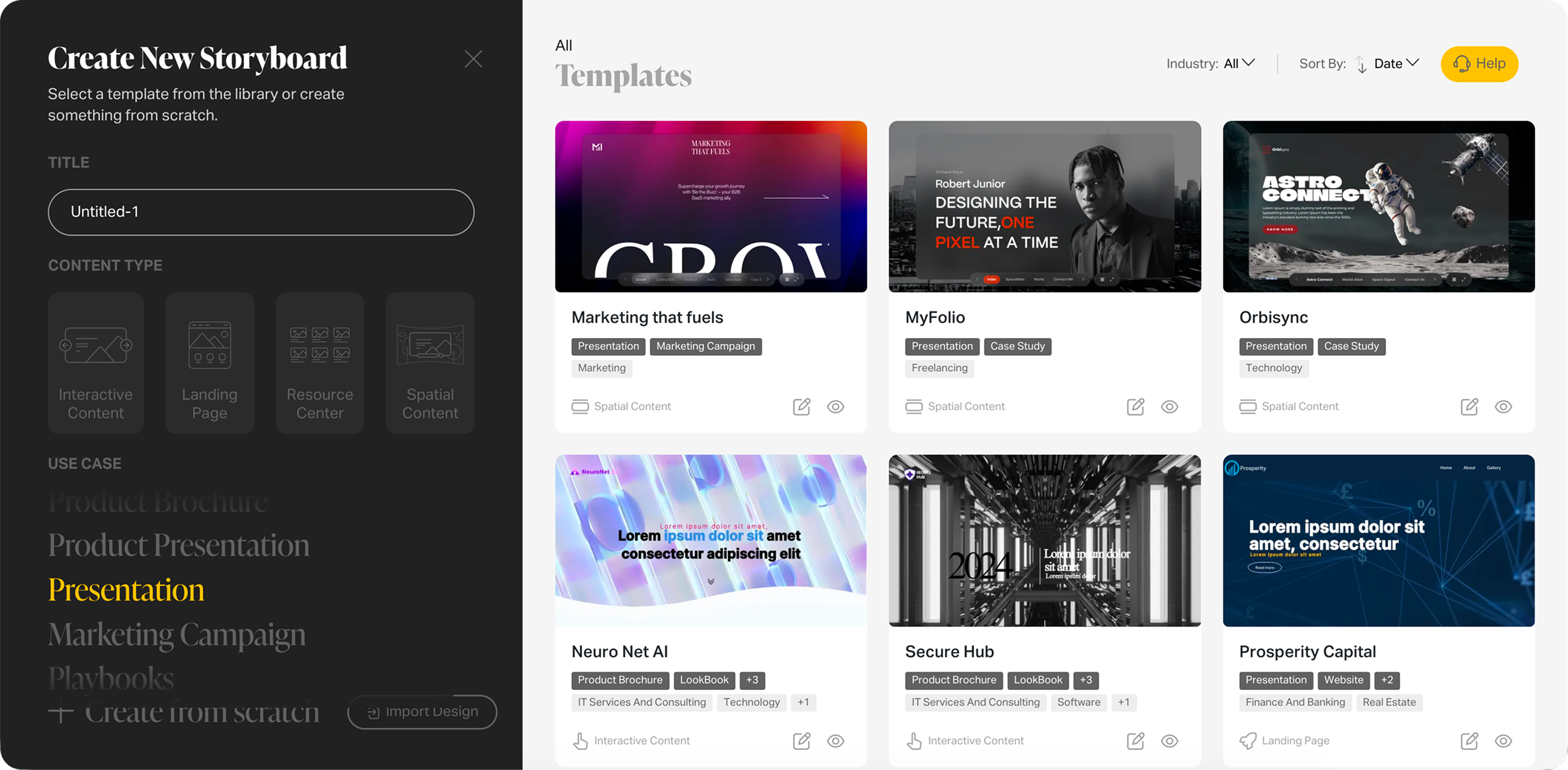
Your marketing team can build and update content without opening a dev ticket. The drag-and-drop editor handles everything from campaign pages and sales decks to self-serve onboarding guides and website embeds. Templates mean you're not starting from scratch with every new account or campaign you're personalizing at scale, not rebuilding from zero each time.
On the security side, Paperflite is SOC 2 Type II certified and GDPR compliant with SSO support across plans. For enterprise buyers evaluating whether a vendor clears the security review bar, the compliance documentation is available on Paperflite's security page. The platform also supports white labeling your brand on the experience, not theirs. If you want to understand what the content experience your buyers actually deserve looks like in practice, the linked guide is a good starting point.
Conclusion
Choosing an interactive content platform comes down to one question: what do you need to happen after someone engages with your content?
If you're a creative team building immersive brand campaigns, Ceros gives you the canvas. If you're running lead-gen funnels built around quizzes and calculators, Outgrow is purpose-built for it. If you need branded long-form publications that look better than PDF attachments, Foleon or Turtl are worth evaluating.
If you're a B2B revenue team that needs content to work harder at every stage of the buyer journey from demand gen to deal close, and you want a single system that connects content creation, buyer engagement, and sales visibility, Cleverstory by Paperflite is built for that job. And it does it without requiring your marketing team to depend on design or dev resources to keep the content moving.
The platforms that matter aren't the ones with the most templates or the prettiest editor. They're the ones that tell you what your buyer did after you hit send and help you do something useful with that information.
Frequently Asked Questions
What is the difference between an interactive content platform and a content management system?
A content management system (CMS) stores, organizes, and publishes content; it's the backbone of your website or content library. An interactive content platform helps you create content that your audience actively engages with quizzes, assessments, personalized decks, microsites, and tracks how individuals interact with it. Many B2B teams use both a CMS for their website content and an interactive content platform for their sales and marketing experiences.
Which interactive content platform is best for B2B sales teams?
For B2B sales teams, the best interactive content platform is one that connects content creation with buyer engagement data and CRM workflows. Platforms like Cleverstory by Paperflite are built for this use case: you create personalized sales experiences and track how each buyer engages with them, so your reps can follow up with real context. Platforms like Ceros and Foleon are stronger fits for design-led or long-form content creation where sales workflow integration is less critical.
How much does an interactive content platform cost?
Pricing varies significantly by platform and use case. Paperflite's Cleverstory plan starts at $500/month. Outgrow starts at approximately $14/month (billed annually) for individual users, with team plans at higher tiers. Turtl's Grow plan starts at £45,000/year. Ceros and Foleon use quote-based pricing that is not publicly disclosed on their websites. Most enterprise platforms offer custom pricing based on team size, features, and contract length; always request a quote and compare against your actual usage requirements.
Can I use an interactive content platform without a design or development team?
Yes. Most modern interactive content platforms are no-code or low-code, meaning marketers can build and publish content without relying on designers or developers. Cleverstory, Outgrow, and Foleon all offer drag-and-drop editors with template libraries. Ceros offers more creative freedom but has a steeper learning curve, particularly for users without a design background. If your team doesn't have dedicated creative resources, prioritize platforms with strong templates and intuitive editors.
What types of interactive content work best for lead generation?
For lead generation, quizzes, assessments, calculators, and product recommendation tools consistently outperform static forms because they deliver a personalized result to the user in exchange for their contact information. Platforms like Outgrow specialize in this format. For mid-funnel or late-stage engagement, personalized microsites and interactive proposals tend to deliver stronger buyer intent signals, the kind that help your sales team prioritize outreach based on actual engagement behavior.
How do interactive content platforms integrate with CRM tools like Salesforce and HubSpot?
Most enterprise-grade interactive content platforms offer native or API-based integrations with CRM and marketing automation tools. Cleverstory integrates with HubSpot, Pardot, Marketo, and Salesforce. Foleon connects with HubSpot and Marketo. Outgrow integrates with 300+ tools, including HubSpot and Salesforce. Check integration documentation before selecting a platform; some integrations are tier-gated and only available on higher plans.
What is the difference between interactive content and a digital sales room?
Interactive content refers to any format that invites active engagement: quizzes, calculators, personalized decks, microsites. A digital sales room (DSR) is a dedicated, shared space where sellers and buyers collaborate throughout a deal: sharing content, tracking engagement, exchanging messages, and managing next steps. DSRs often use interactive content as the medium, but they add a deal management and buyer collaboration layer on top. Paperflite offers both through its platform, so the content your team creates in Cleverstory can live inside a deal room your rep shares with the buyer.
Is interactive content secure enough for enterprise use?
Yes, when you're using enterprise-grade platforms. Look for SOC 2 Type II certification, GDPR compliance, SSO support, and role-based access controls as minimum requirements. Paperflite is SOC 2 Type II certified and supports SSO and GDPR compliance across its plans. Always verify security documentation directly with the vendor before procurement, especially for content that will be shared with external prospects or customers.