What Is the Best Content ROI Software? (It Depends Which Half of the Funnel You're Measuring)
Content ROI software connects content investment to measurable business outcomes, but the category splits into two distinct types. Marketing content ROI tools (HockeyStack, Dreamdata, HubSpot) measure top-of-funnel assets like blog posts and landing pages against pipeline. Sales content ROI tools (Paperflite, Highspot, Seismic) measure the decks, case studies, and proposals reps share directly with prospects against deal outcomes. The best choice depends on which content you're trying to prove the value of.
Search "best content ROI software" and you'll get a dozen lists recommending tools that track blog post conversions and landing page attribution. Useful, if the content you're trying to justify is your editorial calendar. Less useful if the content keeping you up at night is the 40-slide deck your top rep has shared with eleven prospects this quarter, and nobody in marketing can tell you whether it's working.
Content ROI software isn't one category. It's two, measuring two completely different things. One half tracks what happens before a lead enters the CRM: blog reads, landing page conversions, campaign-attributed pipeline. The other half tracks what happens after: the case studies, proposals, and battle cards reps actively share inside live deals. Most "best content ROI software" guides only cover the first half. This one covers both, and helps you figure out which one your team actually needs to prove its content is paying for itself.
Start with what content tracking actually involves: What is content tracking? Types, Techniques, and Tools.
What Is Content ROI Software, Actually?
Content ROI software is any platform that connects content creation and distribution costs to measurable business outcomes, typically pipeline influence, conversion rates, or closed revenue. The category splits into marketing content ROI software (top-of-funnel attribution) and sales content ROI software (post-share, deal-level engagement). Both prove content is working; they just measure entirely different parts of the funnel.
The base promise is the same across every tool in the category: stop guessing whether content is working and start proving it with data. Where the category splits is in what "content" and "working" actually mean.
The Split Nobody Names Explicitly
Search results for "content ROI software" are almost entirely populated by marketing attribution platforms. These tools, HockeyStack, Dreamdata, Heeet, and HubSpot's native reporting, connect top-of-funnel content (blog posts, landing pages, gated assets, webinars) to pipeline and revenue using multi-touch attribution models. They answer the question: which content brought leads into our funnel, and how much pipeline did that generate?
There's a second category that almost never appears in these lists: sales content ROI software. These tools, Paperflite, Highspot, Seismic, measure what happens to content after a rep shares it directly with a prospect: the decks, case studies, proposals, and battle cards used in live deals. They answer a different question: which specific assets are reps using to win deals, and which ones are sitting unused in the library?
Why the Distinction Matters for Software Selection
A marketing leader asking "which blog post generates the most demo requests" needs the first category. A sales enablement leader asking "which case study correlates with closed-won deals" needs the second. The tools don't substitute for each other. Buying a marketing attribution platform to solve a sales content visibility problem, or the reverse, is the single most common mismatch in this software category, and it's usually the reason a content ROI initiative stalls six months after the tool was purchased.
See: Sales Content Management Guide for the full operational picture of what sales content ROI tracking sits inside of.
How to Measure Content ROI (The Formula and Why It's Harder Than It Looks
Content ROI follows the standard formula: (Revenue Generated minus Total Investment) divided by Total Investment, multiplied by 100. Most teams get the inputs wrong on both sides: they understate investment by excluding internal team time, and they overstate attribution by crediting too much revenue to content using last-touch models alone. The fix is comprehensive cost accounting and content-influenced rather than content-caused revenue claims.
The Standard Formula
Content ROI uses the standard ROI calculation. The formula is simple. The inputs are where most measurement efforts break down.
Why Most Teams Understate Investment
Total investment isn't just production cost. It includes content creation time (writers, designers, subject matter experts), distribution costs, platform and tooling costs, and the ongoing maintenance of keeping assets current. Teams that only count direct production costs (a freelancer invoice, a design tool subscription) systematically overstate their ROI, because the largest cost, internal team time, never makes it into the calculation.
Why Most Teams Overstate Attribution
On the revenue side, the common mistake runs the opposite direction: attributing too much revenue to content that had a marginal influence. Last-touch attribution credits whatever content a prospect engaged with right before converting, even if it played a minor role in a six-month sales cycle influenced by a dozen other factors. The more defensible approach uses content-influenced revenue (the deal closed and this content was part of the documented sales process) rather than content-caused revenue (an unprovable causal claim that doesn't survive scrutiny from finance).
The Sales Content Version of the Formula
For sales content specifically, the formula shifts focus. Instead of asking "did this content generate a lead," the better question is "did this content appear in deals that closed, and how does engagement with it correlate with deal velocity?" This requires different inputs than top-of-funnel ROI: which assets were shared in which deals, how prospects engaged with them (time spent, sections read, forwards to other stakeholders), and whether those deals closed faster or at a higher rate than deals where the asset wasn't used.
Related: Why Sales Reps Overlook Marketing Content and How to Fix It covers what happens when this attribution data never reaches the people creating the content in the first place.
Marketing Content ROI Software: What It Measures and the Top Tools
This category gets the most attention in search results, and it deserves accurate, fair treatment, even though it isn't where this guide's primary recommendation sits.
What This Category Measures
Blog post performance, landing page conversion, gated content lead generation, campaign-level attribution, and the multi-touch journey from first content interaction to closed deal. These tools typically integrate with a CRM and a CMS or marketing automation platform to connect content consumption to pipeline stages.
Representative Tools in This Category
- HockeyStack and Dreamdata: Account-based attribution platforms that map full buyer journeys across content touchpoints, ad spend, and CRM data, popular with B2B SaaS companies running complex multi-channel campaigns.
- HubSpot's native reporting: Built-in content-to-revenue attribution for teams already running their marketing automation on HubSpot, with multi-touch attribution available on higher-tier plans.
- Heeet: A marketing intelligence platform built natively inside Salesforce and HubSpot, connecting every touchpoint, including content, to pipeline without a separate CDP layer.
What This Category Is Strong At
Proving the value of top-of-funnel content investment to a CMO or marketing leadership team. Connecting SEO and content marketing spend to pipeline influence. Justifying headcount and budget for content creation teams.
What This Category Doesn't Cover
None of these tools track what happens to a case study, proposal, or battle card after a sales rep shares it directly with a prospect. They have no visibility into post-handoff content engagement, which section of a proposal a CFO spent the most time on, or whether a deck was forwarded to a new stakeholder mid-deal. That's a different layer of the funnel, and it requires a different category of tool, the one covered in the next section.
Sales Content ROI Software: The Category Most "Best Of" Lists Miss
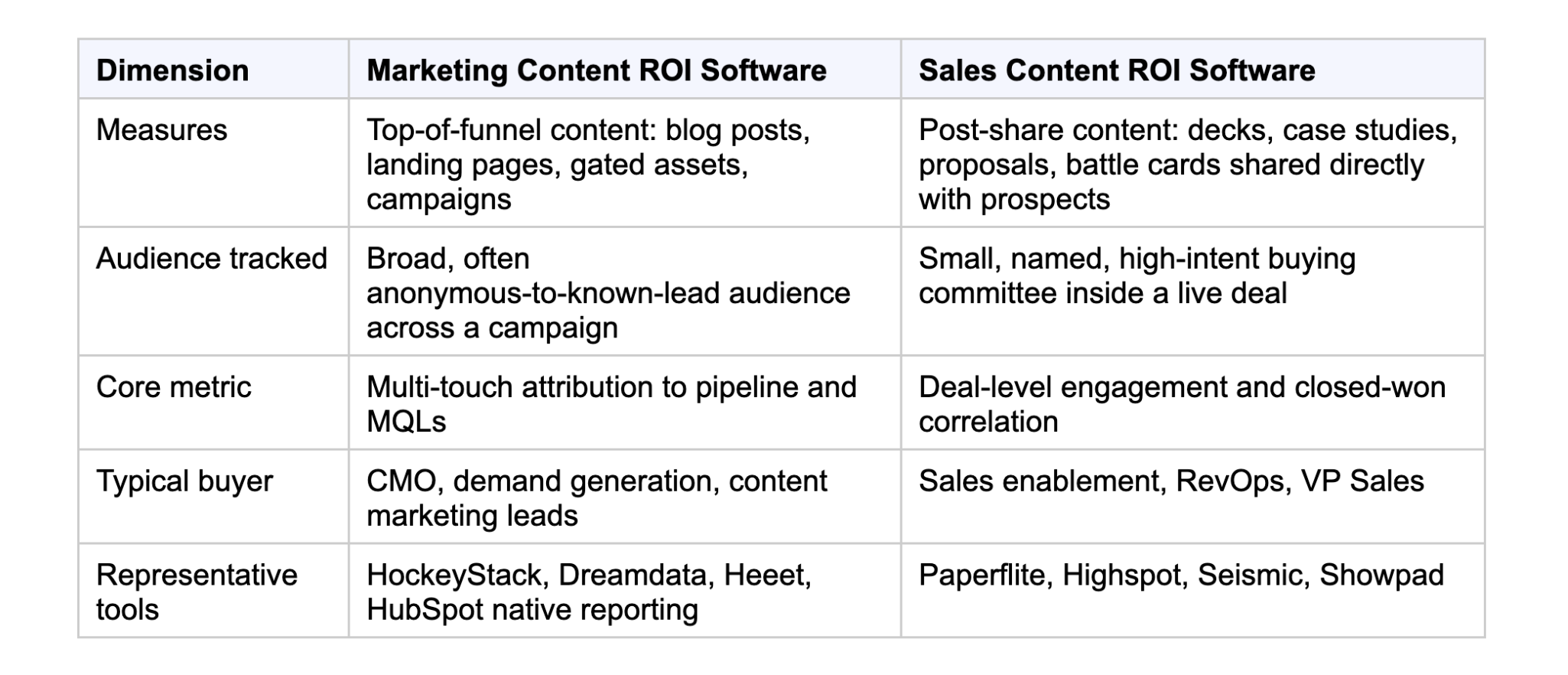
Sales content ROI software tracks engagement with content after a rep has shared it directly with a buyer, typically via email, a tracked link, or a personalized microsite. It's defined by three capabilities: post-share engagement analytics, deal-level attribution, and buying committee visibility. This is structurally different from marketing content ROI software, which tracks pre-handoff, broad-audience engagement rather than named, in-deal engagement with a buying committee.
What Defines Sales Content ROI Software
The defining capability is post-share, deal-level engagement analytics: which pages of a proposal a prospect read, how long they spent on each section, whether they forwarded it to a colleague, and whether the content's presence in a deal correlates with that deal closing faster or at a higher rate.
This is structurally different from marketing content ROI software, which tracks pre-handoff, anonymous-to-known-lead engagement across a broader audience. Sales content ROI tools track named, in-deal engagement with a small, high-intent audience: the actual buying committee.
The Three Capabilities That Define This Category
- Post-share engagement analytics: Page-level and section-level tracking on content shared directly with a named prospect, not aggregate web analytics.
- Deal-level attribution: The ability to connect specific assets to specific deals and deal outcomes, not just to a campaign or channel.
- Buying committee visibility: Detection of internal forwarding, when a rep's contact shares a proposal with a CFO or procurement contact, surfacing new stakeholders automatically rather than requiring manual CRM updates.
Tools in This Category
Highspot and Seismic announced a merger in February 2026, expected to operate under the Seismic brand with Permira remaining the controlling shareholder. They're the longest-established players in this category, built for enterprise sales organizations. Highspot ties content performance to pipeline and revenue through its Nexus AI and analytics engine. Seismic's Enablement Intelligence suite links content and training data to pipeline, revenue influence, and program ROI through its LiveDocs and analytics layer, though Seismic's reporting historically requires more setup and ongoing maintenance to extract revenue-level insight. Both platforms typically require six to twelve month implementations and dedicated enablement administrators, the right investment for organizations with thousands of reps and complex governance needs, but a heavier lift than many growing teams need to start proving content ROI.
Showpad, merged with Bigtincan under Vector Capital in October 2025, similarly serves the enterprise segment, with a particular strength in video-based buyer engagement and the MeetingIQ conversation analysis layer.
Paperflite occupies a different position in this category: a sales content ROI platform built for growing B2B teams that want deal-level content attribution without the implementation overhead of an enterprise suite. It pairs content engagement analytics (views, time-on-section, forwards) with Content Revenue Intelligence that connects specific assets to closed-won deals, deployable in days rather than months.
Here's how the two categories compare side by side:
See also: Content Hub Operations: Strategies for Managing Effectively and What is Content Discovery and why do you need it? for the operational layer beneath sales content ROI tracking.
The Metrics That Actually Define Good Content ROI Software
The metrics that matter depend on the category. Marketing content ROI software should be evaluated on multi-touch attribution depth, native CRM integration, and pipeline influence reporting. Sales content ROI software should be evaluated on page and section-level engagement data, deal-level attribution, closed-won correlation, real-time alerts inside the rep's workflow, and multi-stakeholder forwarding detection. Across both categories, whether the data reaches the person who needs to act on it is the strongest predictor of actual ROI improvement.
For Marketing Content ROI Software, Look For
- Multi-touch attribution models, not just last-click
- Native CRM integration for closed-loop reporting
- Campaign and channel-level breakdowns
- Pipeline influence reporting by content type or topic
For Sales Content ROI Software, Look For
- Page and section-level engagement data, not just "document opened" binary tracking
- Deal-level attribution, the ability to filter by opportunity and see which assets appeared in it
- Closed-won correlation reporting, surfacing which assets appear most often in deals that closed versus deals that stalled
- Real-time engagement alerts inside the rep's existing workflow (CRM, email, Slack), not a separate dashboard nobody checks
- Multi-stakeholder forwarding detection, since most B2B deals involve buying committees the rep doesn't have full visibility into otherwise
The Evaluation Question That Matters Most
Regardless of category, the single most predictive question for whether a content ROI tool will actually get used: does the data reach the person who needs to act on it, inside the tool they already use? A platform with sophisticated analytics that requires a separate login produces reports nobody checks. A platform that surfaces a relevant insight inside Salesforce or Slack at the moment a rep needs it changes behavior. Adoption, not feature depth, is what determines whether content ROI software actually proves ROI.
How Paperflite Proves Sales Content ROI
Paperflite is built around the five evaluation criteria from the section above. Here's how each one shows up in practice, based on verified features and customer reviews.
Content Revenue Intelligence connects assets to closed-won outcomes. Paperflite's Content Revenue Intelligence links asset-level engagement data to pipeline and closed-won deals, surfacing which specific case studies, decks, or proposals appear most often in deals that close. One verified Capterra reviewer described it directly: "I love how I'm able to track Content ROI to amplify what's working. With the analytics they provide, it gives me an in depth view of how the content has been consumed, engaged and helps close deals." (Source: Capterra verified review, Content Editor, Legal Services, 6-12 months tenure.)
Section-level engagement analytics, not just open tracking. Paperflite tracks page-level and section-level engagement on every shared document, showing which parts of a proposal or deck a prospect spent the most time on. This is the granular signal that distinguishes sales content ROI tools from basic "was it opened" tracking.
Multi-stakeholder forwarding detection surfaces the buying committee. When a prospect forwards a shared asset internally, Paperflite detects the new viewer and adds them to the engagement timeline, giving reps visibility into who else is evaluating the deal without requiring manual CRM updates.
Engage: real-time alerts inside the rep's existing workflow. Paperflite's Engage capability notifies reps the moment a buyer opens shared content, inside their CRM, email, browser, Slack, or Teams, rather than requiring a separate analytics login. This is the adoption-driving capability identified in the previous section: data that reaches the person who needs to act on it.
SEEK: AI-powered content discovery. Reps find the right asset by describing what they need in natural language, "show me what closes healthcare CFOs", rather than navigating folders, ensuring the content that's proven to drive ROI is also the content reps actually find and use.
What the Enterprise Alternatives Look Like for This Use Case
Highspot and Seismic, merging since February 2026, with Gartner advising existing customers toward single-year renewals until the combined roadmap is confirmed, both offer sophisticated revenue-attribution reporting, but typically require dedicated enablement administrators and six to twelve month implementation timelines to extract that value. For growing B2B teams, Paperflite delivers the core sales content ROI capabilities, engagement analytics, deal attribution, and rep-facing alerts, with deployment measured in days.
Pricing
Paperflite pricing starts at $30 per user per month (the "I Got Wings" Starter plan, minimum 5 users), placing the entry point at $150/month for a 5-user team. The Professional plan ("I Believe I Can Fly") is $50/user/month, adding CRM integrations (Salesforce, HubSpot, Pipedrive, Freshsales), white labeling, SSO, and a dedicated Customer Success Manager. The Advanced plan ("Touch The Sky") is $60/user/month, adding digital deal rooms and AI-powered content recommendations, including the Content Revenue Intelligence capabilities referenced above. Enterprise pricing requires a custom quote. A 15-day free trial is available.
See also: 13 Most Important Types of Sales Enablement Content and Organize B2B Marketing Content in 8 Simple Steps.
See how Paperflite proves which content is actually driving your closed-won deals. [Start your free 15-day trial]
Conclusion
There is no single "best content ROI software," because content ROI isn't a single problem. If you're trying to prove that your blog and campaign content are generating pipeline, you need a marketing attribution platform: HockeyStack, Dreamdata, or HubSpot's native reporting. If you're trying to prove that the content your sales team shares directly with prospects is moving deals, you need a sales content ROI platform built for post-share, deal-level engagement: Paperflite, Highspot, or Seismic, with the choice between them coming down to team size, implementation timeline, and budget.
The first step in choosing well is knowing which half of the funnel you're actually trying to measure. Most teams discover, once they ask the question directly, that they've been measuring the wrong half.
For the broader picture of where sales content ROI fits: What is Sales Enablement? Tools, Functions and Resources and What is Digital Asset Management?.
Ready to prove which sales content is actually closing deals? [Book a demo]
Frequently Asked Questions
What is content ROI software?
Content ROI software connects content creation and distribution investment to measurable business outcomes, typically pipeline influence, lead conversion, or closed revenue. The category splits into marketing content ROI tools, which measure top-of-funnel assets like blog posts and landing pages, and sales content ROI tools, which measure post-share engagement with content reps actively share inside live deals, like case studies and proposals.
How do you measure content ROI?
The standard formula is (Revenue Generated minus Total Investment) divided by Total Investment, multiplied by 100. The challenge is accurate inputs: total investment should include team time and tooling costs, not just production expenses, and revenue attribution should use content-influenced revenue (the content appeared in the documented sales process) rather than overstated causal claims from last-touch attribution alone.
What is the difference between marketing content ROI and sales content ROI software?
Marketing content ROI software tracks pre-handoff, top-of-funnel engagement across a broad, often anonymous audience, connecting blog posts, landing pages, and campaigns to pipeline using multi-touch attribution. Sales content ROI software tracks post-handoff, named, in-deal engagement with a small, high-intent buying committee, measuring which specific decks, case studies, and proposals correlate with deals that close. The two require different tools because they measure different stages of the funnel.
What metrics matter most for content ROI?
For marketing content, multi-touch attribution, pipeline influence by content topic, and conversion rate from content engagement to MQL matter most. For sales content, page and section-level engagement data, deal-level attribution showing which assets appear in closed-won opportunities, and multi-stakeholder forwarding detection that surfaces the buying committee matter most. Across both categories, whether the data reaches the person who needs to act on it, inside their existing workflow, is the strongest predictor of whether the tool actually drives ROI improvements.
What tools track content ROI for sales teams specifically?
Sales content ROI software includes Paperflite, Highspot, and Seismic, all of which track post-share engagement on content reps send directly to prospects and connect that engagement to deal outcomes. Highspot and Seismic, which announced a merger in February 2026, serve large enterprise sales organizations with dedicated enablement teams. Paperflite serves growing B2B teams that want deal-level content attribution and engagement analytics without an enterprise implementation timeline.
How is content ROI calculated for sales-shared content specifically?
Rather than tracking leads generated, sales content ROI calculation focuses on deal-level correlation: which assets appear in opportunities that closed versus opportunities that stalled, how engagement depth (time spent, sections read, internal forwards) correlates with deal velocity, and whether deals where a specific asset was shared close at a higher rate than deals where it wasn't. This requires content analytics integrated with CRM deal data, not standalone web analytics.
Can the same software handle both marketing and sales content ROI?
Some platforms, like HubSpot, offer broader reporting that touches both categories, but the depth of post-share, deal-level engagement tracking that sales content ROI requires is typically a distinct capability from top-of-funnel marketing attribution. Most organizations that need both run a marketing attribution platform alongside a dedicated sales content platform, connected through shared CRM data, rather than relying on one tool to do both jobs well.
Why don't most "best content ROI software" lists include sales content tools like Paperflite, Highspot, or Seismic?
Most lists targeting this exact search term are written from a marketing and demand generation perspective, focused on proving the ROI of content marketing programs (blogs, SEO, gated assets) to a CMO. Sales content ROI tools serve a different buyer, typically sales enablement or revenue operations, and are usually covered under "sales enablement platform" or "sales content management" search terms instead. The category overlap exists in practice but rarely in search content, which is the gap this guide addresses directly.