Best Tools for Content Engagement in 2026 (and How to Pick One)
You send the proposal. The good one: the one your rep spent an extra hour polishing at 9 PM after everyone else had logged off. Then, nothing. No reply. No read receipt. No signal at all.
Was it opened? Skimmed for thirty seconds and closed? Forwarded to the actual decision-maker, or quietly buried under forty other unread emails? For most sales and marketing teams, that silence is the default, not the exception. You're flying blind at exactly the moment that matters most: what happens after you hit send.
This is the gap content engagement software was built to close. It shows you, in real time, how prospects and buyers actually interact with the content you share with them (not just whether an email got opened, which tells you almost nothing useful on its own). In this piece, we'll break down what content engagement actually means, why the data behind it matters more than open rates ever did, what to look for before you buy, and how the leading tools stack up against each other.
What "Content Engagement" Actually Means (and What It Doesn't)
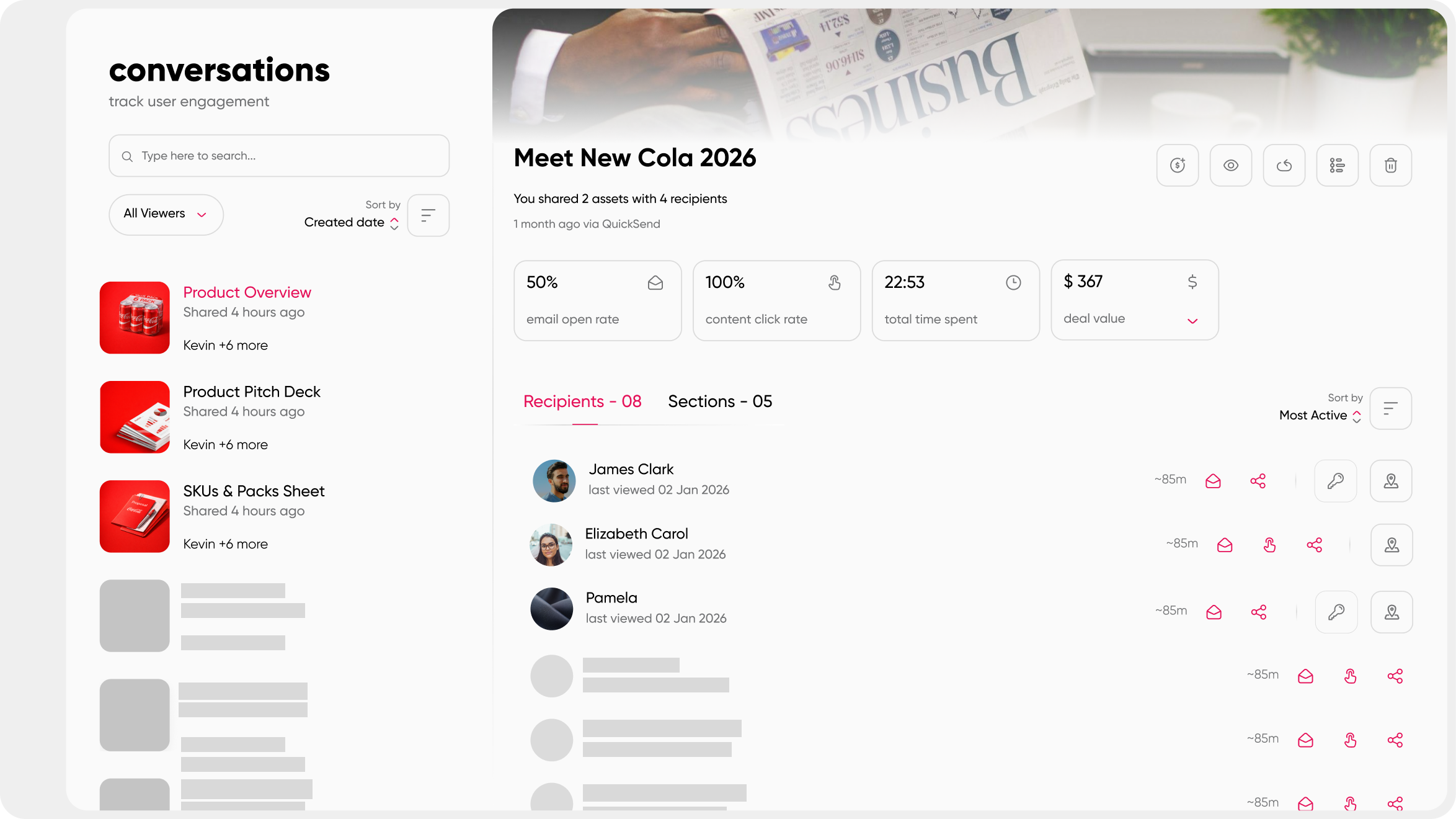
Content engagement software tracks how prospects and buyers interact with the sales and marketing content they're sent, capturing signals like page-level views, time spent per page, video watch time, and reshares. It's a different category from social media engagement tools, which measure public audience reactions like likes and comments rather than buyer-level, deal-specific behavior.
Search for "content engagement" on Google and you'll mostly land on two unrelated categories. One is social media engagement software (think Sprout Social or Sprinklr), built to manage comments, DMs, and audience sentiment across public channels. The other is product or customer engagement platforms (Pendo, Braze, Appcues), built to track in-app behavior and lifecycle messaging inside a live product. Neither is what a sales or marketing team usually means when they ask for help tracking content engagement.
What they actually mean is simpler, and closer to how Netflix knows the difference between someone who finished a season in a weekend and someone who bailed five minutes into episode one. When a rep shares a deck, a case study, or a pricing sheet with a prospect, did the right person actually look at it? For how long? Did they scroll to the end, or bail after page two? To understand what's really being measured under the hood, it helps to look at what content tracking actually involves at a technical level before comparing tools by name.
Why Content Engagement Data Matters More Than Opens and Clicks
Buyers now complete somewhere between 60% and 70% of their purchase journey before they ever talk to a sales rep. Most of the persuading, in other words, already happened by the time your rep picks up the phone, quietly, inside decks, case studies, and comparison pages nobody on your team watched unfold. An email open rate can't tell you which of those moments landed and which one fell flat.
Content engagement in sales is measured through signals like page-level views inside a shared asset, total time spent on each page, video watch time, download and reshare activity, and which specific stakeholders on the buying committee actually opened the material. A tool that only reports a single "opened" event misses almost everything that happens after that.
That single "opened" event is also unreliable on its own. Email clients and link-preview bots trigger false opens constantly, so a rep who sees "opened 3 times" might be looking at a security scanner, not an engaged buyer. Page-level and time-based signals filter that noise out, since a bot doesn't spend four minutes on page six of a pricing deck.
There's a second problem hiding underneath the first one. Roughly 65% of marketing content goes unused by sales teams, mostly because it's outdated, irrelevant, or too hard to customize on the fly. Without engagement data, marketing has no real way of knowing which 35% is actually working, so they keep producing more of the wrong 65% (an expensive way to guess). Once you can see which pages get read and which get skipped, that particular guessing game mostly disappears. Tools that also track how video fits into content strategy go a step further here, since a 90-second product demo watched to completion tells you more about buyer intent than a ten-page PDF that got opened and closed within four seconds.
Put those two things together (unreliable single-event opens, and content that never gets read the way marketing assumes) and the pattern is the same: without engagement data broken down by page, stakeholder, and format, everyone downstream is working from a guess dressed up as a metric.
What to Look For in a Content Engagement Tool
The most useful content engagement tools share four traits: they track buyer-level detail instead of just team totals, they show which specific person from the buying committee engaged (not just "someone at Acme opened this"), they sync that data straight into your CRM so reps see it without switching tabs, and their search is good enough that reps actually use the library in the first place.
- Buyer-level tracking, not team averages. A dashboard that shows "12 opens this week" across your whole team is close to useless for a rep trying to follow up on one specific deal. You want engagement tied to the person and the deal, not buried in an aggregate number.
- Multi-stakeholder visibility. B2B deals rarely close on one person's opinion. Knowing what a digital sales room actually is helps here, since most modern deal rooms are built specifically to show which stakeholders engaged and which ones haven't shown up yet, often the earliest warning sign a deal is stalling.
- Native CRM sync. Reps shouldn't need a separate login and a second dashboard to see if their prospect opened the deck. If the data doesn't reach the CRM automatically, most reps will simply never check it.
- Search and discovery quality. This one gets overlooked constantly. A rep can't share content that took ten minutes to find, or worse, gave up looking for (and sent last quarter's outdated one-pager instead, because at least that one was easy to locate).
None of these traits matter much in isolation. A tool with great stakeholder visibility but no CRM sync just becomes one more dashboard nobody opens, and a tool with fast search but no engagement depth tells you what got shared without ever telling you what happened next.
Best Tools for Content Engagement, Compared
Content engagement tools and sales engagement platforms get mixed up constantly, but they solve different problems. Sales engagement tools like Outreach or Salesloft manage outbound sequencing, cadence, and calls: the "getting a conversation started" layer. Content engagement tools track what happens after content gets shared, regardless of which channel sent it: the "did it actually land" layer. Some platforms touch both, but the tools below are built primarily around the second problem.
Before comparing tools by name, it helps to know the different types of sales enablement content each platform is actually built to track, since a tool designed around static slide decks won't necessarily handle interactive microsites or long-form video the same way.
Paperflite
Paperflite centers on three areas: content management and sharing, engagement analytics, and personalized microsites. Its Content Intelligence breaks down into content discovery (what reps search for and share most), content engagement (how buyers consume what's shared, page by page and video second by second), and content revenue (which assets actually correlate with closed deals rather than just getting opened). Its SEEK search tool is built to surface the right asset fast, which matters because engagement data is only useful if reps are sharing the right content in the first place.
Highspot
Highspot brings content, training, coaching, and buyer engagement together inside one platform, powered by its Nexus analytics engine. It's built for teams that want AI-driven content recommendations layered on top of engagement tracking, and merged with Seismic in February 2026, a move that's still reshaping the enterprise enablement market and the product roadmap for both platforms' existing customers.
Seismic
Seismic focuses on content governance at scale: version control, approval workflows, and an Enablement Intelligence suite that ties content and training data to pipeline and revenue influence. Following its February 2026 merger with Highspot, the combined product direction is still taking shape, which is worth factoring in if you're evaluating either platform right now.
Showpad
Showpad, branded as Showpad eOS, combines content recommendations, interactive presentation tools, and digital sales rooms for in-meeting and virtual selling. It merged with Bigtincan in October 2025, adding mobile-first training capabilities to its existing content and engagement stack.
Mediafly
Mediafly leans into value-selling: ROI calculators, interactive content, and deal-specific tools built to quantify a pitch, not just track whether someone opened it.
At a glance:
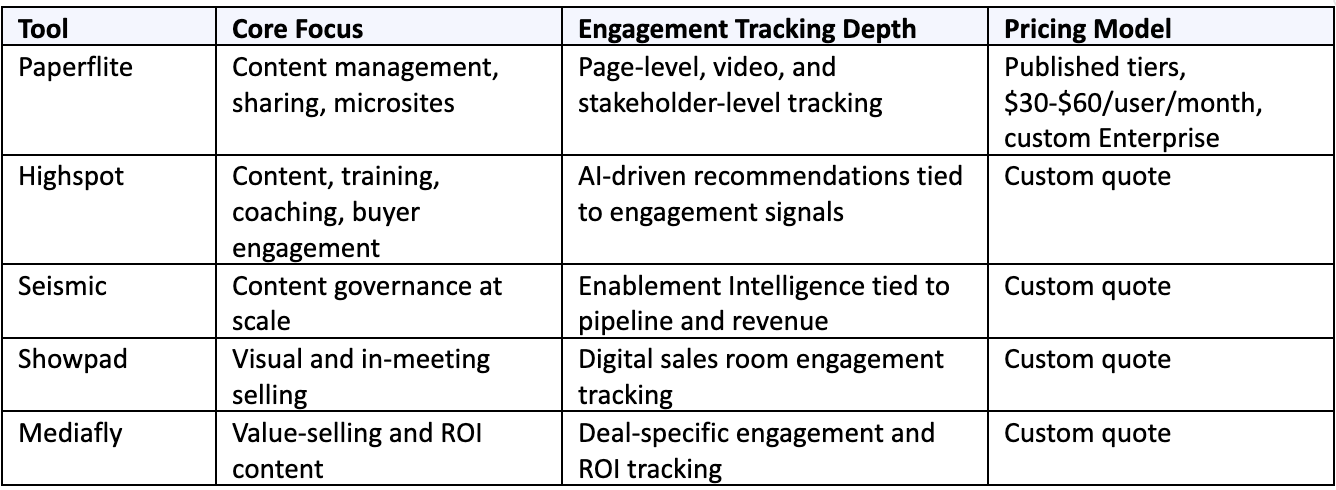
On pricing specifically, Paperflite is the only one of the five that publishes rates up front: Starter runs $30 per user per month, Professional runs $50, and Advanced runs $60, with Enterprise available on a custom quote. Highspot, Seismic, Showpad, and Mediafly are all custom-quote-only, so the real number depends heavily on team size, contract length, and how hard you negotiate at renewal.
There's no universal right answer here. A large, complex sales org already running Salesforce at scale might value Seismic's governance layer more than speed of setup. A lean team that wants to be live and tracking engagement in days, not months, tends to lean toward something lighter.
How Paperflite Approaches Content Engagement
Most engagement dashboards stop at opens and clicks, which tells you that something happened, not whether it actually mattered. Paperflite's digital sales rooms are built around a different question: is this deal actually moving, and who's driving it?
Inside a deal room, you can see the full buying committee at a glance: who's engaged, who's missing, and who just showed up. That last one matters more than it sounds, since a new stakeholder appearing mid-deal is often the first sign procurement or legal just got looped in. Instead of guessing who the real decision-maker is from a CC line on an email thread, you can see it directly in the engagement data.
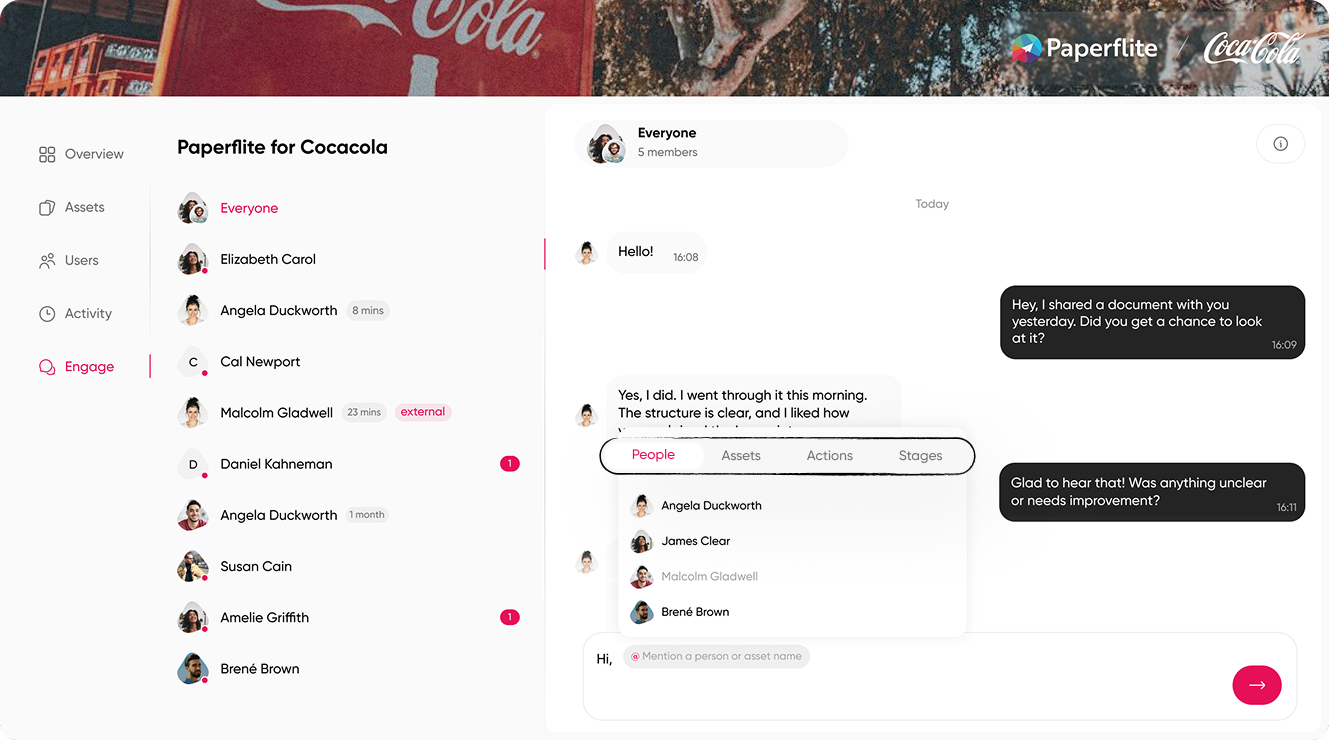
The digital sales room features built into this view go beyond a simple counter of how many times a link was clicked. Buyer questions and seller answers live in the same place, tied to the specific deal, so nothing gets lost in a scattered email thread or buried as a comment on a shared file three weeks after anyone remembers writing it. And every next step, on both sides, has an owner and a due date attached, so momentum is something you can actually see instead of something you assume based on how a call felt.
Conclusion
Content engagement isn't a vanity metric, and it was never really about opens and clicks in the first place. It's the closest thing sales and marketing teams have to knowing what a buyer genuinely cared about, without needing to ask them directly (which, let's be honest, most buyers won't answer with full honesty anyway).
Whichever tool you land on, the test is simple: can you say, right now, which piece of content moved your last deal forward, and which one got ignored entirely? If the honest answer is "not really," that's the exact gap content engagement software is built to close. For a deeper look at how this fits into a broader content strategy, the sales content management guide is a good next stop.
FAQ
What is content engagement software?
Content engagement software tracks how prospects and buyers interact with content shared during a sales or marketing process, capturing signals like page views, time spent, video watch time, and reshares. It's distinct from social media engagement tools, which track public audience reactions instead of buyer-specific behavior.
How is content engagement different from sales engagement software?
Sales engagement software, like Outreach or Salesloft, manages outbound activity such as email sequences, calls, and cadences. Content engagement software tracks what happens after content gets shared, regardless of which channel delivered it. The two often work together, but they solve different problems.
What metrics should you track for content engagement?
Look at page-level views inside a shared asset, time spent per page, video watch time, download and reshare activity, and which specific stakeholders on the buying committee engaged. A single "opened" event on its own tells you almost nothing.
Does content engagement tracking work with video and interactive content?
Yes, in tools built for it. Video watch time and scroll depth on interactive microsites are often stronger buying signals than a static PDF getting opened, since they show sustained attention rather than a single click.
How much does content engagement software cost?
Pricing varies widely, and most enterprise platforms are custom-quote-only. Paperflite is one of the few that publishes rates directly: Starter at $30 per user per month, Professional at $50, and Advanced at $60, with Enterprise available on request.
Can content engagement data integrate with a CRM?
In most modern platforms, yes. Native CRM sync means reps see engagement signals like page opens and stakeholder activity directly inside the records they already work from, instead of logging into a separate dashboard.
Is content engagement tracking only useful for large sales teams?
No. The value comes from speed to insight, not headcount. A lean team with a handful of active deals benefits just as much from knowing which content is working, often more, since every deal carries more relative weight.