Best Content Tracking Software for Sales in 2026: The Full Breakdown
You send the proposal. You spend twenty minutes on the email. You hit send.
And then nothing. No clue whether they opened it, whether the champion actually shared it with the CFO, or whether the pricing page made them wince and close the tab. You follow up on Thursday because that's when your sequence says to. Not because you have any signal that Thursday makes sense.
That gap, between when you share content and when a deal moves, is where most revenue quietly disappears. The best content tracking software for sales closes that gap. It gives you visibility into what happens to your content after it leaves your inbox: which pages your prospect read, how long they spent on each section, who else at their company is now reading the same deck, and when the right moment to follow up actually is.
This guide breaks down the best tools available in 2026, what each one actually tracks (and what it doesn't), and how to choose the right fit for your team's size and sales motion.
What Does Sales Content Tracking Software Actually Do?
Sales content tracking software gives you visibility into exactly how prospects interact with the materials you share after a meeting. You can see which pages they read, how long they spent on each section, who they forwarded it to, and when to follow up, all synced directly to your CRM. The best platforms turn raw engagement signals into timely, targeted follow-ups rather than guesswork.
Most buyers don't make a decision in your meeting. They go back to their desk, loop in the CFO and the head of legal, and hold three internal discussions your reps are never part of. What happens to your content in those rooms determines whether the deal moves. Content tracking software for sales gives you eyes in those conversations.
Here's what the best tools actually surface:
- Real-time engagement notifications. You know the moment a prospect opens your content. Not a day later when you remember to check, but in real time, so your follow-up is timed to actual attention, not a calendar reminder.
- Page-by-page and section-level analytics. You can see which slides they lingered on versus which ones they skipped. A prospect who spent four minutes on your ROI slide is a different conversation than one who closed on the executive summary.
- Multi-viewer tracking. When your primary contact shares the deck with their CTO, you find out. You see a new viewer at the same company domain engaging with the same content, and you know the deal has broader internal interest.
- Forward detection. The moment your content goes viral inside a prospect account, shared from inbox to inbox, you get a signal, not silence.
- CRM sync. Every engagement event logs automatically against the deal record. No manual entry. No gaps. Your CRM reflects the actual state of buyer attention.
A strong sales content management system is the foundation this tracking layer runs on: without organized, discoverable content, the best analytics in the world won't help reps share the right thing.
Why Your CRM's Built-In Tracking Falls Short
Most CRMs and email tools tell you whether someone opened your message. Some tell you whether they clicked a link. That's where the visibility ends. You don't know which page they stopped on, whether they forwarded the proposal to a new stakeholder, or whether they came back to re-read the pricing section at 11 PM before a budget meeting. That gap is exactly what purpose-built content tracking tools are designed to fill.
Here's the practical problem: your rep sends a PDF attachment, it lands in the prospect's downloads folder, and from that point forward, you have zero information. No opens, no page views, no forwarding signals, nothing. The deal either progresses or it doesn't, and you're left guessing which.
Even when reps link to a Google Drive folder or a shared Dropbox file, the visibility doesn't improve much. You know the link was clicked. You don't know what was read, by whom, or for how long.
This is a well-documented failure: why sales reps overlook marketing content often comes down to not knowing whether any of it is working, which kills motivation to use it consistently.
The tools below solve this. Each one differently.
The Best Content Tracking Software for Sales in 2026
There's no single best tool here. The right choice depends on your team size, how many assets you're managing, and how granular your analytics need to be. Here's an honest look at what each platform does well and where it fits.
Paperflite
Best for: Mid-market B2B teams that need section-level buyer engagement analytics across a full content library.
Most content tracking tools answer the question "did they open it?" Paperflite answers a different question: "what exactly did they do with it, who else got involved, and what does that tell us about where this deal stands?"
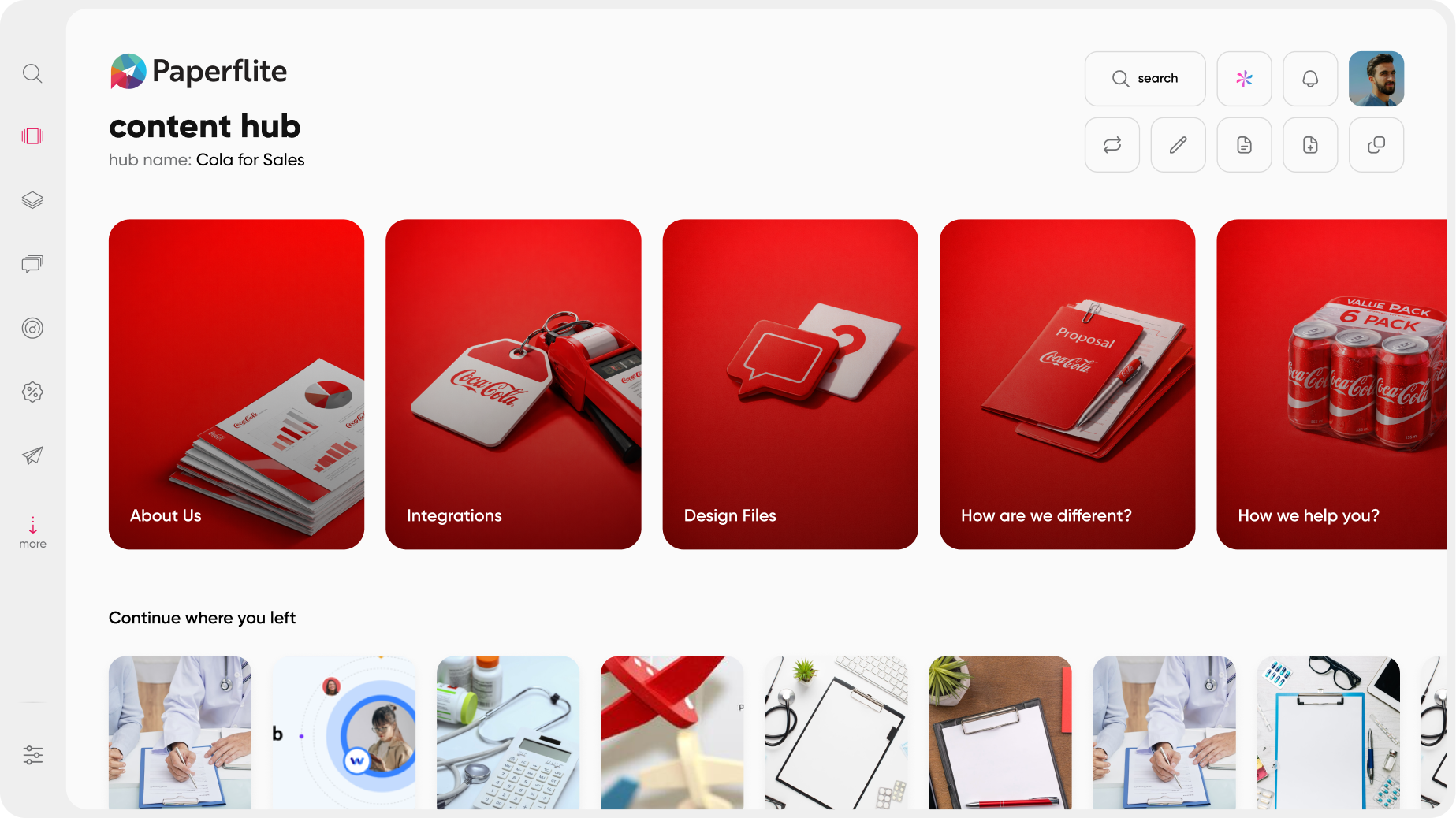
The core of Paperflite's tracking layer is built around Collections (also called FliteView microsites): curated, personalized content hubs you assemble for a specific buyer. Instead of sending three separate attachments, you send one link that opens a branded microsite with every relevant asset: case studies, ROI models, product one-pagers, all in one place. Every scroll, every view, every re-share across that experience is tracked.
What makes this different from a simple link tracker is the depth. You can see which asset within the collection a prospect spent the most time on, which section of that asset held their attention, and when a new viewer from the same company domain engaged with the same content for the first time. That second viewer is often the decision-maker your rep has never spoken to.
The platform's SEEK AI brings natural-language search to the entire content library. A rep can ask "what closes healthcare CFOs" and get targeted results from every deck, case study, and one-pager in the system, without digging through folders.
Real-time engagement alerts fire the moment a prospect views, re-opens, or shares content. AI deal intelligence flags opportunities that have gone quiet based on engagement drop-off, and surfaces which content combinations have historically moved similar deals to closed-won.
All of this syncs into Salesforce, HubSpot, Gmail, and Outlook automatically. Every interaction logs against the relevant contact and deal record. No manual entry.
Pricing: Starts at $30/user/month (Starter plan, minimum 5 users, so $150/month floor). Professional and Advanced tiers unlock CRM integrations, white labeling, digital deal rooms, and predictive deal insights.
The sales enablement content your team has built is only as valuable as the analytics that tell you what's working. Paperflite closes that loop.
DocSend
Best for: Individual sellers, founders, and small teams tracking individual high-stakes documents.
DocSend (owned by Dropbox) built the category of tracked document sharing, and it still does that specific job well. You share a link, and you get page-by-page heatmaps showing exactly how long each viewer spent on each slide, when they opened it, and whether they came back.
For a founder sharing a pitch deck with investors, or a solo seller tracking one proposal at a time, that's genuinely useful. The access controls are solid: password protection, email verification, link expiration, and the ability to update a document without breaking the existing link.
Where DocSend runs into its limits is in team selling environments and multi-asset buyer journeys. The platform is document-centric, not content-journey-centric. You track one file at a time. There's no content library, no multi-asset microsite, no sense of how a buyer has engaged across six different materials over a three-week sales cycle.
Pricing: Personal plan at $10/user/month (annual) or $15/user/month (monthly), which is the entry-level tier with a cap on visits and signatures. Standard plan at $45/user/month (annual) or $65/user/month (monthly). There's no free plan; a 14-day trial is available. Note that DocSend dropped its free tier in March 2025, which pushed many teams to reconsider alternatives.
Understanding what digital sales room capabilities look like at the next level helps frame what DocSend's document-only approach trades away.
Highspot
Best for: Enterprise B2B teams of 50+ reps with a dedicated sales enablement function.
Highspot's SmartPages let reps assemble custom content microsites for prospects. Engagement tracking shows what the prospect viewed and for how long, with deal-level signals flowing into Salesforce, HubSpot, and Dynamics 365. The Nexus AI engine connects content performance to pipeline and revenue, with analytics that are prescriptive rather than just descriptive.
The platform is genuinely strong for organizations with a large content library, complex multi-stakeholder deals, and a team dedicated to managing the enablement function. Content recommendation intelligence surfaces what's worked in similar deals, and the coaching layer helps managers close the gap between top and average performers.
Highspot and Seismic announced a merger in February 2026. Enterprise buyers evaluating either platform should factor integration timelines and roadmap uncertainty into their decision-making.
Pricing: Not publicly listed. Industry sources consistently report ranges in the $600-800/user/year territory. Enterprise contracts with dedicated support are available and typically negotiated. Minimum seat counts apply.
Seismic
Best for: Large enterprises in compliance-heavy industries: finance, pharmaceuticals, life sciences.
Seismic's Engagements toolbox tracks who interacted with content, session length, and time per content piece. LiveSend and LiveDoc capabilities support dynamic documents that auto-populate with buyer-specific data at the time of sharing, which is useful for organizations sending large volumes of personalized proposals.
The analytics are deep, but they run through an outsourced data warehouse that refreshes periodically rather than in real time. You get rich reporting, but there's a lag between when a buyer engages and when that signal reaches your dashboard. Taking action from inside the analytics interface requires jumping to another tool.
Seismic's post-merger integration with Highspot (announced February 2026) adds a layer of transition risk that enterprise buyers should evaluate carefully before signing a multi-year contract.
Pricing: Custom enterprise pricing, not publicly listed. Expect a sales conversation before seeing numbers.
Showpad
Best for: Field sales teams in manufacturing, life sciences, and medtech where in-person demos matter.
Showpad's Shared Spaces handle content sharing and basic buyer collaboration. Its differentiating strength has always been mobile-first, offline access for reps who present in the field (warehouses, hospitals, manufacturing floors) rather than over video calls. The Bigtincan merger (October 2025) added 3D and AR product visualization capabilities that matter specifically to these environments.
Content performance and engagement reporting is a documented gap. Reviews consistently note that the analytics are less granular than what Highspot or Seismic provide. That matters less if your primary use case is field presentation, and more if you're trying to connect content engagement to deal-stage signals in a digital sales motion.
Pricing: Accessible entry point relative to Seismic and Highspot. Contact for custom pricing.
GetAccept
Best for: Teams managing high proposal volume who need tracking and e-signature in the same tool.
GetAccept combines document tracking with video messaging, meeting scheduling, and CRM integration. Engagement metrics are per-document: you see opens, time spent, and forwards. It's primarily proposal-and-close focused rather than a full content library with multi-asset journey tracking.
Pricing: Starts at $35/user/month. Enterprise plans available on request.
How to Pick the Right Content Tracking Software for Your Team
The right choice comes down to five practical questions, not feature lists. Answer these honestly before evaluating any vendor.
1. How granular does your analytics need to be?
If you're tracking a single proposal or pitch deck sent to one recipient, page-level heatmaps (DocSend's strength) are plenty. If you're managing a multi-stakeholder deal where six different assets are shared over eight weeks, you need journey-level tracking: which asset, which section, which stakeholder, in what sequence. That's a fundamentally different analytics model.
2. What's your team size and realistic budget?
DocSend's Standard plan works well for individuals or very small teams ($45/user/month annually). Paperflite starts at $30/user/month with a five-user minimum, putting the floor at $150/month, which is competitive for teams in that range. Highspot and Seismic are enterprise contracts; the math rarely works for teams under 50 reps.
3. How deep does your CRM integration need to go?
Bi-directional sync that logs every content interaction automatically into deal records is the standard to hold any platform to. Tools that require manual tagging or only sync one direction create data gaps that undermine the whole point of tracking.
4. Are you tracking one document or an entire buyer journey?
Some platforms track individual files. Others track the full journey: every asset your buyer touches, in what sequence, across what timeframe, shared with how many stakeholders. If your sales cycle spans weeks and involves multiple content types, you want the latter.
5. Do you need a content library or just a link tracker?
If your team sends the same ten assets in every deal, a link tracker works. If you're managing a library of 200 assets (case studies segmented by industry, one-pagers by persona, ROI models by deal size), you need a content management layer that sits underneath the tracking, so reps can find, customize, and share the right thing without digging through folders.
Getting a sales enablement strategy right before choosing tools saves organizations from expensive mis-fits. The tool should serve the motion, not force you to build a motion around it.
What Good Content Engagement Analytics Actually Look Like
The goal of content tracking isn't data for its own sake. Every metric should answer a question that changes what your rep does next. Here are the six signals that actually move deals.
View rate by asset. Which content in your library actually gets opened versus which sits unread? Low view rates on a particular asset don't always mean the content is bad. Sometimes it means reps aren't surfacing it because they don't know it exists.
Time spent per section. A prospect who spent six minutes on your security and compliance slide is signaling something. A prospect who bounced from the executive summary is signaling something else. Both should change your next conversation.
Multi-viewer signals. When a second person from the same company domain engages with content your rep sent to the primary contact, a stakeholder mapping conversation has just become relevant. You know someone new is involved before your rep gets a heads-up in email.
Re-engagement alerts. The prospect who went cold three weeks ago just re-opened your pricing proposal. That's a better follow-up trigger than "it's been three weeks since they ghosted me."
Forward and sharing signals. When your content moves internally, one stakeholder passing it to another, your deal is advancing without you in the room. Knowing this happens lets your rep time an outreach to the moment of active internal consideration.
Content-to-pipeline correlation. Which specific assets show up most frequently in deals that closed? That's not a marketing question. That's the answer to "what should my rep send next Thursday."
Video content deserves its own tracking lens: video analytics for sales and marketing shows how video engagement data layers into the same content intelligence picture.
How Paperflite Tracks Sales Content Differently
Most platforms answer "did they open it?" Paperflite answers "what happened to this content after it left your inbox, who got involved, and what does that tell you about the deal?"
The architecture is different. When a rep shares a Paperflite Collection with a prospect, they're not sending a single tracked link to one document. They're sharing a curated, branded buyer microsite containing every relevant asset (case studies, demo videos, ROI models, competitive comparisons) all in one place, all tracked at the section level, all logged under one experience.
- SEEK AI means reps don't need to know exactly where content lives to find it. They describe what they need in plain language and get targeted results across PDFs, decks, videos, and web pages. This matters for adoption: reps who can't find content quickly don't use the platform.
- Multi-recipient tracking identifies every person at the buying organization who engages with shared content, not just the primary contact. This is how you build a stakeholder map mid-deal without asking your champion to do it for you.
- Real-time alerts notify the rep the moment content is opened, scrolled, re-shared, or returned to after a gap. The follow-up timing shifts from arbitrary to intentional.
- AI deal intelligence cross-references engagement signals with historical deal data. If engagement drops off at a stage where similar deals historically moved forward, the platform flags the risk. If a particular content combination correlated with closed-won outcomes in your account segment, the system surfaces that recommendation.
- CRM sync is automatic and bi-directional. Every content interaction (who opened, which page, how long, who forwarded) logs against the relevant contact and opportunity record in Salesforce or HubSpot. Nothing requires manual input from the rep.
The digital sales room features built into Paperflite's Advanced plan extend this tracking into a full collaborative buyer environment: deal rooms where buyers and sellers share information, track next steps, and move toward close.
Paperflite is a strong fit for mid-market teams that need depth without enterprise complexity. It requires a minimum of five users, so it's not the right tool for a single rep tracking one pitch deck. For those scenarios, a lighter document tracker does the job. But for teams managing a real content library across real sales cycles with real buying committees, the engagement depth and CRM sync justify the investment.
Pricing: Starter plan from $30/user/month (minimum 5 users). Professional and Advanced tiers add CRM and email integrations, white labeling, SSO, digital deal rooms, and predictive deal insights.
Conclusion
The gap between sending a proposal and knowing whether it moved a deal forward doesn't have to exist. Content tracking software for sales turns that silence into signal: which sections your prospects actually read, who else at their company is engaged, and when following up makes sense because something just happened, not because the calendar says so.
The tools above each solve this differently. DocSend handles individual document tracking cleanly and works well for solo sellers or founders. Highspot and Seismic serve enterprise organizations where content governance, deep analytics, and large-scale coaching are table stakes, though the ongoing Highspot-Seismic merger adds planning considerations for anyone evaluating either platform right now. Showpad is the right call for field teams where in-person demos are the motion.
For mid-market B2B teams that need section-level engagement analytics across a real content library, without a months-long enterprise implementation or enterprise pricing, Paperflite is the most complete option. The combination of journey-level tracking, multi-recipient identification, AI deal intelligence, and CRM auto-sync handles the full picture of how content moves through a buying committee, not just whether one person opened one file.
Content tracking is one piece of a broader revenue enablement strategy: how you connect content, coaching, and deal execution into one motion that consistently closes.
Book a Paperflite walkthrough and see exactly what happens to your content after you hit send.
Frequently Asked Questions
What is the best content tracking software for sales?
The best tool depends on your team size and how granular your analytics need to be. Paperflite is the strongest option for mid-market teams that want section-level engagement data and journey-wide visibility across a full content library. DocSend suits individual sellers or founders tracking single documents. Highspot and Seismic (now merging) serve enterprise organizations with 50+ reps and dedicated enablement functions. No single platform wins across every team size and use case.
How do I track content engagement in sales?
Use a purpose-built sales content tracking platform rather than standard email open-rate tools. These tools let you share content via tracked links, see which pages prospects read and for how long, identify who forwarded it internally, and receive real-time alerts when prospects re-engage with your materials, all synced automatically into your CRM so the follow-up timing is tied to actual buyer intent, not a scheduled check-in.
What does sales content tracking software actually do?
Sales content tracking software gives you visibility into how prospects interact with the materials you share after a meeting or email. It tracks views, time spent per page or section, internal sharing between stakeholders, and re-engagement signals. The best platforms sync all of this into your CRM automatically, so your sales team follows up when buyers are actively engaged, not when a calendar reminder fires.
How is Paperflite different from DocSend?
DocSend is built for tracking individual documents, pitch decks and proposals, one file at a time. It's a strong fit for founders and solo sellers. Paperflite offers a full content library with section-level tracking across personalized buyer microsites (Collections), multi-recipient identification across buying teams, and AI deal intelligence that connects content engagement to pipeline signals. It's a better fit for sales teams managing complex, multi-asset deals with multiple stakeholders than for single-document sharing.
Does sales content tracking software integrate with CRM?
Yes, most purpose-built platforms include CRM integration. Paperflite syncs bi-directionally with Salesforce, HubSpot, Gmail, and Outlook, logging every content interaction against the relevant contact and deal record without manual input. Highspot offers native sync with Salesforce, HubSpot, and Dynamics 365. DocSend's CRM integration is more limited on its lower pricing tiers.
What content engagement metrics matter most for sales?
The most actionable metrics are time spent per section (not just total open time), multi-viewer identification across the buying organization, re-engagement alerts when previously cold prospects return to your content, forward and sharing signals that reveal internal deal movement, and content-to-pipeline correlation showing which assets appear most frequently in closed-won deals. Page-level open rates alone tell you very little about buyer intent.
Is sales content tracking software only for large enterprise teams?
No. DocSend and Paperflite both serve smaller and mid-market teams. DocSend's Personal plan starts at $10/user/month (annual billing), while Paperflite starts at $30/user/month. Enterprise platforms like Highspot and Seismic are better suited for organizations with 50+ reps and a dedicated enablement function, the pricing and implementation complexity don't make sense at smaller scale.
How does content tracking help shorten the sales cycle?
Engagement signals tell you which deals are actively moving and which have stalled, so reps can prioritize follow-ups based on real buyer behavior rather than scheduled sequences. A prospect who re-opened your commercial proposal at 10 PM on a Tuesday is a better follow-up signal than "it's been five days." Knowing when your champion shared the content internally with a decision-maker is a better trigger for an executive outreach than guessing when the right moment is.