Paperflite vs Seismic for AI Search: Which One Actually Finds the Right Content?
Paperflite Seek AI uses natural language queries and an agentic search flow to surface exact assets inside CRM, Slack, and email, without opening a separate app. Seismic Aura Copilot also handles natural language search but consistently draws G2 complaints for search accuracy and a steep learning curve, particularly in organizations without a dedicated enablement team.
INTRODUCTION:
You are ten minutes out from a call with a healthcare CFO. You need the Q3 renewal case study, the one from the manufacturing vertical that closed a similar deal last quarter. You type "healthcare CFO renewal" into your enablement platform. The results come back: a 2021 onboarding deck, a generic product overview, a whitepaper dated three years ago. Nothing usable. You open Google. You find it. You paste the link into your notes and join the call two minutes late.
Quick question: is your sales enablement content hard to find in the moments that matter?, This comparison is built for those moments, so you find the right content easily
What AI Search Actually Means in a Sales Enablement Platform
AI search in a sales enablement platform is not just a smarter search bar. It is the ability to query a content library in natural language and get results ranked by relevance to a specific deal, buyer context, or conversation stage, not just the closest keyword match to a file name someone chose two years ago. Three layers separate genuine AI search from a polished interface: semantic understanding (the system grasps intent, not just text), contextual ranking (results weighted by deal stage, buyer persona, or past performance), and workflow integration (search lives where reps work, not in a portal they have to open separately).
Forrester data shows 60 to 70% of marketing-created content goes unused because reps simply cannot find it when they need it. That is a content findability problem, and AI search is the mechanism that solves it, but only if the underlying indexing is strong enough to surface the right asset before the rep gives up and searches elsewhere. The G2 review data for Seismic makes this concrete: "poor search functionality" is the platform's most-cited complaint category, with 17 explicit review mentions. That is the problem buyers are describing when they search "Seismic alternatives."
How Seismic Aura Handles AI Search
Seismic Aura is their AI engine, launched in 2024 and extended with Aura Copilot and Aura AI Agents in Fall 2025. Aura Copilot is the conversational interface: reps type a natural language question inside Seismic and it surfaces suggested content. The underlying model is Elastic's ELSER, and Seismic's own data credits it with a 20% increase in search usage and a 30% reduction in content search time. Those numbers come from Seismic's own press materials; the G2 complaint data (17 reviews citing poor search, 16 citing steep learning curve, 12 citing filtering issues) reflects the day-to-day experience of average users who have not yet seen those gains in their workflow.
The root of the gap is structural. Seismic's AI search works well when the underlying content library is clean, well-tagged, and maintained by someone whose job it is to do exactly that. Aura's recommendation engine needs a coherent content taxonomy to rank against. Organizations without a dedicated enablement admin, or with a library that has grown organically with inconsistent naming, find that the AI's intelligence is bottlenecked by the messiness underneath it. The system is only as good as the content structure you have built.
digital sales room functionality, and content analytics, which makes it a genuinely comprehensive platform for large GTM teams. One factor for buyers evaluating today: Seismic announced a merger with Highspot in February 2026. Both platforms are operating independently in the interim, but for a purchase decision spanning two to three years, roadmap clarity is a reasonable ask.
How Paperflite's Seek AI and SmartSearch Work
Paperflite has two distinct search layers that work together: SmartSearch (the underlying search engine) and Seek AI (the conversational interface on top). They are different features with different jobs, and understanding both is the clearest way to see why content discovery works differently here.
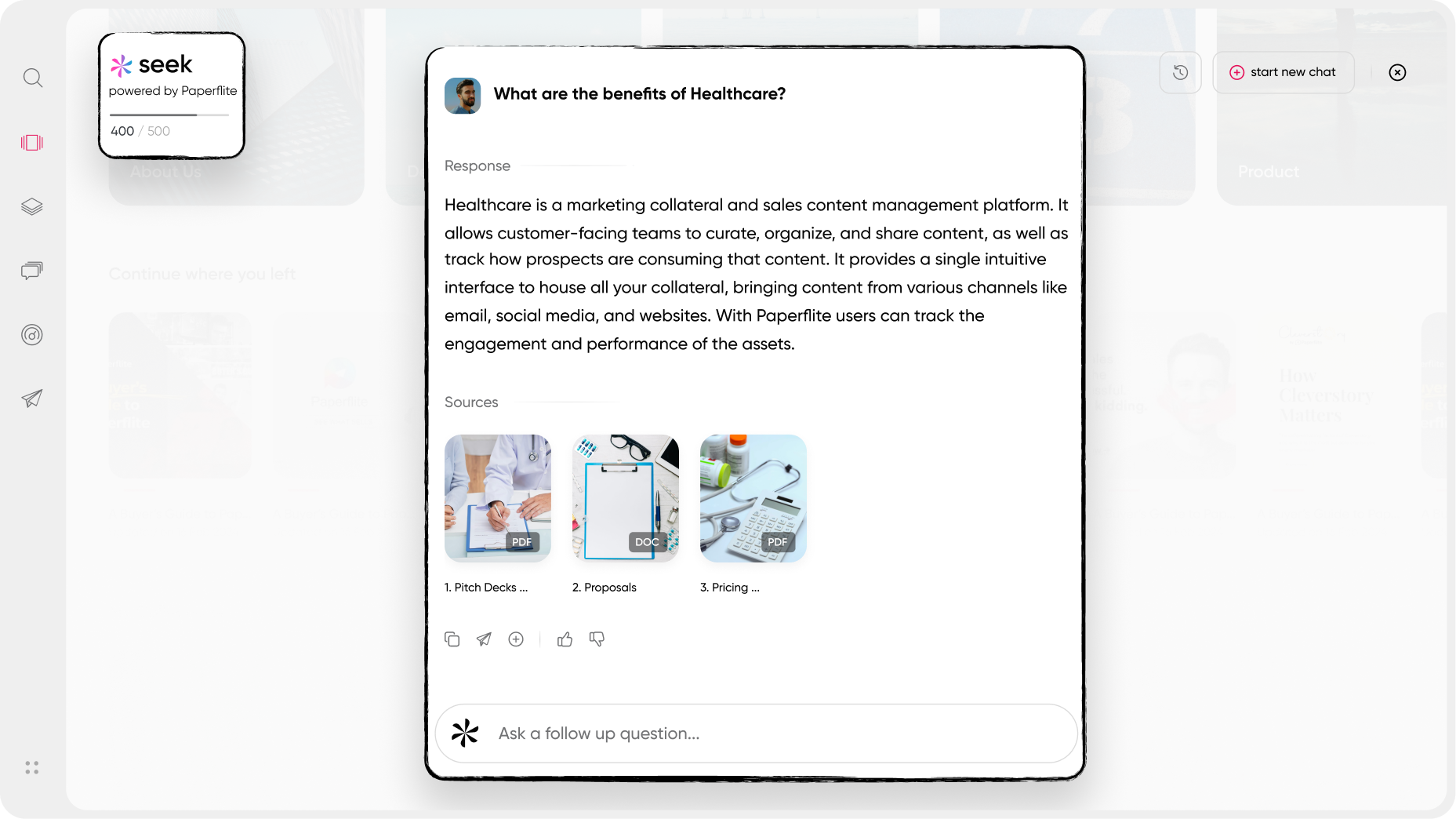
Paperflite's Seek AI is a natural language search engine that lets revenue teams query their content library conversationally: inside Salesforce, HubSpot, Slack, or email. It is powered by OpenAI and uses an agentic search flow that does not just match keywords; it reasons through the content to return contextually relevant results. Seek learns from user interactions and from what top performers used to close similar deals, so recommendations sharpen over time without requiring admin intervention.
SmartSearch, the layer underneath, indexes across 30+ signals: titles, tags, categories, full in-content text, and usage paths. A rep searching "healthcare CFO renewal objection" finds the right asset even if those exact words do not appear in the file name, because SmartSearch is reading what is inside the document.
Auto-tagging: When content is uploaded to Paperflite, Seek's AI automatically reads and tags it based on the document's actual content: topic, audience, buying stage, and keywords, without anyone manually categorizing it. This is the direct inverse of Seismic's dependency on clean taxonomy. Paperflite's auto-tagging builds that taxonomy for you, automatically, as content lands in the library. A messy inherited content library does not stay messy once it is in Paperflite: it gets indexed, tagged, and surfaced by Seek from day one.
Seek v3's agentic search flow takes this further. Rather than pattern-matching against an index, Seek reasons through your content to return what is contextually right, similar to how a knowledgeable colleague would answer "what do I send to a manufacturing CFO in a competitive renewal" rather than handing you a folder of possibilities.
For workflow integration: Seek works directly inside Salesforce, HubSpot, and Slack. Reps do not open a separate portal. They stay in their CRM, type a question, and get the answer. Setup connects to existing content storage (Google Drive, SharePoint) in a single click. Granular access controls let admins restrict what specific user groups can see, so a rep in one territory is not searching through content that does not apply to their region or product line.
Side-by-Side Comparison
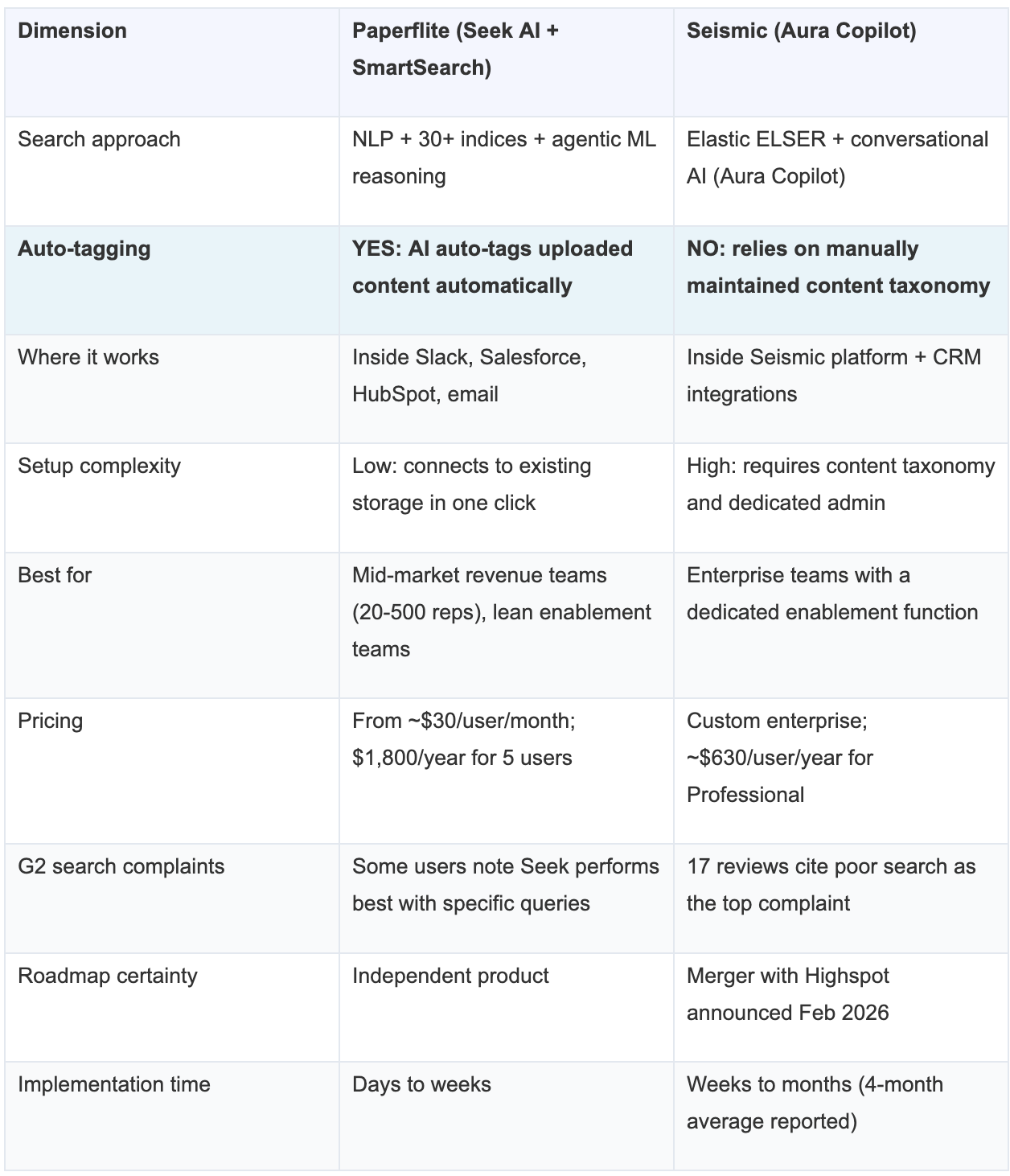
The fundamental difference: Seismic Aura is a sophisticated AI layer on an enterprise system that rewards investment in content taxonomy and dedicated admin time. Paperflite Seek AI is a lighter, faster-to-deploy natural language engine that auto-tags and indexes your existing library from day one, and works inside the tools your reps are already using.
When Seismic Makes More Sense
Seismic earns its keep in organizations with dedicated enablement leaders, large GTM teams of 500 or more reps, complex content governance requirements, and multi-region deployments where consistent messaging at scale is non-negotiable.
The value of Seismic compounds when you have an enablement team whose specific job is to maintain content taxonomy, configure Aura's AI settings, and train reps on the system. The breadth of Aura AI Agents, launched in Fall 2025, goes well beyond search: onboarding automation, content creation assistance, and coaching capabilities that are genuinely difficult to replicate with a lighter platform.
One practical caveat: if you are evaluating Seismic today, ask your rep for roadmap specifics given the Highspot merger. Both platforms operate independently for now, but that "for now" deserves a direct conversation.
When Paperflite Makes More Sense
Paperflite's AI search is built for teams that need it to work from week one, not after a four-month configuration project. The specific scenario it is designed for: a 20 to 200 rep revenue team, a lean or nonexistent dedicated enablement function, and a content library that has grown organically and could charitably be described as "organized enough."
Auto-tagging handles the messy library problem directly. When you connect your Google Drive or SharePoint to Paperflite, Seek's AI reads your existing content and auto-tags it based on what is actually inside each document: topic, audience, buying stage, keywords. You do not need to manually re-categorize 400 assets before search starts working. It indexes what you already have, as it is, and starts surfacing the right content from day one.
Three specific situations where Paperflite pulls ahead:
Speed to value: Connect your existing storage and Seek starts working the same day. No re-upload, no manual tagging sprint, no weeks-long taxonomy project before your reps can search productively.
Workflow integration: Seek works directly inside Slack, Salesforce, and HubSpot. A rep on an active deal does not switch to a portal; they type a question in Slack and get the asset in seconds.
Deal-stage intelligence: Seek's ML learns from your team's own deal history. The more your team uses it, the sharper the recommendations get, without anyone touching admin settings.
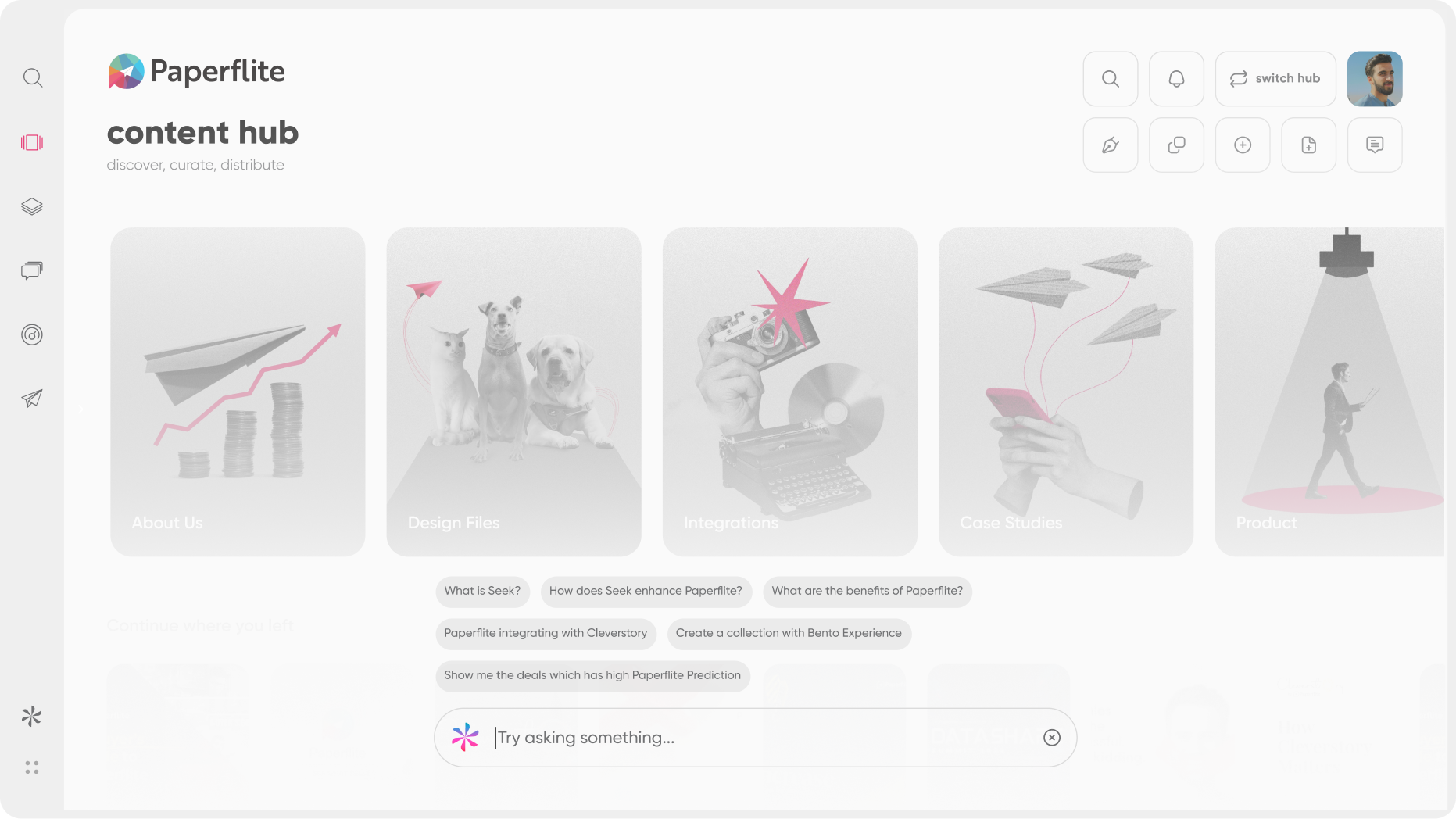
content hub layer underneath Seek also means search is not the only entry point. Reps can browse curated collections, see trending content across the team, and get notified when assets they have used are updated. Pricing is published: you can evaluate, trial, and decide without a negotiation.
See Seek AI find the right content in under 10 seconds: in your CRM, in Slack, or in a live call.
Book a 20-minute demo
What to Ask Before You Choose Either
Before you talk to a vendor, four questions will tell you more than any product demo:
Do we have someone whose job is to maintain our enablement platform?
Seismic's AI depth pays off with a dedicated admin. Without one, you are buying a high-performance engine and leaving it without a mechanic.
Where do our reps actually spend their time?
If they live in Salesforce and Slack, you need AI search that works there, not in a separate portal they will remember to open for two weeks and then quietly stop using.
How fast do we need to see ROI from AI search?
Seismic's full capability takes months to configure. Paperflite's auto-tagging and Seek work from the first week.
What does our content library look like today?
Seismic rewards a well-organized, well-tagged library. Paperflite's auto-tagging handles a messy one. If you are being honest about the state of your content storage, this question alone narrows the decision considerably.
sales enablement tools covers the full category.
Conclusion
Go back to the rep from the intro: ten minutes before the call, searching for the healthcare CFO case study. The right platform is the one that solves that problem without creating a new one, a complex system nobody maintains, a portal nobody opens, a taxonomy project still in flight six months into the contract.
Both Paperflite and Seismic have real AI search capability. The difference is in who gets value from each one. Seismic is genuinely excellent for enterprise organizations with the resources to configure and maintain it. Paperflite's Seek AI is built for revenue teams who need natural language content discovery working now, with auto-tagging that eliminates the manual setup that makes other platforms slow to show value.
A Beginner's Guide to Sales Enablement is the next read.
Frequently Asked Questions
What is Seismic Aura and how does it handle AI search?
Seismic Aura is their AI engine, including Aura Copilot, which lets reps search for content using natural language inside the Seismic platform. It is powered by Elastic's ELSER model and launched in 2024. It improves search speed and relevance, though G2 reviews still flag search as Seismic's most-cited frustration, particularly for teams without a dedicated admin maintaining content taxonomy.
Does Paperflite have AI-powered content search?
Yes. Paperflite has two layers: SmartSearch (which indexes 30+ signals including titles, tags, and full in-document text) and Seek AI (a natural language interface that works inside Salesforce, HubSpot, and Slack). Seek is powered by OpenAI, uses an agentic search flow that reasons through content rather than just matching keywords, and auto-tags newly uploaded content so search works from day one without manual taxonomy setup.
What are the most common complaints about Seismic's search?
G2 reviewers cite poor search functionality (17 mentions), steep learning curve (16), filtering issues (12), and navigation difficulty (12) as Seismic's top pain points. Most trace back to the same root cause: Seismic's AI search performs best when the underlying content library is well-organized and maintained, a setup requirement many teams underestimate before signing the contract.
How does Paperflite's pricing compare to Seismic?
Paperflite publishes its pricing, starting around $30/user/month with plans from $1,800/year for 5 users. Seismic does not publish pricing publicly. Vendr benchmarks put Seismic Professional at roughly $630/user/year at list price, with enterprise tiers varying by modules and contract size. The practical difference: you can evaluate Paperflite's fit without a pricing negotiation.
Is Seismic still a good option given the Highspot merger?
It depends on your evaluation timeline. Seismic and Highspot announced a merger in February 2026 and continue operating as independent platforms in the interim. For a purchase decision spanning two to three years, it is reasonable to ask your Seismic rep for roadmap clarity: specifically which platform features will be preserved and which will consolidate post-merger.
Which platform is easier to implement for a mid-market team?
Paperflite is significantly faster to implement. Teams connect existing Google Drive or SharePoint storage in a single click, Seek's auto-tagging indexes the existing library automatically, and AI search begins working from day one. Seismic's average implementation runs four months and typically requires a dedicated enablement admin to configure the content taxonomy that makes Aura search effective.
Can both platforms integrate with Salesforce and HubSpot?
Both integrate with Salesforce and HubSpot. The practical difference is where the AI search actually lives. Paperflite's Seek AI answers content queries directly inside Salesforce, HubSpot, and Slack without switching apps. Seismic's Aura Copilot operates primarily within the Seismic interface, with CRM integrations that surface content recommendations but require more workflow switching.
What should I look for when evaluating AI search in a sales enablement platform?
Evaluate three things: the quality of the underlying index (does it search full document content and auto-tag new uploads, or just titles?), workflow integration (does search live where reps work, or in a separate tool they have to remember to open?), and contextual ranking (does it personalize results based on deal stage and past performance, or return a flat keyword match?). How you answer these three tells you which architecture fits your team.