Best ABM Content Hub: 7 Platforms Compared for 2026
An ABM content hub is a centralised, personalised destination where marketing and sales teams organise content for specific target accounts, replacing generic resource pages with curated experiences tailored to each account's buying stage and stakeholders, so every person on the buying committee sees content matched to their role.
Introduction
A VP of Operations, a security reviewer, a finance lead, and a procurement manager walk into your website. They all land on the exact same “Resources” page you built eight months ago for a completely different account. Nobody's looking for a security whitepaper from three product launches back, and nobody says so. They just close the tab.
That's the gap an ABM content hub exists to close. Instead of one generic page pretending to serve everyone, an ABM content hub gives each target account, or account segment, its own curated, personalized destination built around what that specific buying committee actually cares about.
If you're evaluating the best ABM content hub for your team, you've probably noticed the market is crowded and confusing. Some platforms handle intent data and ad orchestration. Others focus purely on the content experience layer. A few try to do both, with mixed results. This guide breaks down what an ABM content hub actually does, how it's different from a digital sales room or a full ABM suite, and which platforms are worth your shortlist in 2026, including where Paperflite fits for teams that want content intelligence without a six-month rollout.
By the end, you'll know exactly which category of tool matches your team's stage of ABM maturity (and you won't have to sit through nine demo calls to figure it out).
What Is an ABM Content Hub?
What is an ABM content hub, exactly? Think of it as a mini website built just for one account or account segment, stocked only with the content that matters to them: case studies from their industry, an ROI calculator sized to their deal, maybe a security overview if procurement is in the room. Instead of a static resources page trying to be everything to everyone, marketing and sales curate a living hub that shifts based on where that account sits in the buying process.
An ABM content hub is a personalized, centralized content destination built for a specific target account or account segment within an account-based marketing program. Unlike a general resources page, it organizes assets around that account's industry, persona mix, and buying stage, and it typically tracks who on the buying committee engaged with what.
That last part matters more than people expect. (We'll get to why in a minute.) Most B2B deals over a certain size aren't decided by one person clicking “buy.” They're decided by a committee: someone worried about budget, someone worried about implementation risk, someone worried about whether this becomes their problem in six months. A generic content hub can't tell these three people apart. An ABM content hub is built to.
How It Differs from a Digital Sales Room
It's easy to mix up an ABM content hub with a digital sales room, and honestly, the line is blurry because the best platforms let one flow into the other. The distinction that actually matters: a content hub typically operates earlier, during the awareness and consideration stages, personalizing content for a segment or account before there's an active deal. A digital sales room activates once a specific opportunity opens, built around one deal, one buying team, and a shared path to close. Some platforms handle both. Others specialize in one and expect you to bolt on the other.
Content Hub vs. Full ABM Suite: Where Each One Fits
Do you need a content hub if you're already running Demandbase or 6sense? Usually yes, and here's why: those platforms are built to answer “which accounts should we target and when are they in-market,” not “what should this specific account see when they land on our site.” They're the intelligence layer. A content hub is the experience layer.
A content hub and a full ABM suite solve different problems in the same program. Platforms like Demandbase, 6sense, and Terminus identify in-market accounts, score them, and orchestrate multi-channel outreach across ads, email, and direct mail. A content hub takes over once that outreach lands somewhere: it's the personalized destination the account actually sees. Most mature ABM programs run at least one of each, layered together rather than swapped for one another.
Here's a rough way to think about the split. Your intent platform tells you which fifty accounts are showing buying signals this month. Your content hub is what those fifty accounts land on when your ads, emails, or SDR outreach actually gets a click. Skip the content hub, and you've done all that targeting work just to send someone to the same “Solutions” page as every other visitor (kind of defeats the purpose).
This is also where budget conversations get easier. Full ABM suites with intent data and ad orchestration often run five or six figures a year before you've spent a dollar on media. A content hub is a smaller, faster piece of that stack, which makes it a realistic starting point for teams that aren't ready for, or don't need, the whole orchestration layer yet. A mid-market team running one-to-few ABM against fifty target accounts, for instance, often gets more mileage from a sharp content hub than from a six-figure intent platform they don't yet have the headcount to operate.
What to Look For in an ABM Content Hub
Not every content hub does the same job well, and the marketing on most vendor sites tends to blur together after the third demo. A few criteria actually separate the useful platforms from the pretty ones.
Account and segment-level personalization. Can you build a hub for one account and also spin up a template for a segment of fifty look-alike accounts, without redesigning from scratch each time? Segment-level personalization is what makes one-to-few ABM programs scale without burning out your design team.
Stakeholder-level engagement visibility. The best content hubs don't just tell you a hub was opened. They tell you which named stakeholder viewed which asset, for how long, and whether they came back a second time, so a rep can walk into a follow-up call already knowing the finance lead spent ten minutes on the pricing page and the security reviewer never opened the compliance doc at all.
CRM and MAP integration. Engagement data that lives in a separate dashboard nobody checks is engagement data that doesn't exist. Look for native routing into Salesforce, HubSpot, or Marketo so a hot signal turns into a rep notification instead of a report someone reads next Tuesday.
Time to value. Some content hub builders, Folloze is a good example, are genuinely powerful and genuinely built for months-long enterprise rollouts with a dedicated implementation team. If your marketing team is three people, that's not a criticism of the platform, it's just not the right fit. Ask directly how long it takes to get your first hub live.
Content discovery, not just content storage. A hub full of forty assets is only useful if a rep or a marketer can find the right one in seconds. Content discovery matters just as much as the personalization layer sitting on top of it, and it's often the piece teams underestimate until their library gets messy.
Keep this list next to you during demos. Most vendors will happily show you the parts that look good in a fifteen-minute call and skim past the parts that only show up after month three.
7 Best ABM Content Hubs Compared
The platforms below split roughly into two camps: purpose-built content hubs, and full sales enablement suites that include a content hub as part of a bigger product. For a deeper look at what a content hub itself needs to include, see this breakdown of content hub tools. Both camps are represented here, since which one you need depends on whether you're solving for the content experience alone or for the whole rep-facing workflow around it.
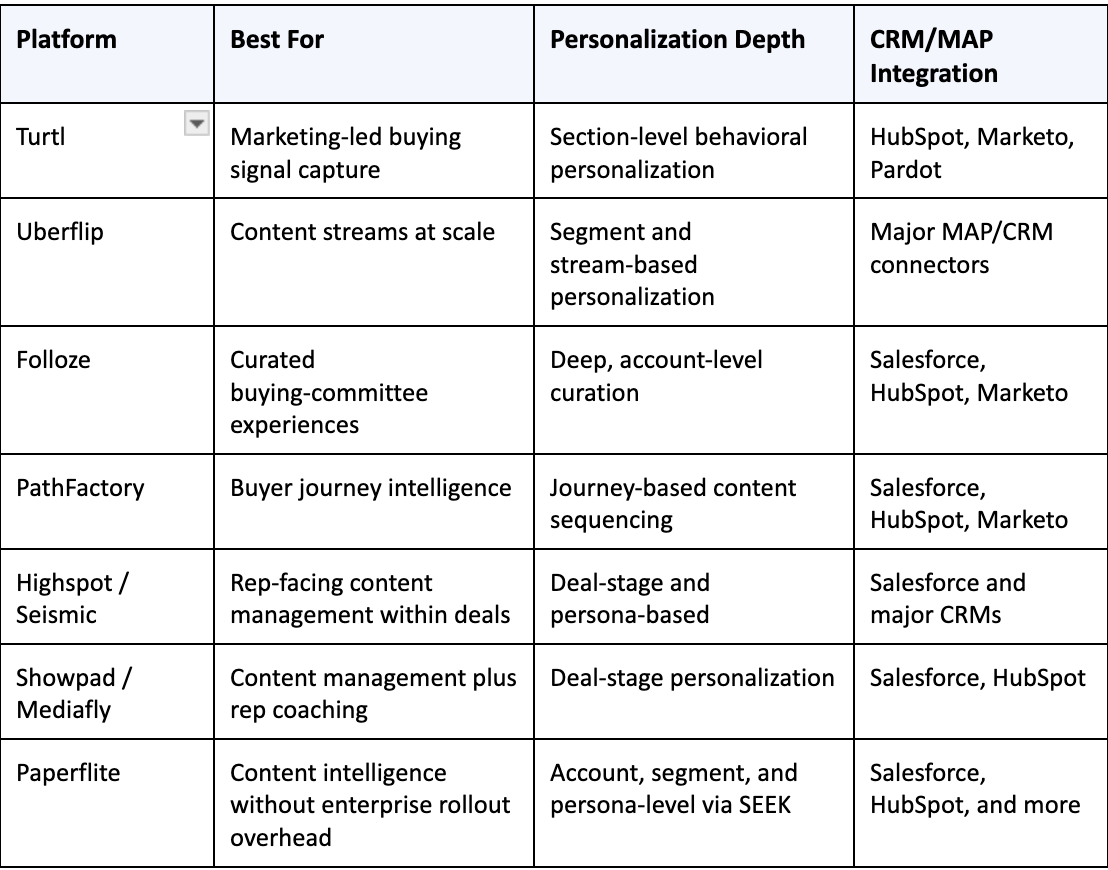
Turtl: Best for Marketing-Led Buying Signal Capture
Turtl leans hardest into the signal side of the equation. It captures section-level engagement (how long someone spent on the ROI slide, whether they came back) and routes those events into HubSpot, Marketo, or Pardot as custom activities, which can trigger a rep notification the moment an account shows real interest. If your bottleneck is marketing generating usable buying signals for sales to act on, Turtl is built specifically for that handoff.
Uberflip: Best for Content Streams at Scale
Uberflip, now part of PathFactory, organizes content from multiple sources into streams tailored to different audience segments, without a developer building a new page for every campaign. For teams running one-to-few ABM against dozens of look-alike accounts, that stream-based approach is genuinely efficient. Its AI layer recommends content based on behavior and intent data as visitors move through a stream.
Folloze: Best for Curated Buying-Committee Experiences
Folloze built its reputation on deep, hand-curated content hubs for late-stage enterprise deals with complex buying committees. It's a mature platform with real depth, and its customer support consistently gets called out as a differentiator. The tradeoff: its architecture predates the current wave of AI-native tools, with AI features layered on more recently rather than built in from the start.
PathFactory: Best for Buyer Journey Intelligence
PathFactory uses machine learning to recommend the next piece of content based on what an account has already consumed, effectively acting as a guide through the buyer journey rather than a static library. That's a real strength for teams whose biggest gap is knowing what to serve someone next, not just where to store what they already have.
Highspot / Seismic: Best for Rep-Facing Content Management Within Deals
Highspot and Seismic, which completed a merger in February 2026, both excel once a deal is active: organizing content by stage and persona for reps, tracking how buyers engage during live conversations, and layering in AI recommendations for what to share next. They're built for large, distributed sales organizations with dedicated enablement teams to run them.
Showpad / Mediafly: Best for Content Management Plus Rep Coaching
Showpad, which merged with Bigtincan in October 2025, pairs content management with rep training and coaching tools, making it a solid fit for mid-market sales organizations that want to build rep capability alongside content control. Like other suite vendors currently mid-consolidation, it's worth asking directly about product roadmap continuity over the next year or two.
Paperflite: Best for Content Intelligence Without the Enterprise Rollout
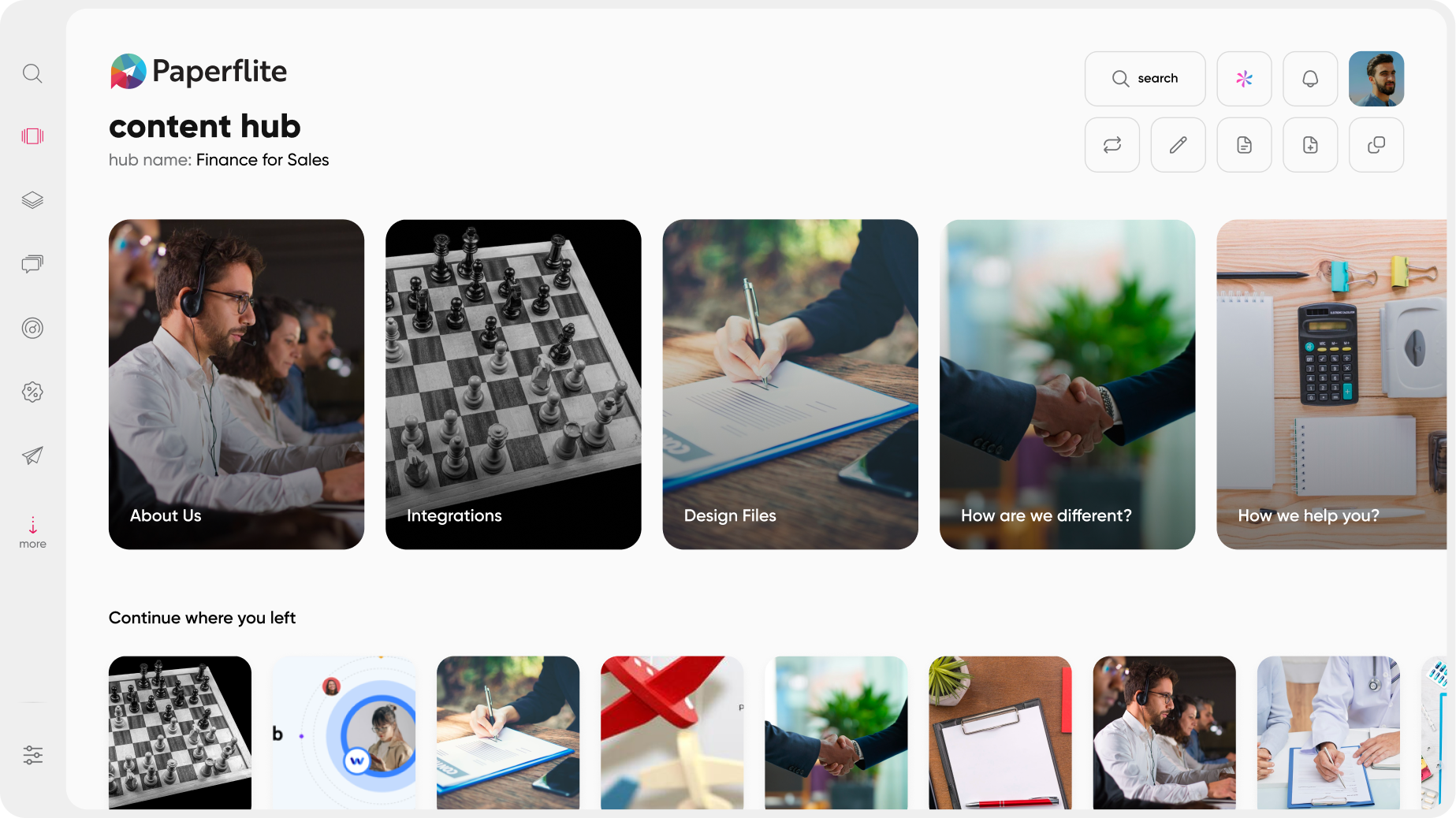
Paperflite covers the same core job, personalized, trackable content hubs for target accounts, built for teams that want to be live in days, not quarters. More on exactly how, below.
Paperflite as an ABM Content Hub
Here's the scenario most of the platforms above don't solve well: you've built beautiful personalized hubs for forty target accounts, and now nobody on your team can find the right asset fast enough to keep them updated. Paperflite starts from that problem.
How Paperflite Personalizes Content by Account and Segment
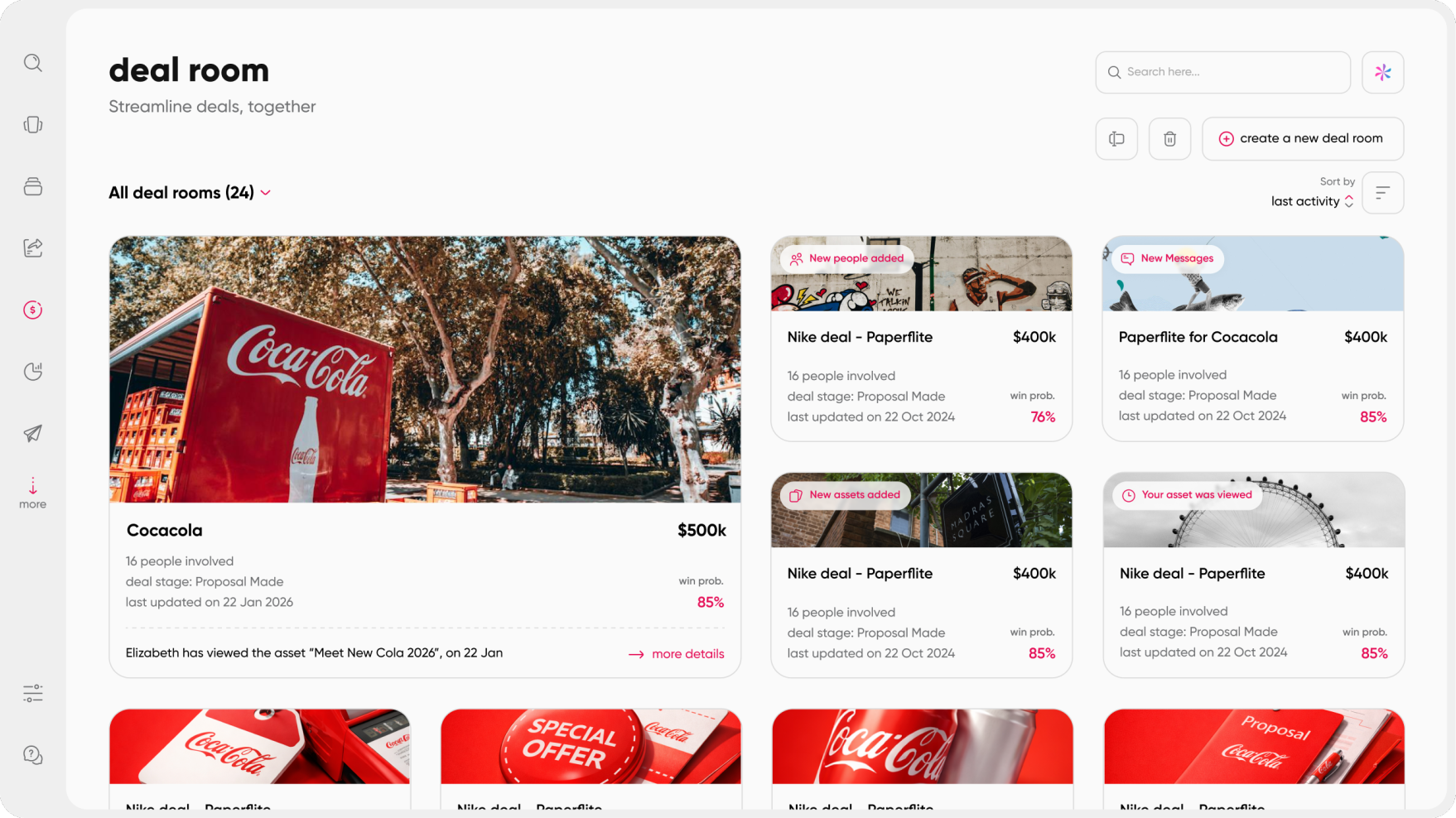
SEEK, Paperflite's LLM-powered search, lets anyone on the team type a plain-language request, something like “the healthcare case study with the ROI numbers from Q1,” and get the right asset back in seconds, instead of digging through folders someone else named eight months ago. That matters more than it sounds like it should: the personalization layer of an ABM content hub is only as good as the team's ability to keep it fresh, and manual tagging is where most content hubs quietly rot.
Content streams let marketing build segment-specific hubs, by industry, persona, or account tier, without spinning up a brand-new microsite for every campaign. Set up a stream once for “mid-market healthcare accounts in evaluation stage,” and every account that fits gets a hub tailored to that segment automatically, no rebuild required each time a new account enters the pipeline.
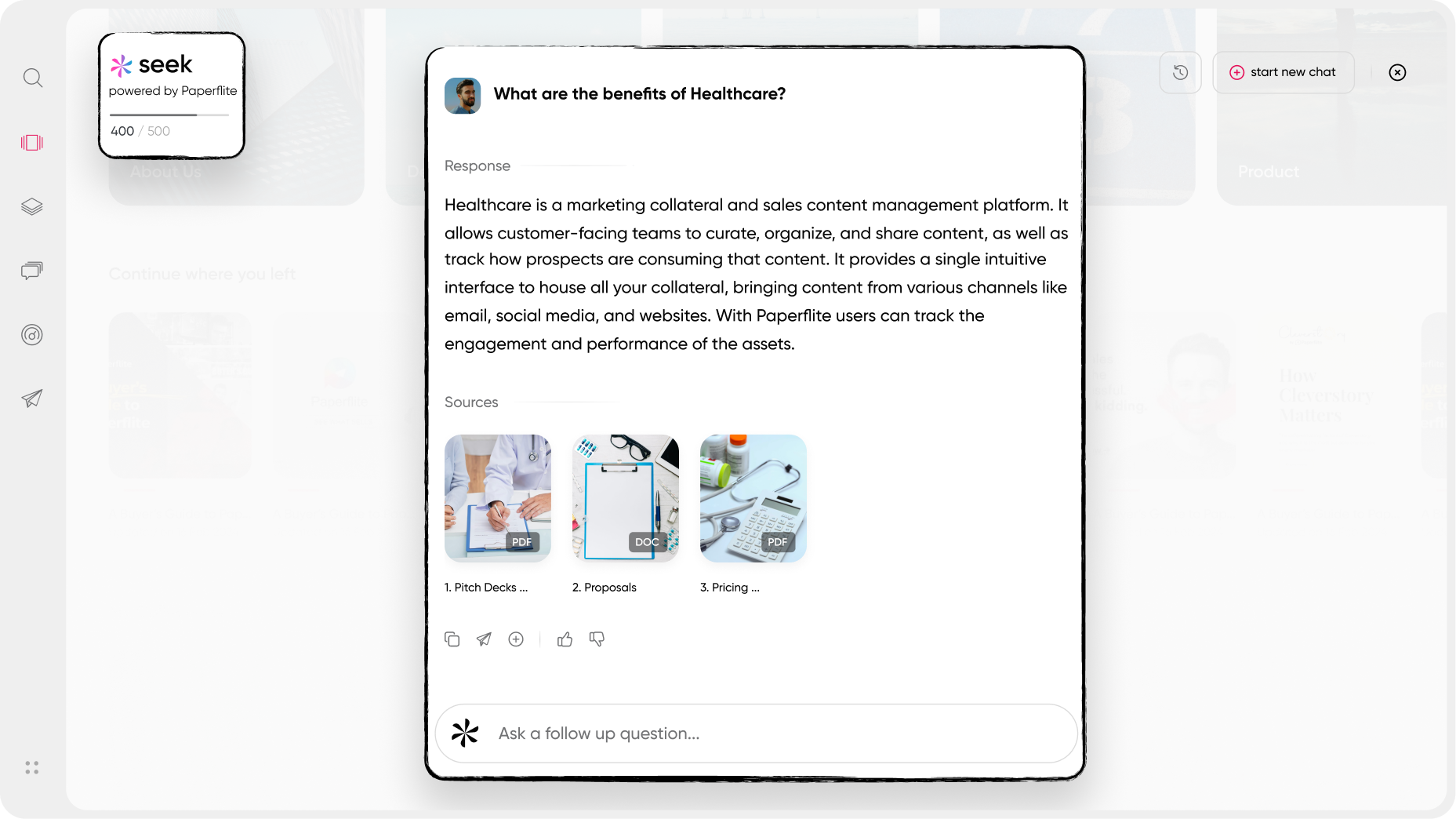
From Content Hub to Deal Room: Closing the Loop with FliteView
Most content-hub-only tools stop at the top-of-funnel personalization layer, and hand the account off to a completely different tool once a deal actually opens. Paperflite extends the same account intelligence into FliteView, its digital deal room, so the work marketing put into personalizing a hub during the awareness stage doesn't get abandoned the moment sales takes over.
That continuity is the practical difference for the buying committee on the other end. They get one branded experience from the first ad click to the signed contract, instead of a polished content hub for the first three touches and a scattered email thread for the ninety that follow.
Engagement Intelligence Built for Buying Committees
Section-level and stakeholder-level engagement tracking shows which member of the buying committee spent time where, not just that “the content was opened” (a distinction that matters a lot once you've sat through a deal review where nobody could say who on the buyer side had actually seen the pricing page). Those signals feed back to reps and marketers directly, without a separate reporting dashboard nobody remembers to check.
Why Speed-to-Value Matters for Mid-Market Teams
Folloze and similar mature content-hub builders are genuinely strong platforms, and they're built for long enterprise rollouts with dedicated implementation resources. Paperflite is built to be live in days. There's no requirement for a multi-month onboarding project or a dedicated admin just to keep hubs updated, which is exactly the constraint most lean marketing teams running ABM are working under.
That speed also matters right now for a less obvious reason. With Seismic and Highspot completing their merger in February 2026, and Showpad and Bigtincan merging in October 2025, several of the larger suite vendors are mid-transition on product roadmaps. That's not a knock on either company; consolidation is a normal part of a maturing market. But if you're signing a multi-year contract, it's a fair question to ask any vendor: what does the roadmap look like in eighteen months, and who's answering that question right now?
Where Paperflite Fits in a Broader ABM Stack
Paperflite is the content and hub layer. If you're also running an intent platform like 6sense or Demandbase to identify and prioritize target accounts, Paperflite is what those accounts land on and what your reps use to keep the conversation moving, not a replacement for the targeting layer sitting upstream.
See how it works for your team, and bring your messiest content library. We'll show you what SEEK does with it.
Conclusion
An ABM content hub isn't a nice-to-have add-on to your ABM stack, it's the layer your target accounts actually experience. Intent platforms decide who to target. Content hubs decide what happens next. Get the second part wrong and all the targeting precision in the world lands someone on a page that could have been built for anyone.
If you're running a lean team and don't need the intent and orchestration layer yet, or already have it covered elsewhere, start with a content hub that's fast to launch and easy to keep current. That's the gap Paperflite is built to close: personalized hubs, searchable content, and a straight line from first touch to signed deal, without the six-month runway some of the larger suites require.
Ready to see it against your own sales enablement content? See how it works.
FAQ
What is an ABM content hub?
An ABM content hub is a personalized, centralized destination where marketing and sales organize content for a specific target account or account segment. Instead of sending every visitor to the same generic resources page, it curates assets around that account's industry, persona mix, and stage in the buying process, and typically tracks which stakeholders engaged with what.
Do I need a content hub if I already use an ABM platform like 6sense or Demandbase?
Usually yes. Platforms like 6sense and Demandbase identify which accounts to target and when, but they don't build the personalized experience an account sees once your outreach lands. A content hub is the experience layer that sits downstream of that targeting work, and most mature ABM programs run both together rather than choosing one over the other.
How is a content hub different from a digital sales room?
A content hub typically operates earlier in the funnel, personalizing content for an account or segment before an active deal exists. A digital sales room activates once a specific opportunity opens, built around one deal and one buying committee's path to close. Some platforms, including Paperflite, cover both so the transition between the two feels continuous rather than like switching tools.
What does an ABM content hub cost?
Pricing varies widely, and most vendors, including Turtl, Uberflip, Folloze, and PathFactory, require a custom quote. Paperflite publishes its pricing directly: Starter plans begin at $30 per user per month, Professional at $50, and Advanced at $60, each with a five-user minimum, with Enterprise available on a custom quote for larger deployments.
Can a small marketing team run an ABM content hub without a full enablement suite?
Yes, and for many mid-market teams it's the more realistic starting point. A dedicated content hub is a smaller, faster piece of the stack than a full enablement suite with training and coaching built in, which matters if your team doesn't have the headcount to run, or the budget for, the larger platform yet.
How long does it take to set up an ABM content hub?
This varies significantly by vendor. Enterprise-grade builders like Folloze are built for multi-month rollouts with dedicated implementation support, which suits large, complex buying committees. Platforms built for speed-to-value, including Paperflite, are designed to get a first hub live in days rather than quarters.
What features matter most in an ABM content hub?
Account and segment-level personalization, stakeholder-level engagement visibility, native CRM and MAP integration so signals reach reps automatically, and genuine content discovery so your team can actually find the right asset fast. Time to value matters just as much as feature depth for teams without a dedicated implementation function.
What's the difference between a content hub and a marketing automation platform?
A marketing automation platform like HubSpot or Marketo manages broad campaigns, email sequences, and lead nurture across your entire funnel. A content hub is narrower and deeper: it's a personalized destination built for one account or segment, usually fed by data from your MAP and CRM rather than replacing them.