Which Tool Predicts Deal Health From Buyer Engagement?
No single tool “predicts” deal health with certainty. Instead, two categories of tools surface the signals that reveal it: conversation-intelligence platforms (Gong, Clari, Outreach, Salesforce Einstein) that score CRM and call activity, and content engagement platforms like Paperflite that track how buyers actually interact with shared content and deal rooms.
Introduction:
Your rep just moved a $40,000 deal from "Discovery" to "Proposal Sent" in the CRM. On paper, that's progress. In reality, the buyer hasn't opened the proposal in nine days, the champion went quiet after the last call, and nobody on your team has noticed because the pipeline report still shows green.
This is the gap between what a CRM says and what a buyer is actually doing. And it's exactly why so many revenue teams go looking for a tool that predicts deal health from engagement, something that reads the room the way a good rep would, instead of trusting a stage field a rep updated between meetings.
If you're a sales manager staring at a pipeline report that looks healthier than your gut says it is, or a rep who wants proof before telling your manager a deal is slipping, this is written for you. Both problems trace back to the same root cause: the signal everyone's trusting was never designed to tell you what a buyer is actually doing.
Here's the honest answer before you scroll further: no single tool predicts deal health with total certainty. (If one claimed that, we'd be skeptical too.) What exists instead are two categories of tools that surface the signals worth watching: platforms that mine your CRM and call data for patterns, and platforms that track what buyers actually do with the content and deal rooms you send them. This piece breaks down both, tells you honestly where each one falls short, and shows you where Paperflite's Digital Sales Room fits into the picture.
What "Deal Health" Actually Means (and Why CRM Stages Keep Getting It Wrong)
A deal health score is supposed to answer one question: is this deal actually going to close. Most tools calculate it by blending pipeline stage, activity volume, and historical win patterns into a single number or status, usually on a red, yellow, green scale or a 0 to 100 point range.
What is a deal health score?
A deal health score is a calculated assessment of whether an open deal is likely to close, built from signals like activity level, stakeholder engagement, and how a deal compares to previously won or lost opportunities at the same stage. It's meant to replace gut instinct with something closer to evidence.
That sounds solid until you look at where the “evidence” actually comes from. In most CRMs, a stage change is a manual action. A rep drags a card from “Discovery” to “Proposal” because they sent a document, not because the buyer showed any real interest in it. Digital Sales Room tracking exists precisely because that gap between “we sent it” and “they engaged with it” is where deals quietly die.
There's a version of this complaint that shows up constantly among sales managers: reps treat CRM updates as a box-ticking exercise for leadership, not a genuine signal about the deal. It's a fair complaint. Managers can realistically review less than 5% of sales calls in a given week, which means most of what feeds a deal health score is rep-reported, not buyer-verified. (No wonder half of pipeline reviews turn into an argument about whether the notes are accurate.)
It gets murkier once you bring qualification frameworks into it. Teams that run MEDDICC, MEDDPICC, or BANT sometimes assume a well-filled-out framework equals a healthy deal. It doesn't. A qualification framework tests whether you understand the deal well enough to pursue it correctly. It says nothing about whether the buyer is still engaged this week. You can have every MEDDICC field completed with a champion, a documented pain point, and a decision process, and still lose the deal because nobody noticed the champion stopped opening anything you sent after week three.
Put concretely: two deals can sit in the exact same CRM stage, with the exact same MEDDICC score, and be nowhere near equally healthy. Deal A has three stakeholders who opened last week's proposal, one of whom spent six minutes on the pricing page. Deal B has one contact who hasn't opened anything in twelve days. The stage field can't tell them apart. A rep's gut might, on a good day. A tool built to watch buyer behavior tells them apart every time, automatically.
Why a "Proposal Sent" Stage Tells You Almost Nothing
A stage field answers one question: did a rep take an action. It says nothing about whether the CFO opened the pricing page, whether the champion forwarded the deck to three more people, or whether the deal has gone silent for two weeks. Health isn't a snapshot of what your team did. It's a pattern of what the buyer is doing, and that pattern lives outside the CRM more often than inside it.
Two Ways Tools Try to Predict It: Conversation Signals vs. Engagement Signals
Strip away the marketing language and the deal health category splits cleanly into two camps, and understanding which camp a tool belongs to tells you more than any feature list.
Can content engagement predict deal health?
Content engagement can be a strong leading indicator of deal health because it reflects what a buyer actually does, not what a rep reports. A deal where three stakeholders are reviewing shared content and returning to the pricing section is objectively different from one where a single contact opened an email once. Engagement alone isn't proof a deal will close, but it's harder to fake than a CRM note.
Category 1: CRM and Conversation Intelligence
Tools like Gong, Clari, Salesforce Einstein, Outreach's Deal Health feature, and Data Parrot fall here. They ingest call recordings, email cadence, and CRM fields, then run that data against patterns from previously won and lost deals to output a score. Gong is genuinely strong at dissecting a single call. It's less built for rolling those calls up into one holistic deal picture. Clari and Salesforce Einstein lean more on structured CRM data, which means they inherit the same staleness problem that started this whole conversation: a field is only as fresh as the last time someone remembered to update it.
Category 2: Buyer Engagement and Deal Room Platforms
Paperflite and a small number of adjacent tools like GetAccept sit in this second camp. Instead of inferring intent from a rep's notes, these platforms watch what happens after content leaves your outbox: who opened it, how long they stayed, whether it got forwarded to someone new, whether the pricing section got a second look three days later. One What is content tracking? Types, Techniques, and Tools breakdown puts it plainly: engagement tracking is a reality check on what's actually happening, separate from whatever the CRM claims.
There's real evidence this approach works. One case referenced in GetAccept's research showed a team's enterprise win rate climb from 13% to 26% in nine months after they started building sales accountability around buyer engagement data instead of rep-reported activity. Another case in the same research showed a sales cycle drop from 150 days to 50 days once a team started watching which sections of a deal room buyers actually returned to. The pattern isn't universal, but it's consistent enough to take seriously: when reps act on what buyers do instead of what they promise, deals move faster.
Worth a quick mention: intent data platforms like 6sense or ZoomInfo's Copilot sit in a third, adjacent lane. They're built to flag which accounts are researching your category before a deal even exists, which is a different job than reading the health of a deal already in motion. Useful for pipeline generation, not a substitute for either category above once you're mid-deal.
What to Look for in a Tool That Reads Deal Health From Engagement
Once you know the two categories exist, the real question becomes narrower: what actually makes one of these tools useful, versus just another dashboard nobody opens after month two?
Signal source matters most. Is the data coming from an identified buyer clicking a real link with their name attached, or from an anonymous aggregate that gets reverse-engineered later? Identified, first-click data is harder to argue with in a pipeline review, and it's the difference between “someone from that company visited a page” and “Sarah from Procurement spent four minutes on the pricing section.”
Buying committee visibility comes next. A deal with one engaged contact is fragile no matter what the CRM says. A tool worth using should show you who's in the room, who just joined, and who's gone quiet, not just a single engagement score for “the account” as a blurry whole.
Real-time versus batch refresh is easy to overlook until it costs you a deal. Some scoring models recalculate once a day. If a champion goes cold on a Tuesday morning, you want to know Tuesday morning, not find out in Wednesday's digest, by which point the deal has already lost two days of possible intervention.
Actionability separates a genuinely useful tool from a vanity dashboard. A number without a next step is trivia. The better tools pair the signal with something to actually do: follow up on the section a buyer just revisited, loop in the stakeholder who unexpectedly appeared, flag the deal for a manager's attention before it's too late to save.
Stack fit decides whether any of this gets adopted at all. Does the tool require replacing your CRM, or does it sit alongside the one you already have? Rip-and-replace tools face months of adoption friction before they generate a single useful signal, and most sales teams don't have months to spare on a tool rollout.
None of these five criteria work in isolation. A tool with perfect real-time refresh but no buying committee visibility still shows you one contact's behavior and calls it “the account.” A tool with a full committee map but no actionability just becomes another tab reps stop opening by week three. The tools worth paying for tend to score well across most of the five, not spike on one and coast on reputation for the rest.
Keep those five in mind. They'll make more sense of the comparison below than any spec sheet will on its own.
Tools That Help You Read (or Predict) Deal Health From Engagement
Here's how the major players stack up against those five criteria. This isn't a ranking so much as a map: some of these tools are built for conversation intelligence, some for engagement tracking, and knowing which lane a tool lives in matters more than which one scores "best" on a review site.
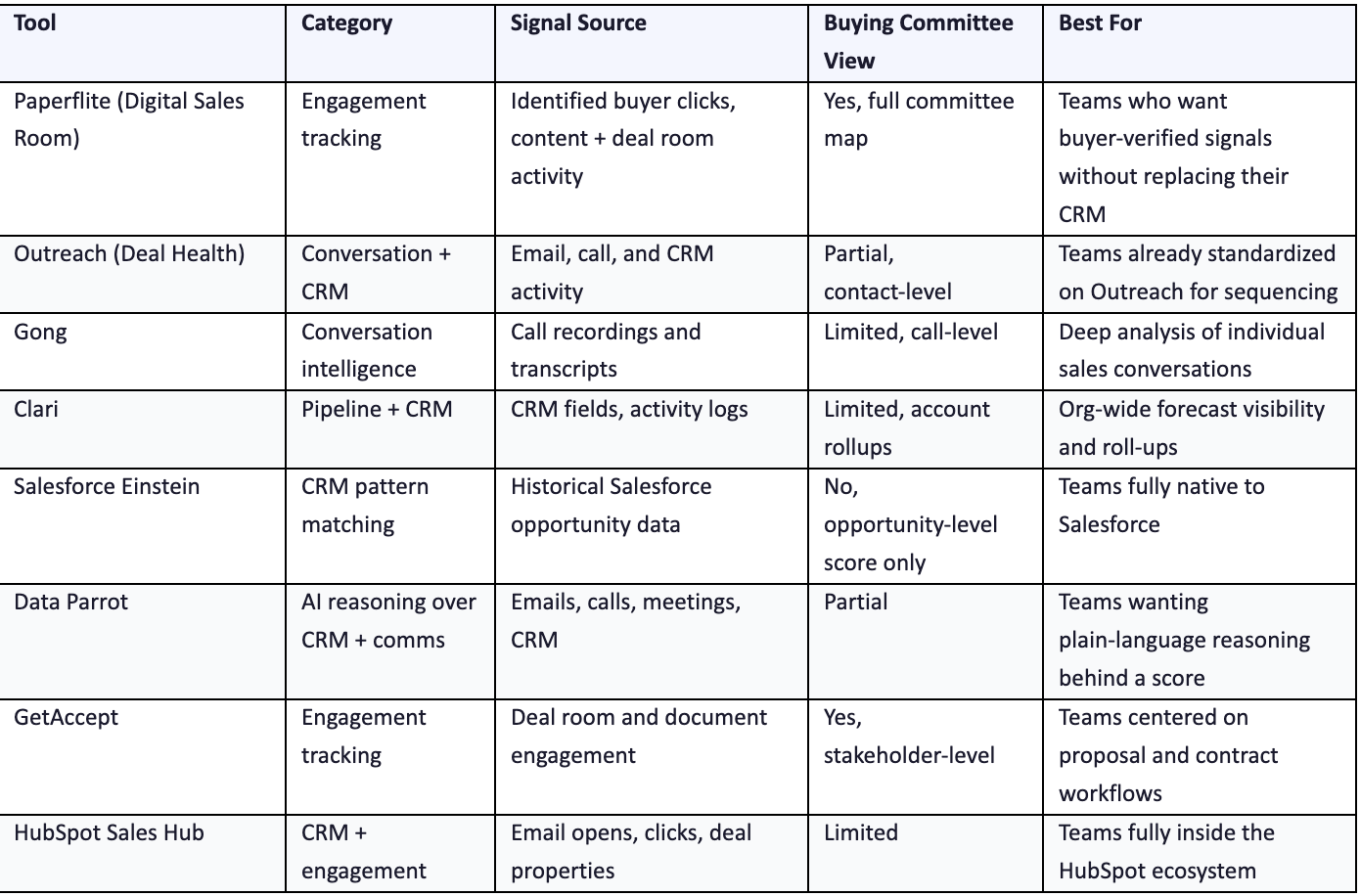
Paperflite (Digital Sales Room). Paperflite's DSR captures buyer identity from the first click, not through UTM guesswork, and shows a full buying committee map: who's engaged, who's missing, who just joined. It's built to sit alongside your existing CRM rather than replace it, which matters if your team has already invested a year of adoption effort into that CRM.
Outreach (Deal Health). Outreach's Deal Health feature is a machine-learning model that scores deals 0 to 100 against similar deals at similar stages, recalculated once daily from email, call, and CRM signals. It's a natural fit if your team already runs sequencing through Outreach and wants the health score in the same place.
Gong. Gong is excellent at dissecting a single call for sentiment, objections, and talk-time ratios. It's a call-level tool first, which means rolling those insights into one deal-wide health picture isn't its core strength, and teams often pair it with a separate forecasting layer.
Clari. Clari specializes in pipeline-level visibility and forecast roll-ups for revenue leadership, pulling from CRM data, activity logs, and, via its Copilot module, conversation intelligence. It's built more for the CRO's dashboard than the individual rep's daily workflow.
Salesforce Einstein. Einstein Opportunity Scoring assigns a 1 to 99 score based on how closely an opportunity matches historically won deals, updating automatically as Salesforce records change. The tradeoff is that it only knows what Salesforce knows, which loops back to the same rep-logged data problem.
Data Parrot. Data Parrot uses AI to analyze CRM activity, emails, calls, and meetings, then produces a health score alongside plain-language reasoning for why a deal looks strong or weak, which helps managers coach without digging through raw data themselves.
GetAccept. GetAccept tracks engagement inside deal rooms and proposals, similar in spirit to Paperflite's approach, with a focus on document and contract-stage workflows specifically rather than the full content lifecycle from first share onward.
HubSpot Sales Hub. HubSpot blends CRM deal properties with engagement tracking such as email opens and clicks inside its own ecosystem, useful for teams who run their full revenue motion through HubSpot already and don't want a separate tool to manage.
How Paperflite's Digital Sales Room Turns Buyer Engagement Into Deal Health Signals
Picture the deal from the intro again: proposal sent nine days ago, champion quiet, pipeline still marked green. Here's what that same deal looks like inside a Digital Sales Room instead.
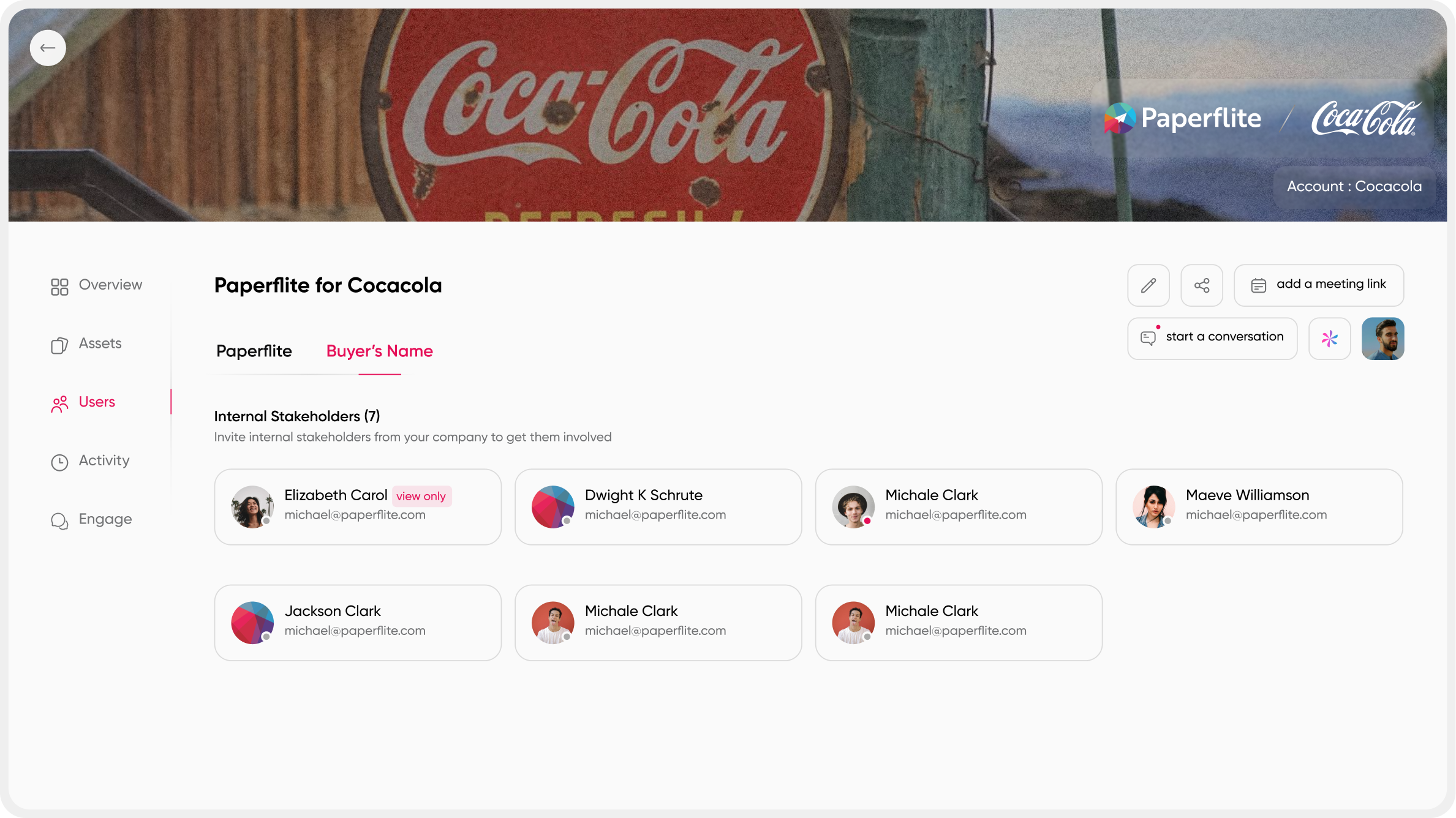
Paperflite's DSR captures buyer identity the moment someone clicks into the room, so you're looking at Sarah from Procurement and Mike from Finance by name, not an anonymous "3 visits" counter that could be the same person refreshing a page three times out of boredom. That single difference changes what a health signal even means. You're not staring at a number hoping it's right. You're looking at a room full of named people, doing or not doing things.
From there, the room shows you the full buying committee as it forms: who joined, who's missing, and who just showed up uninvited, which, incidentally, is usually good news since it means someone is building internal consensus on your behalf. It surfaces deal signals that go past opens and clicks: how deep someone read into a section, whether the pricing page got revisited at 9pm the night before a renewal deadline, whether engagement is spreading to new stakeholders or staying stuck with one contact who might not even have budget authority.
Buyer questions live inside the room too, tied to the actual deal context, instead of scattered across email threads and Slack messages nobody can find during a pipeline review. An unanswered question sitting in a deal room for four days is its own health signal, and a fairly loud one, since it usually means either the rep missed it or the answer requires someone more senior to weigh in.
None of this requires ripping out your CRM. Paperflite is built to sit inside the workflow you already run, including must-have Salesforce integrations for sales and marketing that push engagement data back where your team already looks for it. Content organization plays a role here too. Paperflite's content hub means the assets landing in that deal room are the right ones for the deal stage, not whatever a rep found first, and the 7 must have features of content hub it's built around are worth a look on their own if you're evaluating the platform end to end. Underneath both, Paperflite's content intelligence layer (SEEK for AI-powered search, Cleverstory for the interactive experience itself) is what makes sure the right asset surfaces in the first place, so the engagement data you're reading later is measuring the right content, not a stale deck from two quarters ago.
One honest note before you assume this is an AI black box: Paperflite's Advanced plan includes a named "Predictive deal insights" capability alongside the Digital Sales Room, but the platform's real strength is the same as its category's real strength everywhere on this list. It surfaces what buyers are actually doing so your team can act on evidence instead of a stage field. That's a different job than replacing your forecasting model entirely, and it's worth choosing a tool for what it's actually built to do rather than what a landing page implies it can do.
If the honest objection in your head right now is "great, one more login my reps will ignore by month two," it's a fair worry, and it's the reason stack fit made the list of five criteria earlier. A deal room only earns its keep if reps see it as the fastest way to share the right asset with a prospect, not as a reporting chore layered on top of their real job.
Teams that get the most out of a Digital Sales Room tend to be the ones who make it the default way content leaves the building, rather than an optional add-on reps remember to use only when a manager asks.
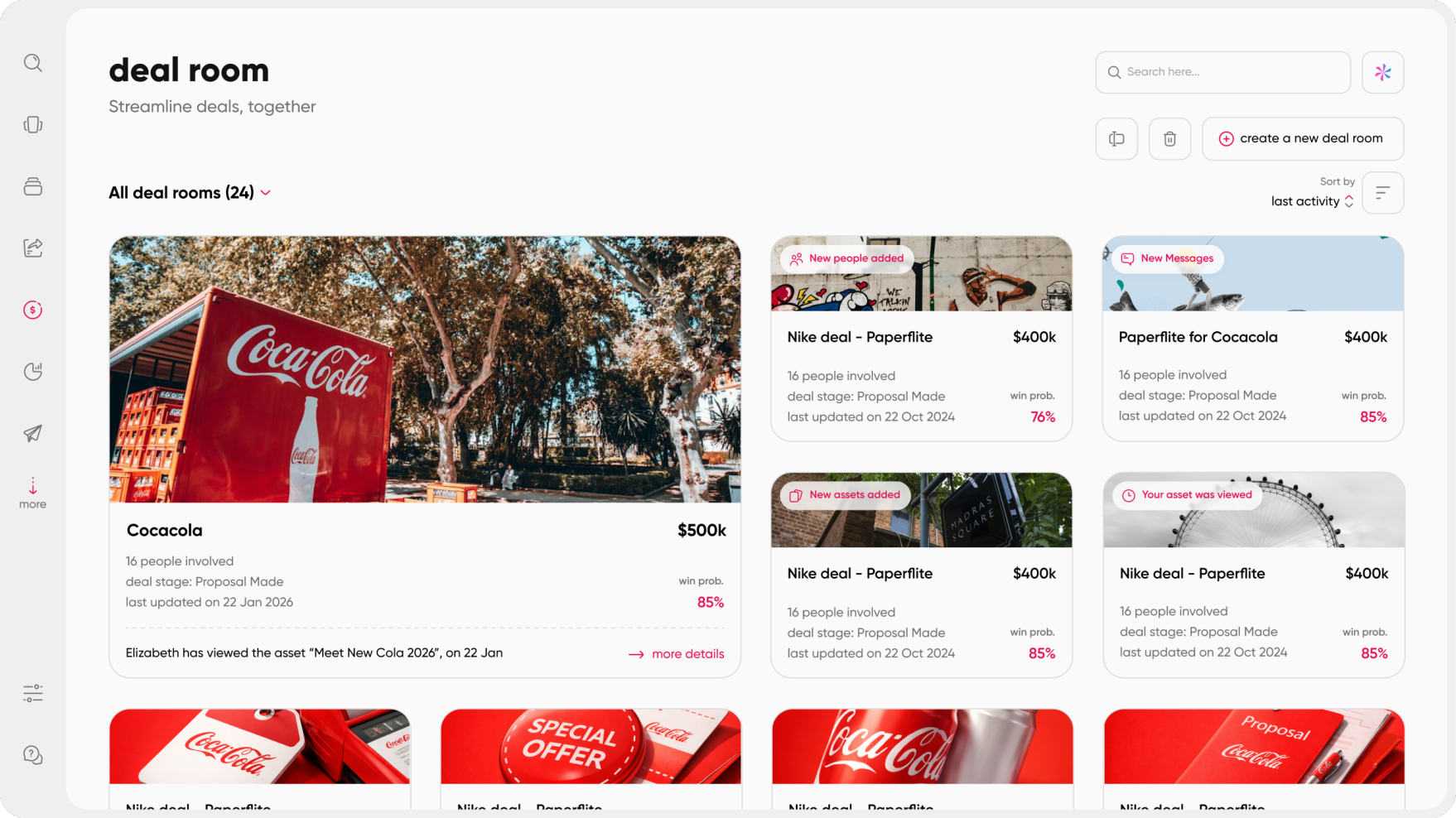
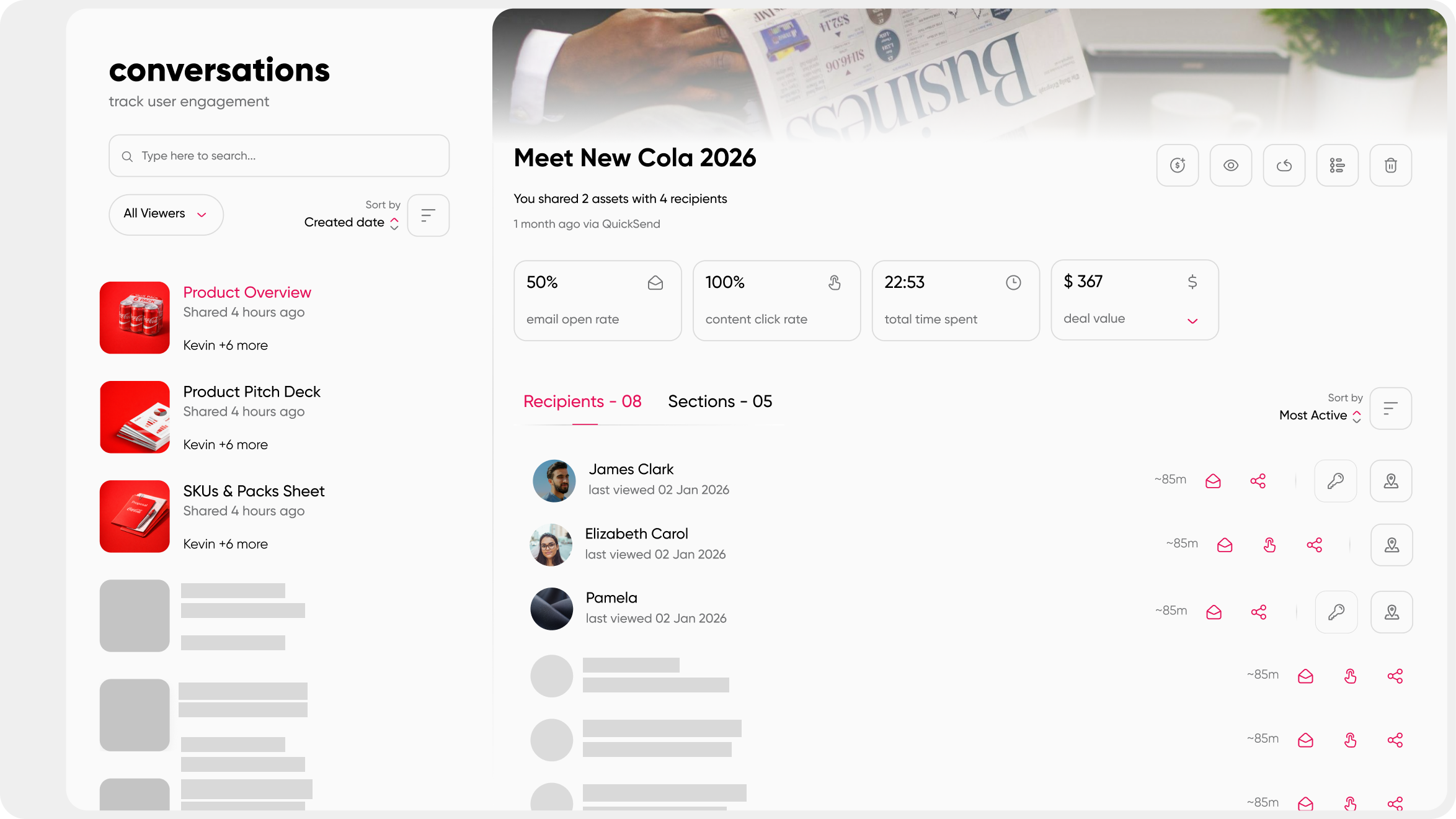
If you're currently piecing deal health together from a CRM stage field and a rep's word for it, seeing it laid out in a room instead is worth 20 minutes of your week. See how Paperflite's Digital Sales Room works with a live demo, no CRM migration required.
How to Actually Read Deal Health From Engagement Data (In Practice)
Buying a tool solves half the problem. Reading the signals correctly is the other half, and it's the part most teams skip past in the rush to get a dashboard live.
Check stakeholder count, not just activity count. Five opens from one contact is weaker than two opens each from three different people. Multi-threading is one of the strongest anti-stall signals across every deal health framework referenced in researching this piece, including one from Weflow, which pegs a healthy benchmark at roughly 6 to 8 emails a week on active deals, with at least 3 coming from the prospect's side, not the rep's.
Watch for engagement spreading to new roles, not staying put. A deal that only ever touches the person who requested the demo is still single-threaded no matter how many times they've logged back in. True progress looks like a second name, then a third, showing up in the room without you having to chase an introduction.
Treat silence after a content share as a signal, not a scheduling gap. A champion who reliably opened every share for six weeks and then goes quiet for ten days isn't just busy. Something changed, and it's worth a direct call before the deal quietly slips a quarter, rather than waiting for the forecast meeting to bring it up.
Cross-reference in-room questions against what the stage claims. If a deal is marked "Proposal" but there's an unanswered pricing question sitting in the room from last week, the stage is ahead of reality. Shorten your b2b sales cycle advice tends to agree on this point: the fastest-closing deals are the ones where questions get closed within a day, not carried into the next call as an afterthought.
Finally, review engagement weekly, not just at forecast time. A once-a-quarter glance at deal room activity means you're always reacting to a slip that already happened. A five-minute weekly scan across your top ten deals catches the quiet ones while there's still time to do something about it.
None of these habits require a new tool if you already have engagement data sitting somewhere. They require someone actually looking at it on a schedule, which is the part most teams intend to do and then quietly stop doing by the third busy week of the quarter.
Conclusion
There's no single tool that predicts deal health with certainty, and anything that claims otherwise is selling you a number, not an answer. What actually works is combining two lenses: conversation intelligence tools like Gong, Clari, and Salesforce Einstein that mine your CRM and call data, and engagement tracking tools like Paperflite's Digital Sales Room that show you what buyers do once content and deal rooms land in their hands.
If your pipeline reviews currently run on stage fields and optimism, start with the side of the equation that's easiest to trust: what the buyer actually did this week. Book a demo of Paperflite's Digital Sales Room and see your next deal's real engagement, not just its stage.
Frequently Asked Questions
What is a deal health score?
A deal health score is a calculated status or number, often on a 0 to 100 scale or a red, yellow, green rating, meant to show whether an open deal is likely to close. Most tools build it from a blend of pipeline stage, activity volume, and comparisons against previously won or lost deals at a similar point in the sales cycle.
How is deal health calculated?
It depends on the tool. Conversation intelligence platforms like Gong, Clari, and Salesforce Einstein calculate it from CRM fields, call recordings, and historical win patterns. Engagement tracking platforms like Paperflite's Digital Sales Room calculate it from what buyers actually do with shared content: who's engaging, how deeply, and across how many stakeholders.
Can content engagement predict whether a deal will close?
Content engagement is a strong leading indicator, not a guarantee. A deal where multiple stakeholders are actively reviewing shared material behaves differently than one with a single, shallow open, and that difference tends to show up in win rates. It works best paired with stakeholder spread rather than read on its own.
Are CRM-based deal health scores accurate?
They're only as accurate as the data feeding them. Since CRM stages and activity logs are largely rep-reported, a health score built entirely from CRM fields inherits any lag or bias in how consistently reps update those fields. Pairing CRM signals with buyer-side engagement data closes most of that gap.
What's the difference between a deal room and a deal health scoring tool?
A deal room, like Paperflite's Digital Sales Room, is a signal source: it shows you what buyers are doing with shared content and who's involved. A deal health scoring tool, like Outreach's Deal Health feature or Salesforce Einstein, is a model that takes signals (sometimes including deal room activity) and outputs a single score or status.
Does Paperflite predict deal health with AI?
Paperflite's Digital Sales Room surfaces buying committee engagement and deal signals in real time, and its Advanced plan includes a named "Predictive deal insights" capability. Its core strength, though, is showing you what buyers are actually doing rather than replacing your forecasting model outright, which is a meaningfully different job than the conversation intelligence platforms on this list.