Paperflite vs Highspot for Deal Rooms: What Changes When One Is Merging
Paperflite and Highspot both offer digital deal rooms, but they suit different teams. Highspot is a full enterprise enablement suite with deal rooms as one component of a larger platform built for 200-plus rep organizations. Paperflite is a content-first platform where deal rooms (called microsites) are a core capability, built for growing B2B teams that want personalized buyer experiences and engagement analytics without enterprise implementation overhead.
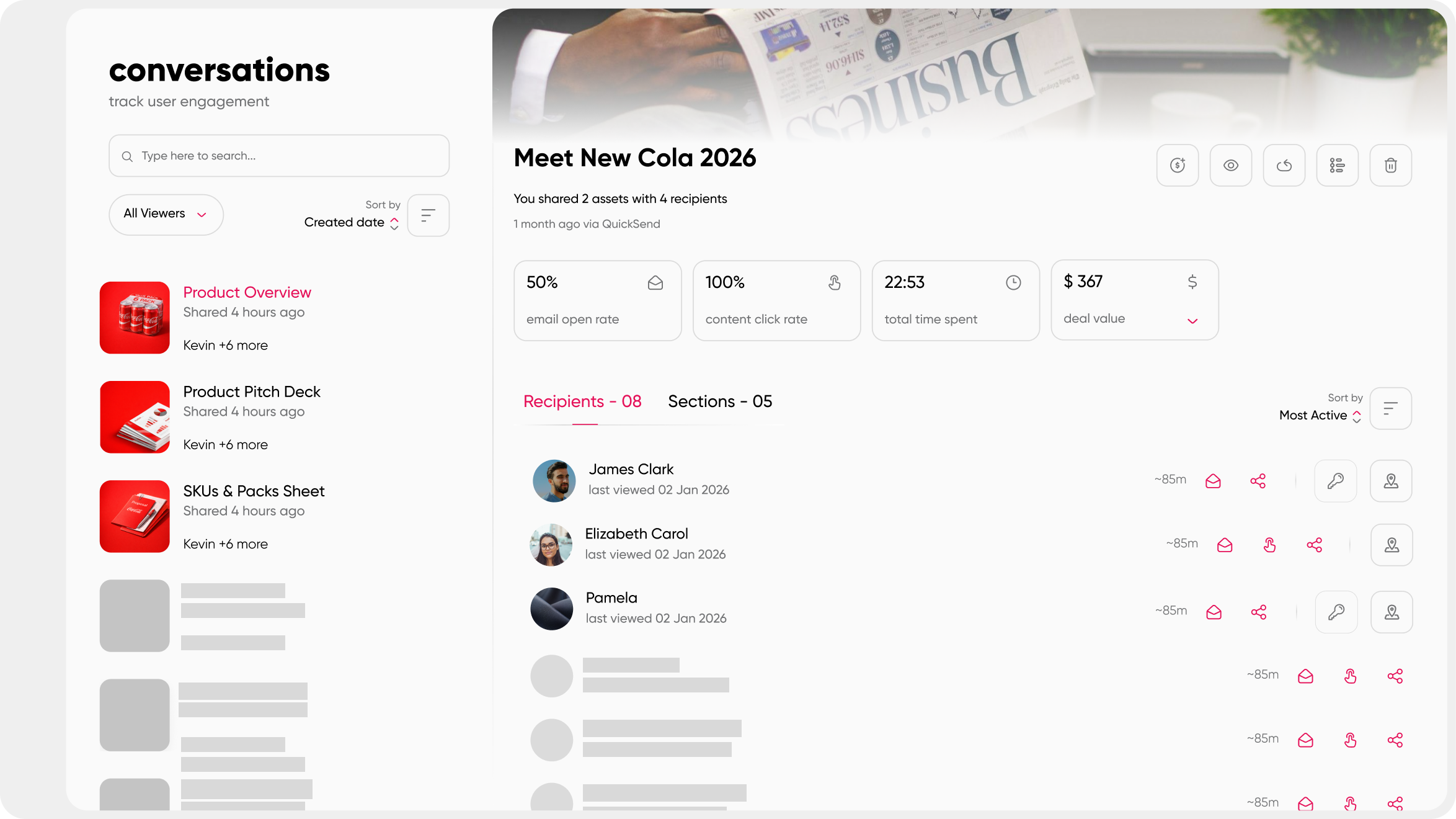
And by the way, if you're evaluating deal rooms. You've shortlisted Paperflite and Highspot. You run a quick search for a comparison and find half a dozen "Highspot alternatives" listicles that treat deal rooms as one checkbox on a feature grid. None of them address the question that's probably in the back of your mind: Highspot announced a merger with Seismic in February 2026. What does that mean for a deal room decision you're making today?
This guide gives you the comparison you're actually looking for: how Paperflite and Highspot deal rooms differ in feature depth, design philosophy, pricing, deployment timeline, and what the merger means for buyers evaluating Highspot right now. It's written from Paperflite's perspective, so you'll see where we think Paperflite is the right choice. But it also names where Highspot is genuinely stronger, because a comparison that only tells you one thing is an advertisement.
Start with the category context: What is a Digital Sales Room and How Does it Help Sales?.
What Deal Rooms Are (And the Two Different Philosophies Behind Them)
The fundamental difference between Paperflite and Highspot is product philosophy. Paperflite is a content-first platform where deal rooms are the primary buyer-facing output. Highspot is a full-suite enterprise enablement platform where deal rooms are one component alongside training, coaching, and content governance. The right choice depends on whether you're primarily solving a deal room and content problem, or a whole-of-enablement problem.
What a Deal Room Is
A digital deal room is a shared, branded, tracked workspace where a rep and a buying team collaborate on an active deal. It typically includes curated content (case studies, proposals, ROI models, security documentation), stakeholder access tracking, mutual action plans, and sometimes communication threads. The defining characteristic that separates a deal room from a shared Google Drive folder: it's buyer-facing, deal-specific, and every interaction generates behavioral data the rep can act on.
Paperflite's Approach: Content-First
Paperflite is built around a governed content library with AI-powered search at its core. Deal rooms, called microsites in Paperflite's terminology, are the buyer-facing layer on top of that library. A rep selects assets from the library, builds a personalized microsite, shares it via a single tracked link, and receives real-time data on what the buyer does with it: which sections they read, how long they stayed, whether they forwarded it internally. The deal room is where the content intelligence becomes visible to the buyer and the rep simultaneously.
Highspot's Approach: Full Enablement Suite
Highspot is a full-suite enterprise enablement platform. Its core purpose is to unify content management, sales playbooks, training, coaching, and conversation intelligence into one platform for large revenue organizations. Deal rooms were added as a feature within that broader suite. For teams that need the full stack, that integration is valuable. For teams that primarily need deal rooms and content management, it means paying for significant capabilities they may not use.
For the specific deal room use case, see What can a digital sales room do for you? for a capability overview.
Deal Room Features: Side by Side
Highspot has digital deal rooms, added as part of its enterprise platform. Per independent analysis from Dock.us, Highspot deal rooms function as branded file repositories: documents can be shared with basic engagement tracking, but interactive pricing, buyer task assignment, and joint project plans in real time are not native features. Paperflite's microsites offer section-level engagement data, multi-stakeholder forwarding detection, and content-to-revenue attribution as core capabilities.
Paperflite Deal Rooms (Microsites)
Available from the Advanced plan tier. The following features are verified from the Paperflite product page, Capterra reviews, and GetApp listings as of June 2026:
- Branded, personalized microsites built from the governed content library and shared via a single tracked link
- Section-level and asset-level engagement tracking: time per page, which document sections received attention, video watch-time if video is embedded
- Multi-stakeholder forwarding detection: when a buyer shares the microsite link internally, new viewers are identified and linked to the deal in the CRM automatically
- Real-time rep notifications when any viewer opens or engages with content inside the microsite
- SEEK AI-powered search surfaces the most relevant assets for a deal context automatically, based on deal stage, industry, and persona
- Embeddable video, documents, and external links in a single curated buyer experience
- No separate admin layer required: a rep builds the microsite directly from their content library in the same interface they search
- Mutual action plan and deal room collaboration capabilities available in the Advanced tier
- CRM integration: engagement data surfaces inline on Salesforce, HubSpot, Pipedrive, and Freshsales opportunity records without manual entry
Highspot Deal Rooms
Available as part of Highspot's enterprise platform. Features verified from Highspot's product documentation, GetApp, and independent analysis from Dock.us (the most comprehensive third-party evaluation available as of June 2026):
- Branded, shareable content collections for specific buyers
- Document sharing with engagement tracking
- Integrated with Highspot's broader content governance system and sales playbooks
- Per Dock.us independent analysis: Highspot deal rooms 'function more like branded file repositories.' Documents can be shared but interactive pricing, buyer task assignment, and joint project plans in real time are not supported as native features.
- Highspot's deal rooms are positioned as one component within a much larger platform
- Full Highspot capabilities (training, coaching, conversation intelligence, AI role-play) are available alongside deal rooms and add cost and configuration overhead
Full side-by-side comparison:
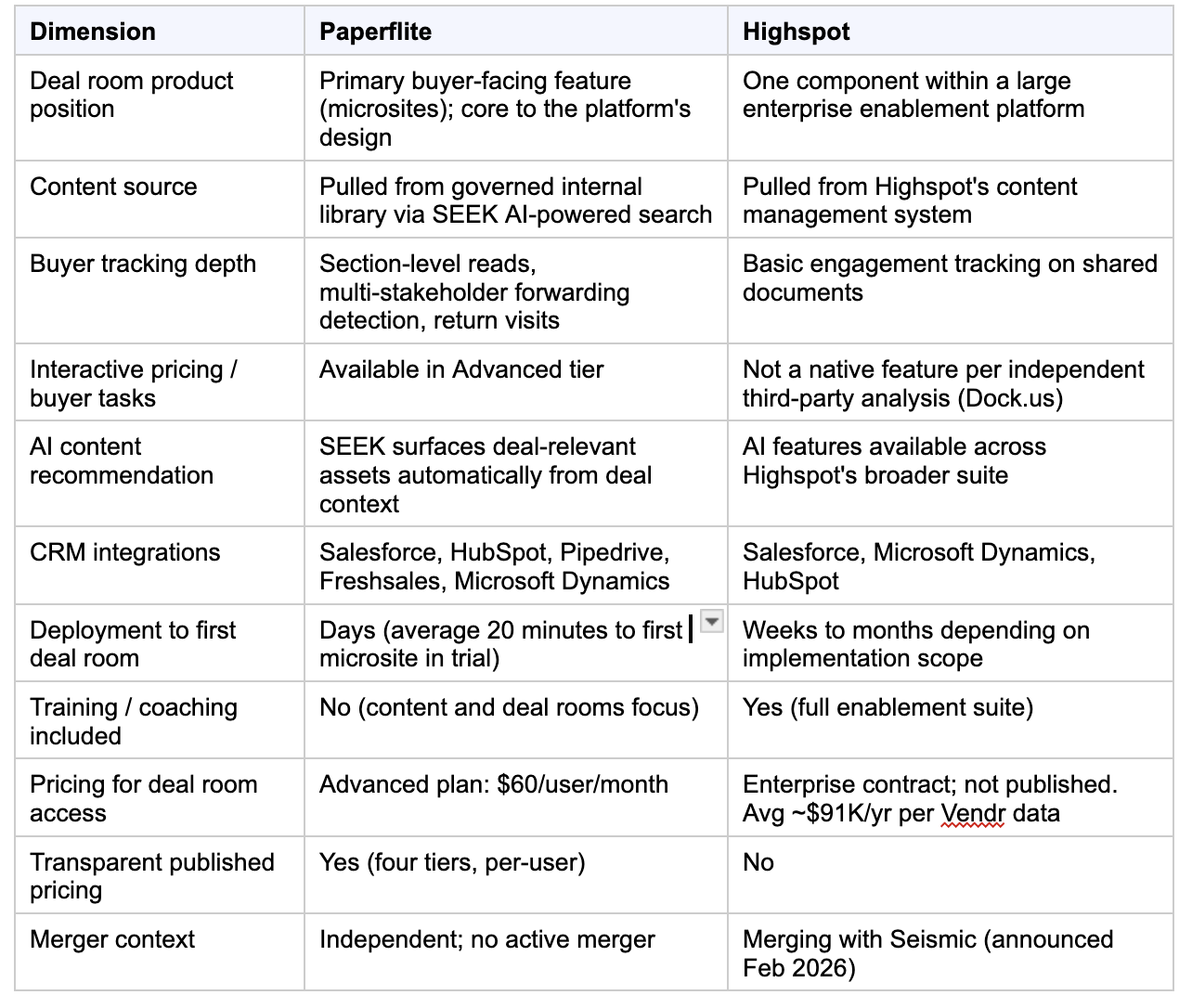
For the full deal room feature criteria: What are important features of a digital sales room?.
Pricing Comparison
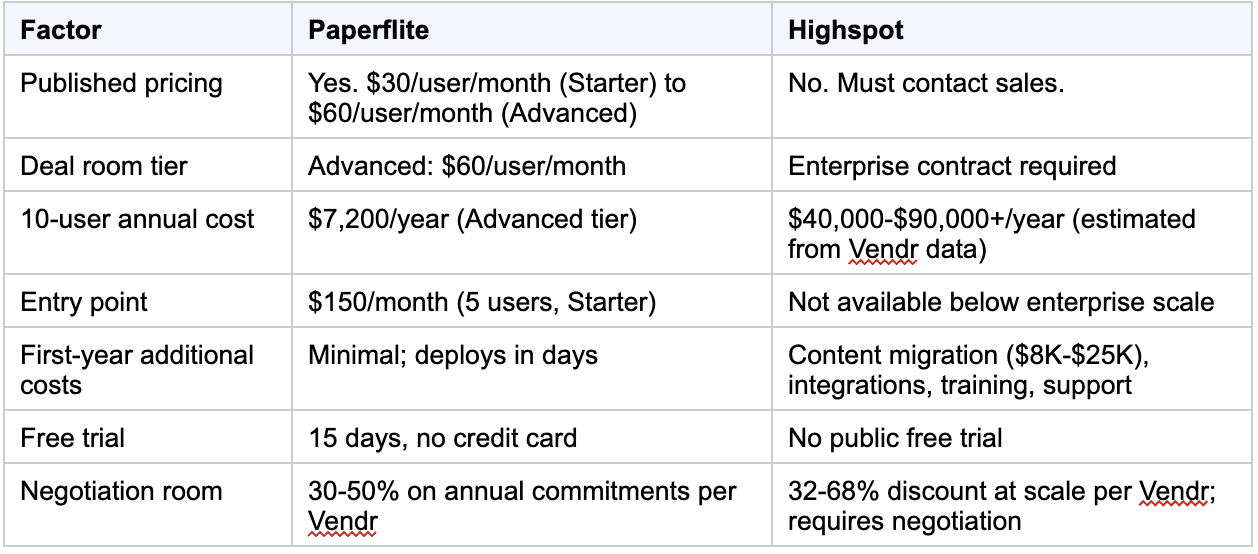
Paperflite publishes transparent per-user pricing. Deal room capabilities are available on the Advanced plan at $60/user/month. A 10-user team pays $7,200/year. Highspot does not publish pricing; Vendr benchmarking shows average contracts around $91,000/year, with first-year implementation costs (content migration, integrations, training, support) adding $30,000 to $70,000 above the license. The pricing gap reflects the scope difference: Highspot includes training, coaching, and conversation intelligence; Paperflite focuses on content management and deal rooms.
Paperflite Pricing
Starter ('I Got Wings'): $30/user/month, minimum 5 users. Entry point $150/month. Includes content hub, SEEK AI-powered search, storage sync (Google Drive, SharePoint, Dropbox), basic microsite sharing.
Professional ('I Believe I Can Fly'): $50/user/month. Adds CRM integrations (Salesforce, HubSpot, Pipedrive, Freshsales, Microsoft Dynamics), white labeling, SSO, and a dedicated Customer Success Manager.
Advanced ('Touch The Sky'): $60/user/month. Adds full digital deal rooms with mutual action plans, predictive Deal Insights, and AI-powered content recommendations. This is the tier where the full microsite capabilities described above are available.
Enterprise: Custom quote. Adds deeper Salesforce integrations, custom reporting, language localization, and advanced security configurations.
15-day free trial available, no credit card required. Paperflite is SOC 2 Type II certified. Vendr benchmarking shows real contracts ranging from $5,000 to $24,000 annually, averaging around $14,400, with 30 to 50% negotiation room on annual commitments.
Highspot Pricing
Highspot does not publish pricing. From Vendr deal data and Prospeo's independent analysis:
- No published per-user rate. The Professional Edition is cited at approximately $630/user/year at list price; Enterprise Premier scales to approximately $494/user/year at volume.
- Average contract value: approximately $91,000/year per Vendr benchmarking. A 100-seat deal typically lands around $42,714/year at a median 42% discount; 500-seat deals see median 57% off.
- Paid add-ons above the base license: Highspot Copilot (AI features), Advanced Analytics, Premium Marketplace.
- First-year costs beyond the license: content migration ($8K-$25K), custom integrations ($5K-$15K each), training ($10K-$30K), premium support ($12K-$25K/year). Professional services typically add 15-25% to first-year costs.
The Pricing Gap in Plain Terms
For a 10-person B2B sales team evaluating deal rooms as the primary use case: Paperflite Advanced tier costs approximately $7,200/year. A comparable Highspot contract runs $40,000 to $90,000 or more annually, plus first-year implementation costs. Whether that gap is justified depends entirely on whether the team needs Highspot's full enablement suite, including training, coaching, AI role-play, and conversation intelligence, alongside the deal room capability. For teams that need deal rooms and content management and nothing else, the pricing gap is the most important single factor in this comparison.
Sales Content Management Guide covers the full content management layer that sits beneath both platforms' deal room capabilities.
The Merger Factor: What the Highspot and Seismic Combination Means for Your Deal Room Decision
This is the section most comparison articles skip. It's also the one most relevant to buyers evaluating Highspot right now.
What Happened
Highspot and Seismic signed a definitive merger agreement on February 12, 2026. The combined entity will operate under the Seismic name, led by Seismic CEO Rob Tarkoff, with Highspot CEO Robert Wahbe joining the board. Highspot had raised $650M since 2011 at a peak $3.5B valuation. Seismic was valued at $3B in 2021 and serves roughly 2,000 customers worldwide. Independent analysts expect 12 to 18 months before a unified platform emerges from the integration.
What Gartner's Advisory Says
Gartner's published guidance for customers of platforms involved in mergers includes the following direction (summarized, not quoted directly): keep renewals to one year maximum; negotiate price protections and opt-out provisions upfront before integration begins; secure data egress rights now while the platforms are still separate; and begin evaluating AI-native alternatives as a diversification strategy rather than waiting for the combined roadmap to crystallize.
What This Means Specifically for Deal Room Buyers
A deal room is stickier than a content library. The URLs, content structures, and engagement history in a deal room are referenced throughout a sales cycle and often into the customer lifecycle. If the Highspot/Seismic combined platform architecture shifts deal room features to Seismic's technical infrastructure, existing deal room configurations may require migration or rebuilding.
For buyers evaluating now, the practical implications are: if you're signing with Highspot, build one-year renewal terms and specific merger-related opt-out provisions into the contract rather than committing to multi-year pricing. If your organization is starting from a clean slate with no existing Highspot investment, the merger context makes a focused alternative worth evaluating before committing to a platform whose roadmap is in transition.
What the Merger Doesn't Mean
It doesn't mean Highspot is a bad choice today. The platform continues to operate normally, and for teams already deeply embedded in the Highspot ecosystem, the disruption cost of switching during an integration period may exceed the uncertainty of staying. The merger is a procurement factor to be managed, not a reason to abandon a platform that's working. For buyers already mid-implementation with Highspot, the right move is to negotiate contract protections, not necessarily to restart the evaluation.
Which Team Should Choose Which Platform?
Choose Paperflite for deal rooms if your team is under 100 users, deal rooms and content management are the primary use case, you need to deploy in days, and you want transparent pricing without enterprise implementation overhead. Choose Highspot if you have 200-plus reps, need training, coaching, and content management in a single platform, have a dedicated enablement team, and are prepared for a 6-12 month implementation cycle and an enterprise contract.
Choose Paperflite Deal Rooms If
- Your team is 5 to 100 users and deal rooms plus content management are the primary use case, not a companion to a full training and coaching program
- You need to deploy in days, not months. Paperflite was tested at first microsite within 20 minutes of trial signup.
- Transparent pricing matters: you want to know what you're paying before talking to sales
- You need section-level buyer engagement analytics (which part of a proposal a buyer spent the most time on) as a core deal room feature, not a premium add-on
- Enable sales managers with buyer engagement data they can use to coach reps on follow-ups, messaging, and content usage. It may not replace a full coaching or LMS platform, but it shows what buyers consumed, who engaged, and which assets helped move the deal forward.
- The Highspot/Seismic merger uncertainty increases the risk threshold of committing to a multi-year enterprise contract right now
- Your CRM ecosystem extends beyond Salesforce to HubSpot, Pipedrive, Freshsales, or Freshworks, where Paperflite has broader native coverage
- You're a growing B2B SaaS, mid-market, or professional services team building your content and buyer experience layer for the first time
Choose Highspot If
- Your team has 200-plus reps with complex, multi-territory content governance requirements that justify a full enablement platform
- You need sales training, AI role-play, coaching, conversation intelligence, and content management in a single platform, and the ROI of reducing tool sprawl justifies the cost and implementation time
- You have a dedicated enablement team and the budget and timeline for a 6 to 12 month implementation
- You're already embedded in the Highspot ecosystem with existing playbooks, training content, and workflow integrations that would be materially costly to rebuild
- You can negotiate one-year contract terms with merger protections built in, following Gartner's advisory, rather than locking into a multi-year commitment at current pricing
The Honest Middle Ground
Some buyers will outgrow Paperflite. The platform is focused on content and deal rooms, not on training and coaching. Teams that eventually need sales onboarding programs, AI role-play, and performance analytics alongside deal rooms will either need to add separate tools or migrate to a full suite. Paperflite is the right starting point and the right long-term choice for teams whose primary need is content and buyer experience. It's not the final destination for every team. Knowing that going in means you make the decision clearly rather than discovering it twelve months later.
7 Key Benefits of Sales Enablement You Can't Afford to Miss and What is Sales Enablement? Tools, Functions and Resources for the broader context both platforms sit within.
Getting Started with Paperflite Deal Rooms
Paperflite is a strong fit when your team wants deal rooms, content management, buyer engagement analytics, and AI-assisted content discovery in one connected workflow, without taking on the weight of a full enterprise training and coaching suite.
With Paperflite, teams can build personalized microsites, organize sales content in a central hub, use SEEK for AI-powered content discovery, and track how buyers engage with shared content. In our hands-on test, the first microsite was created within 20 minutes of trial signup.
That speed matters. For growing B2B SaaS, mid-market, and professional services teams, the problem is rarely “we need a six-month enablement transformation.” It is usually much simpler: reps need the right content, buyers need one clean place to review it, and managers need visibility into what is actually moving the deal forward.
Paperflite’s deal rooms are built around that workflow. A deal room becomes a shared buyer workspace for key assets, stakeholders, questions, next steps, pricing, proof, and follow-up. Instead of sending five links across ten emails, sellers can give buyers one guided space where the deal can keep moving.
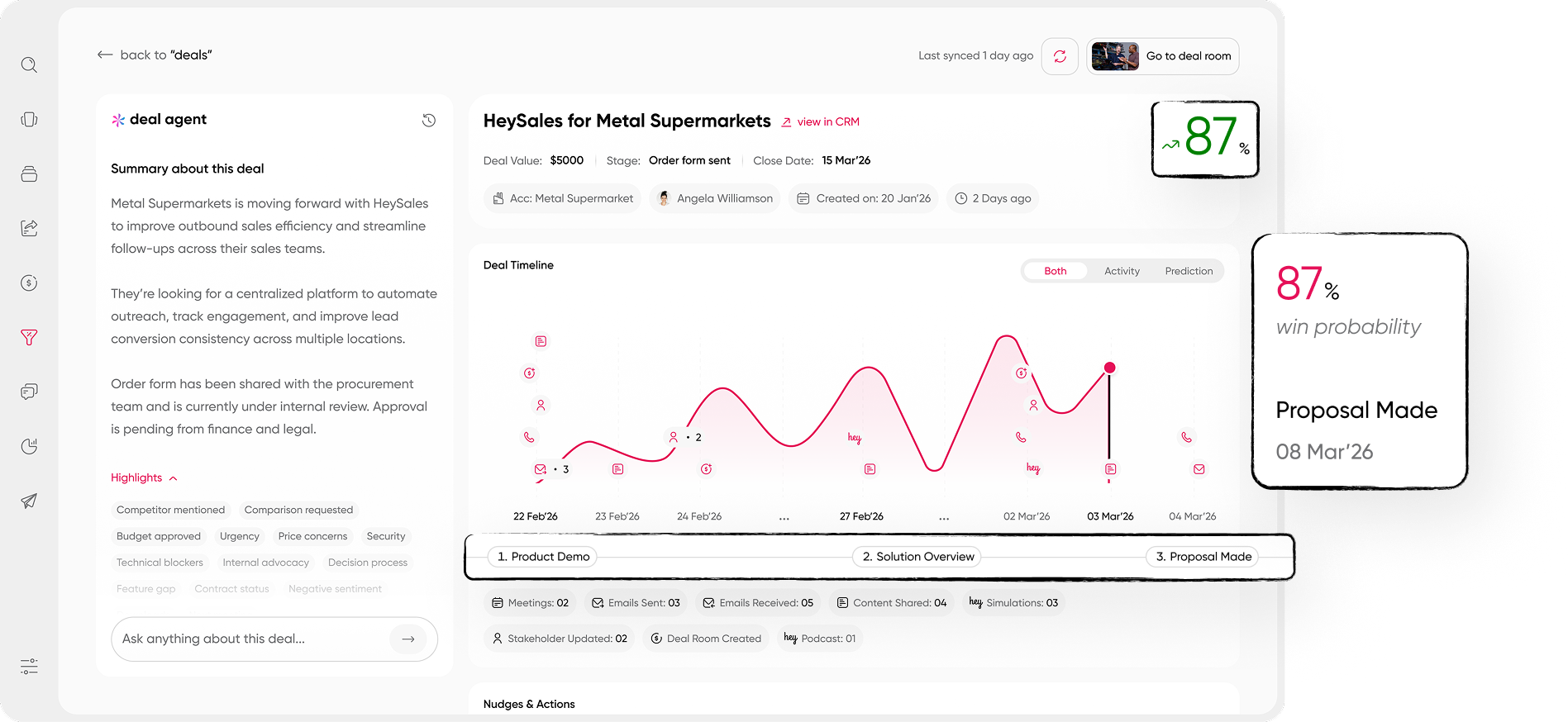
The engagement layer is where Paperflite becomes more than a content-sharing tool. Teams can track depth of engagement, stakeholder activity, priority signals, and which assets or sections buyers spend time on. That gives reps better follow-up context and gives managers a practical coaching layer: what content was shared, who engaged, what mattered, and where the deal may be stalling.
Paperflite’s Advanced plan includes AI-powered content recommendations, content personalization at scale, digital deal rooms, and predictive deal insights at $60/user/month. Starter is listed at $30/user/month, Professional at $50/user/month, and Enterprise is available as a custom plan.
Conclusion
Paperflite and Highspot both offer deal rooms. They're built for different teams with different problems, and the comparison is more straightforward than most listicles make it look.
Highspot is the right choice for large organizations that need training, coaching, and content governance in a unified platform, and are prepared for the implementation, cost, and, currently, merger uncertainty that entails. Paperflite is the right choice for growing B2B teams that need deal rooms and content intelligence, want to be live in days, and don't want to pay for capabilities they'll never use. The Seismic merger adds a timing dimension: if you're evaluating Highspot seriously, negotiate one-year terms with merger protections now rather than after the integration has progressed further.
What can a digital sales room do for you? and What are important features of a digital sales room? give you the criteria to evaluate any deal room platform against the same standard.
Frequently Asked Questions
What is the difference between Paperflite and Highspot for deal rooms?
Paperflite is a content-first platform where deal rooms (called microsites) are a primary capability, built for growing B2B teams. Highspot is a full enterprise enablement suite where deal rooms are one component alongside training, coaching, and content governance. Paperflite deal rooms offer section-level engagement analytics and multi-stakeholder forwarding detection as core features. Highspot deal rooms function more as branded file repositories, with document sharing and basic tracking but without native interactive pricing or buyer task assignment, per independent analysis from Dock.us. Paperflite deploys in days; Highspot typically requires weeks to months.
Does Highspot have digital deal rooms?
Yes. Highspot added digital deal rooms as a feature within its enterprise enablement platform. Per independent analysis from Dock.us, Highspot deal rooms currently function as branded file repositories: documents can be shared with engagement tracking, but features like interactive pricing, buyer task assignment, and joint project plans in real time are not supported as native features. Highspot positions deal rooms as one component of a larger platform rather than a primary use case.
What is Paperflite's deal room feature called?
Paperflite calls its deal rooms microsites. They are available from the Advanced plan ($60/user/month) and allow reps to build branded, personalized buyer experiences from their governed content library, share them via a single tracked link, and receive real-time engagement data including section-level reads, multi-stakeholder forwarding detection, and deal-stage insights surfaced directly in the connected CRM.
How does Paperflite pricing compare to Highspot for deal rooms?
Paperflite publishes transparent pricing. Deal room capabilities are fully available on the Advanced plan at $60/user/month (minimum 5 users), putting a 10-person team at $7,200/year. Highspot does not publish pricing; Vendr benchmarking shows average contracts around $91,000/year for typical enterprise deals, with first-year implementation costs (content migration, integrations, training, support) adding $30,000 to $70,000 above the license. The pricing gap reflects scope: Highspot includes training, coaching, and conversation intelligence; Paperflite focuses on content management and deal rooms.
What does the Highspot and Seismic merger mean for a deal room decision?
Highspot and Seismic announced a definitive merger in February 2026. The combined entity will operate under the Seismic name. Gartner's advisory for customers is to keep renewals to one year, negotiate price and opt-out protections, and secure data egress rights before platforms merge. For deal room buyers specifically, deal rooms are sticky: the URLs, content structures, and engagement history may require migration if the combined platform architecture shifts. Buyers evaluating Highspot now should build merger protections into contract terms rather than signing multi-year commitments.
Is Paperflite better than Highspot for small teams?
For teams under 100 users whose primary need is deal rooms and content management, Paperflite is typically the stronger fit. Pricing is accessible ($150/month entry point), deployment is measured in days rather than months, and deal room capabilities (section-level engagement, multi-stakeholder tracking, content-to-revenue analytics) are core to the platform. Highspot is purpose-built for enterprise organizations with 200-plus reps, dedicated enablement teams, and the budget and timeline for a full platform implementation.
Can Paperflite replace Highspot entirely?
For teams whose primary need is content management and buyer-facing deal rooms, Paperflite covers the core use case. For teams that also need built-in sales training, AI role-play, onboarding programs, and conversation intelligence in the same platform, Paperflite does not currently offer those capabilities. Paperflite is the right choice for many teams, but teams that specifically need the training and coaching layer alongside deal rooms would need to evaluate whether to run Paperflite alongside a separate enablement tool or choose a full suite.
What CRMs does Paperflite's deal room integrate with?
Paperflite's deal rooms integrate with Salesforce, HubSpot, Pipedrive, Freshsales, and Microsoft Dynamics (available on the Professional plan and above), as well as Salesloft, Outreach, Gmail, and Outlook for rep workflow. Engagement data from deal room interactions (views, section reads, forwards) surfaces automatically in the connected CRM's deal records without manual data entry. Highspot's primary CRM integrations are Salesforce, Microsoft Dynamics, and HubSpot.