Which Tool Tracks Buyer Engagement by Asset? A Practical Comparison
A prospect opens your proposal. Then they open it again the next morning. Then they go quiet on email for four days, and when they finally reply, they mention a competitor by name. Something happened in that gap, you just don't know what. Maybe they forwarded the pricing page to their CFO. Maybe they never made it past slide three. Maybe a totally different stakeholder opened the deck and you never even knew they existed.
This is the exact problem that "tracking buyer engagement by asset" is meant to solve. Instead of one vague activity signal ("they were active"), you get engagement broken down by the individual document, video, or page a buyer actually spent time on. That's a very different question from the one most sales tools answer, and picking the wrong tool for it means you're still guessing.
The best tools for tracking buyer engagement by asset show you which specific document, video, or page a buyer opened, how long they spent on it, and who they shared it with, not just whether a link was clicked. Platforms like Paperflite tie every one of those interactions back to a specific person from the first click, so asset-level activity rolls up into a real picture of who's actually engaged in the deal.
This piece walks through what asset-level engagement tracking actually means, what separates a real tracking tool from a glorified read-receipt, and how the major options (document trackers, sales engagement platforms, enterprise enablement suites, and Paperflite) stack up when you put them side by side.
What "Tracking Buyer Engagement by Asset" Actually Means
Tracking buyer engagement by asset means measuring interaction at the level of an individual piece of content, this one-pager, that pricing sheet, this specific product video, rather than lumping everything into a single "engagement score." It's the difference between knowing someone was active in a deal and knowing exactly what they were looking at when they decided to go quiet.
Most CRMs and sales engagement platforms track activity, not assets. A logged call, a sent email, a meeting on the calendar. Useful information, but none of it tells you what the buyer actually did with the content management you sent them. Asset-level tracking fills that gap. It answers questions like: did they open the case study at all? Did they skim it or read every page? Did they come back to the security one-pager three separate times in one week (a pretty strong signal, by the way)?
The distinction matters because content is doing more of the selling than it used to. A buyer might read a case study, watch a demo video, and skim a pricing deck all before your rep gets on a second call. If your tool only tells you "there was activity," you're flying blind on which piece of content actually moved them.
Think about how you personally research a purchase outside of work. Before you book a flight, you don't just click "buy" off one ad. You check a couple of review sites, compare a couple of airlines, maybe watch a video walkthrough of the seat you're worried about. Each of those touchpoints tells a very specific story about what you care about (legroom, price, layover length).
A B2B buyer does the same thing with your content, just with higher stakes and more people involved in the decision. A tool that only tells you "they were on your site" is giving you the equivalent of "someone looked at travel websites." Not exactly actionable.
This is also why the word "asset" matters more than "content" in this conversation. Content is a catch-all. An asset is something specific and trackable: this PDF, this video, this microsite. When a tool talks about tracking engagement "by asset," it's making a promise that it can tell the two apart, not just report one combined score for everything you've ever sent someone.
What to Look For in a Buyer Engagement Tracking Tool
Not every tool that claims to "track engagement" is built the same way underneath. Before comparing specific platforms, it helps to know what separates the tools that give you real signal from the ones that just send you a notification when a link is clicked.
Per-Asset Granularity
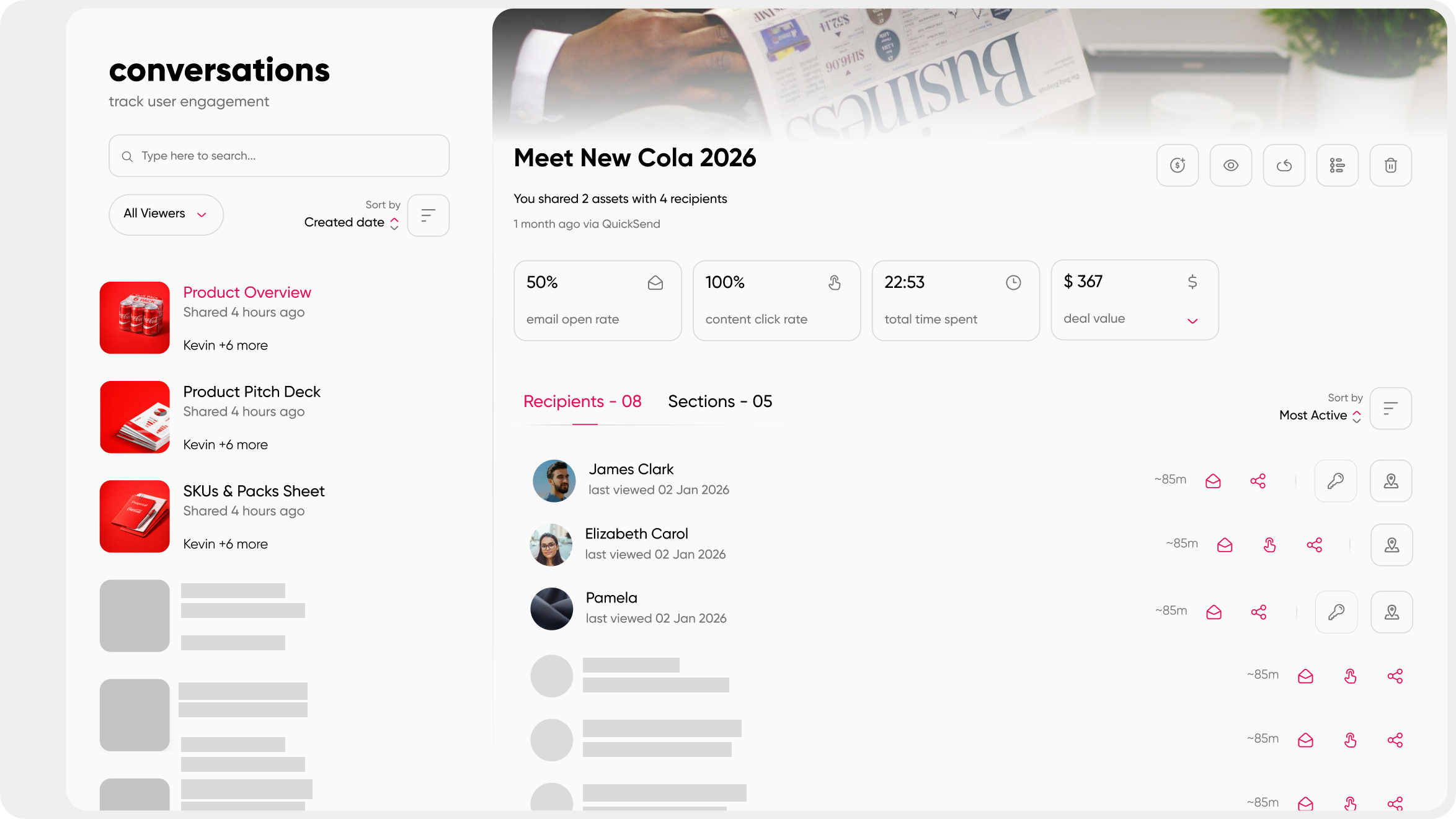
The first question is simple: does the tool show engagement at the level of the individual document or page, or does it just tell you a link was opened? A lot of tools stop at "opened." The useful ones go further, showing how long a viewer spent on each page or section, whether they scrolled through the whole thing, and whether they came back a second time.
This granularity is what separates a tracking tool from a notification system. Getting pinged that "your document was viewed" is nice, but it doesn't tell your rep what to say on the next call. Knowing that a prospect spent four minutes on the ROI slide and skipped the team bios entirely gives your rep something concrete to open with.
Buyer Identity, Not Just Link Activity
A lot of tools quietly fall short here. Anyone can tell you a link was clicked. Fewer tools can tell you who clicked it, especially the first time, before that person has filled out a form or replied to an email. Some platforms try to reconstruct identity after the fact by matching UTM parameters back to a contact record. That works sometimes. It also breaks the moment a link gets forwarded, opened on a different device, or clicked from inside an email client that strips tracking parameters.
The tools worth paying attention to solve this differently: they capture identity at the point of first click, usually through a personalized link or microsite tied to that specific person, rather than trying to piece it together after the fact from imperfect data.
Multi-Stakeholder Visibility
B2B deals rarely have one buyer. There's the person who replied to your first email, sure, but there's also the finance lead who's going to review the pricing sheet, the technical evaluator who cares about the security one-pager, and the executive sponsor who might only look at one slide before deciding whether the deal is worth their attention. A tool that only tracks the one named contact you have is only showing you a fraction of the room.
Real Deal Signals Versus Vanity Metrics
An open is weak signal on its own. A click is weaker still (bots and email previewers trigger plenty of false positives). What actually tells you something is depth of engagement, how many stakeholders are involved, and whether interest is holding steady or building. A tool that just reports raw open counts is handing you noise and calling it insight.
Why This Matters More as Deals Get Longer
B2B sales cycles have stretched out. More people sign off on purchases now than they used to, and each of those people wants to do their own homework before a rep ever gets them on a call. That means more of the actual persuasion is happening inside your content, quietly, without anyone on your team in the room to see it happen.
Here's the practical version of that problem. Say five people touch a deal: the champion who first reached out, a technical evaluator, a finance approver, and two people in the buying committee who never reply to a single email but absolutely have veto power. If your tracking tool only shows you what the champion did, you're managing the deal with 20 percent visibility and calling it full context.
This is also why "who engaged" ends up mattering as much as "how much they engaged." A pricing sheet that got opened once by the champion is a very different signal than the same pricing sheet getting opened three separate times by three different people from the same account. The second scenario tells you the deal has real internal momentum. The first one just tells you somebody clicked a link.
There's a follow-up question worth asking here too: what do you actually do once you have this visibility? Knowing that the finance approver just spent six minutes on the security page is only useful if that information reaches your rep before the next call, not buried in a dashboard nobody checks. The tools that get this right surface engagement in near real time, ideally right where the rep is already working, rather than requiring someone to log in and pull a report after the fact.
How the Major Tools Compare on Asset-Level Tracking
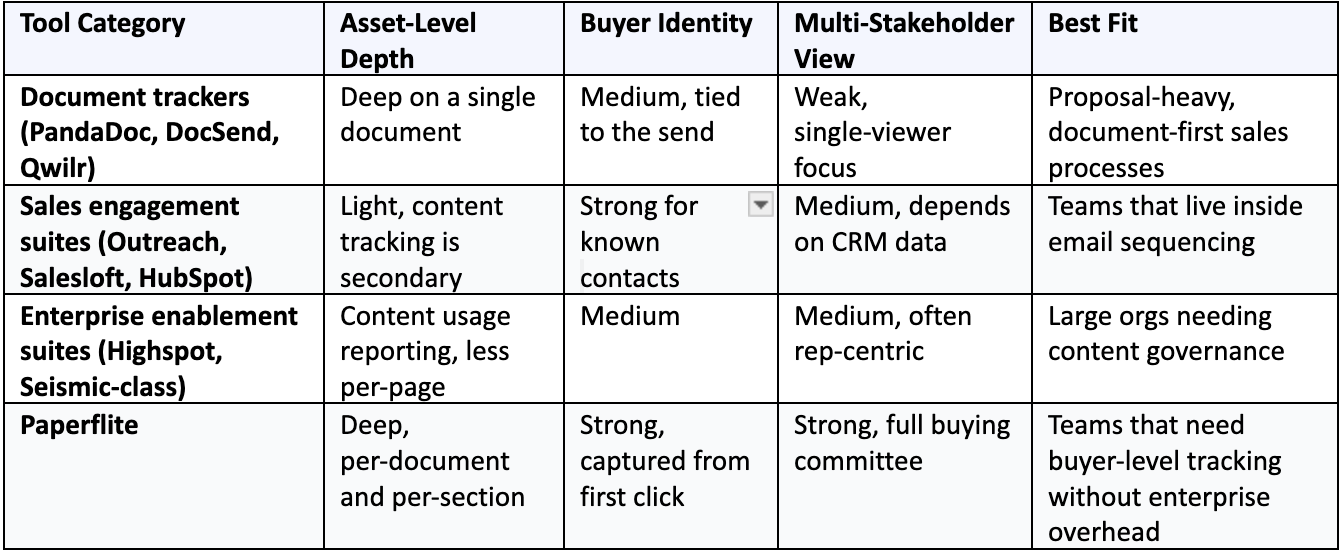
Here's the honest breakdown of how the main categories of tools handle this, based on what each one is actually built to do well.
Document Trackers: Strong on One File, Thin Beyond It
Tools like PandaDoc, DocSend, and Qwilr are genuinely good at what they were built for: telling you what happened inside a specific proposal or document. Page-level opens, time spent, sometimes scroll depth. Where they get thinner is the moment a deal involves more than one asset (which is most deals). A case study, a security one-pager, and a demo video sent through three different tools don't add up to one picture. You're stitching it together yourself, usually by exporting a few reports and hoping the timestamps line up.
That's not a knock on these tools, it's a scope issue. They were built to solve "did they read the proposal," and they solve that well. The moment your question becomes "what has this account engaged with across the entire deal," you're asking something outside what a single-document tracker was designed to answer.
Sales Engagement Suites: Great at Activity, Light on Content
Content tracking and CRM activity tracking answer different questions. CRM activity tracking tells you an email was sent, a call happened, a meeting is on the calendar. Content tracking tells you what the buyer actually did with the material they were given. Tools like Outreach, Salesloft, and HubSpot are built primarily for the first job, so content-level detail tends to be a secondary feature layered on top rather than the core of what they do.
That secondary status shows up in practice. Basic email and link tracking, sure. But per-page depth, section-level reads, or a clean view of which of five stakeholders opened a specific asset? That usually isn't there, because it isn't what the platform was designed around. If your team already lives inside one of these tools for outreach, it's worth checking honestly whether the content tracking is a real feature or a checkbox on a features page.
Enterprise Enablement Suites: Governance Over Granularity
Enterprise-grade platforms in the Highspot and Seismic category are strong at answering "which reps are using which assets, and are they following brand guidelines." That's content governance, and it matters at scale. It's a different question from "what did this specific buyer spend 40 seconds reading on page 7." These suites also tend to come with longer implementation timelines, which is a real cost if you need visibility now, not in a quarter.
There's also a practical sizing question here. These platforms are built with large, distributed sales orgs in mind, often hundreds of reps across multiple regions who need consistent brand messaging and centralized content approval. If that's not the problem you're solving, you may be paying for a layer of governance infrastructure you don't need just to get at the buyer-level tracking underneath it.
Paperflite: Built for Asset-Level Buyer Tracking From the Start
Paperflite tracks engagement asset by asset, which document, which section, which video, for how long, and ties every one of those interactions to a specific buyer starting from the moment they first click a shared link or open a personalized microsite. No reverse-engineering identity later through UTM matching, no guessing which of five people on the account actually opened the deck. Buying committee members show up individually, so you can see exactly who on the other side engaged with what.
How Paperflite Tracks Buyer Engagement by Asset
Every buyer gets a personalized, trackable microsite built around their specific deal. Whatever you place on it, a deck, a case study, a pricing sheet, a product video, gets its own engagement layer underneath: opens, time spent, which sections got read, and who did the reading.
- Buyer identity captured from first click. No waiting for a form fill or reverse-engineering identity through UTM parameters after the fact.
- Asset-level analytics on everything shared. See exactly which piece of content a stakeholder spent time on, not just that "the microsite was viewed."
- Full buying committee visibility. Every person who touches the deal room shows up individually, not just the one contact whose email address you happen to have.
None of this requires a lengthy setup process either. A rep can spin up a personalized microsite for a specific deal, load it with the relevant assets, and start seeing per-asset engagement the moment a buyer clicks in, without waiting on a drawn-out implementation cycle or a dedicated admin to configure it first.
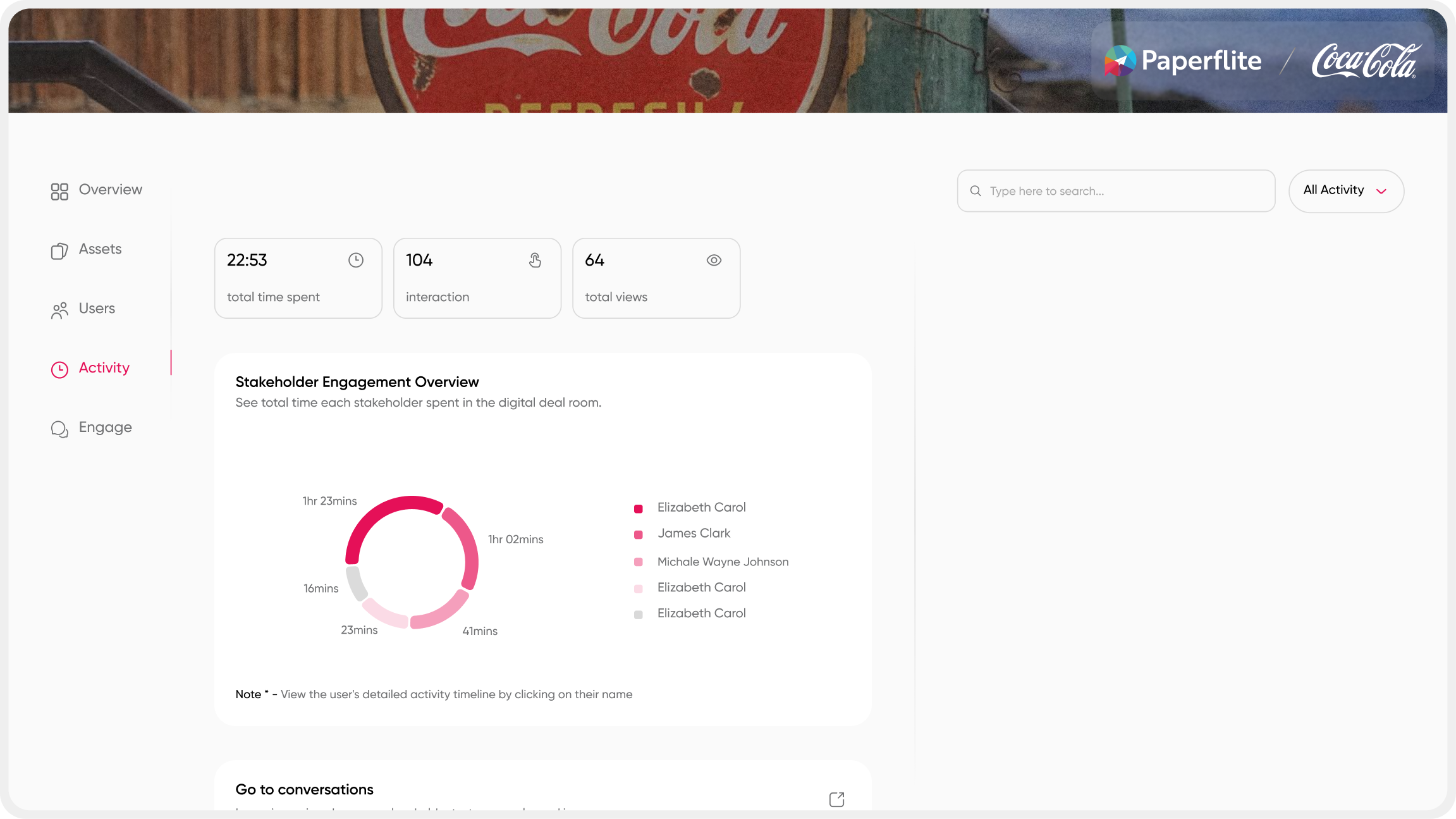
Beyond simply logging opens and clicks, Paperflite's deal room surfaces the signals that actually indicate deal momentum: how deep engagement goes, how many stakeholders are involved, and where priority is shifting. That's a meaningfully different signal than "a link was clicked," and it's the difference between assuming a deal is active and actually knowing it's moving.
Real Deal Signals, Not Just Opens and Clicks
A deal room built around asset tracking does more than count views. It shows depth of engagement (did they read three pages or thirty), stakeholder spread (is it one person or five), and priority signals (which asset is getting repeat visits). Put together, that's a much sharper read on deal health than a raw open count ever gives you, and it lets you spot risk early instead of finding out about it on the next call.
Deal-Rooms and Mutual Action Plans
Buyer questions and next steps live inside the same deal room as the assets being tracked, so engagement data and deal progress aren't scattered across five email threads and a Slack DM you forgot about. When a buyer has a question about the pricing sheet, they can ask it right there, next to the pricing sheet, instead of starting a new email thread that gets buried by Friday. That context matters more than it sounds. A question asked in isolation ("what's included in the Advanced plan?") is hard to act on fast. The same question asked directly underneath the pricing sheet the buyer was just reading tells your rep exactly what prompted it and lets them respond without playing detective first.
Mutual action plans work the same way. Milestones, owners, and due dates live next to the content that supports each step, so both sides can see what's next without a status-update call. Buyers know what's expected of them, sellers stay in control of the process, and fewer deals stall out simply because nobody was sure whose turn it was to move next.
Getting There Without an Enterprise Rollout
One thing worth calling out plainly: none of this requires the kind of implementation project that enterprise enablement suites typically involve. Setting up buyer-level asset tracking with Paperflite doesn't mean months of onboarding, a dedicated administrator, or a multi-quarter rollout plan before your team sees any value. A rep can be tracking real engagement on a live deal within days of getting started, which matters a lot if the problem you're trying to solve is "I need visibility on this quarter's pipeline," not "I need a five-year content governance strategy."
That speed-to-value tradeoff is worth being upfront about. If your organization genuinely needs deep brand governance across hundreds of reps in dozens of regions, an enterprise suite's overhead buys you something real. If what you actually need is to know which specific stakeholders are engaging with which specific assets on the deals in front of you right now, that overhead is mostly just friction between you and the answer.
See how Paperflite tracks buyer engagement asset by asset. Book a demo and see your next deal room in action.
See how Paperflite tracks buyer engagement asset by asset. Book a demo and see your next deal room in action.
Conclusion
If all you need to know is whether a document got opened, most CRMs and basic document tools already cover that. But if you need to know which specific asset actually moved a deal forward, who on the buying side engaged with it, and whether the right stakeholders have even entered the deal yet, that requires tracking built around individual assets and tied to real buyer identity. That's a narrower category than "sales tool with analytics," and most platforms only cover part of it.
Worth being honest about the tradeoffs here too. Document trackers are excellent if your process genuinely revolves around one proposal at a time. Sales engagement suites make sense if outbound sequencing is your bigger bottleneck than content visibility. Enterprise enablement suites earn their complexity at real scale, when governance across hundreds of reps is the actual problem you're solving. None of those are wrong tools, they're just built to answer different questions than "what did this specific buyer do with this specific asset."
The next time a deal goes quiet after a proposal, the difference between guessing and knowing usually comes down to whether your content tracking tool was built to answer that question in the first place.
FAQ
What does it mean to track buyer engagement "by asset"?
It means seeing engagement broken down per individual document, video, or page, rather than one combined activity score. You can tell exactly which piece of content a buyer spent time on, not just that they were "active" somewhere in the deal.
Can I see which stakeholder viewed which document?
With tools built around buyer identity capture, yes. Each person who opens a shared asset is tracked individually rather than lumped into one anonymous "link click" total, which matters a lot once more than one person from the buying side is involved.
Is buyer engagement tracking different from email open tracking?
Yes. Email open tracking tells you a message was opened. Asset engagement tracking tells you what happened next: which document they clicked into, how much of it they read, and whether they came back to it later.
Do I need a CRM integration to track engagement by asset?
Not to get started. Standalone content and deal room platforms track engagement natively without any CRM connection. Integrating with a CRM adds the benefit of surfacing that engagement data next to your existing deal records, but it isn't a requirement for the tracking itself to work.
What counts as a real deal signal versus noise?
A single open on its own is weak signal. Repeat visits to the same asset, multiple stakeholders engaging independently, and time spent on decision-critical sections like pricing or security are much stronger indicators that something is actually happening in the deal.
How much does an asset engagement tracking tool cost?
It varies by depth and scale. Paperflite starts at $30 per user per month on its Starter plan (minimum 5 users), moving up to $50 and $60 per user per month on the Professional and Advanced plans for deeper features like CRM integrations and digital deal rooms, with custom pricing for Enterprise. Competitors in the document-tracking and enablement-suite categories generally require a custom quote rather than publishing per-user pricing.
Can asset tracking tell me if a buyer forwarded my content internally?
Some tools can. If a buyer forwards a tracked link or shares a deal room microsite with a colleague, platforms with buyer identity capture can pick up that new person as a separate viewer, which is often one of the earliest signs that a champion is building internal support for the deal.