Is Paperflite Good for Content ROI? An Honest Answer From the Platform Itself
Yes, Paperflite is purpose-built to prove content ROI for sales and marketing teams. Content Analytics tracks engagement at the asset and section level, Content Revenue Intelligence connects that usage to pipeline and closed-won deals, and the platform surfaces exactly which assets are driving revenue. Verified reviewers on G2, Capterra, Gartner Peer Insights, and GetApp consistently name content ROI visibility as one of Paperflite's core benefits.
We're going to answer this question directly, from Paperflite, so you know exactly where we're coming from.
Is Paperflite good for content ROI? The short version: yes, if content ROI means connecting the content your team creates and shares to engagement data, pipeline influence, and closed deals. The longer version explains exactly what we track, what we don't, and what dozens of verified customer reviews say about the results.
Content ROI means different things to different teams. For a CMO, it might mean proving that blog content is generating pipeline. For a sales enablement manager, it might mean showing which specific case study closed the most deals last quarter. For a content strategist, it might mean understanding which assets reps are actually sharing versus which are sitting unread in the library. Paperflite addresses all three of these definitions but with a specific focus: we're built for the sales-side content ROI question, not the marketing-attribution-to-pipeline question. Understanding that distinction is the fastest way to know whether we're the right tool for what you're actually trying to measure.
For the full picture of what content tracking involves: What is content tracking? Types, Techniques, and Tools.
What 'Content ROI' Means in Paperflite's Context
Paperflite measures content ROI at the deal level: which content reps share with buyers, how buyers engage with it, and whether that content appears in deals that close. It does not replace top-of-funnel marketing attribution tools that measure whether blog posts or campaigns generated leads. For teams whose primary question is 'which content closes deals,' Paperflite directly answers that. For teams whose primary question is 'which content generated the pipeline in the first place,' a different tool is the right starting point.
What Paperflite Measures
When a rep shares content with a prospect, Paperflite captures: who viewed it, how long they spent on each section, whether they forwarded it to a colleague, whether they returned without being prompted, and whether that specific asset appeared in deals that closed. Aggregate this data across dozens or hundreds of deals and you have a clear picture of which content is actually moving deals forward versus which content is being shared without measurable impact.
What Paperflite Does Not Replace
Paperflite is not a top-of-funnel marketing attribution platform. It doesn't measure whether blog posts, paid campaigns, or SEO content generated the original lead. If your primary content ROI question is 'which marketing channel produced the most pipeline,' you need a platform like HockeyStack, Dreamdata, or HubSpot's native reporting. Paperflite answers the question that comes after that: once the lead is in a deal, which content is closing it?
The Three Content ROI Questions Paperflite Answers
- Is this content actually being shared? (Usage tracking at the rep level Content Discovery Intelligence)
- Are buyers engaging with it when it's shared? (Engagement analytics at the asset and section level Content Engagement Intelligence)
- Does this content appear in deals that close? (Content Revenue Intelligence at the deal level)
These three questions map directly to the three intelligence layers covered in the next section. See also: What is Content Discovery and why do you need it?
How Paperflite Measures Content ROI: The Three Intelligence Layers
Paperflite provides three layers of content analytics. Content Discovery Intelligence shows which assets are being used by reps versus sitting unread. Content Engagement Intelligence tracks section-level reads, time spent, multi-stakeholder forwarding, and return visits on every shared asset. Content Revenue Intelligence connects asset engagement to pipeline and closed-won deals, identifying which specific content appears most often in deals that close. Predictive Deal Insights, available on the Advanced plan, add AI-identified patterns from best-performing deals.
Layer 1: Content Discovery Intelligence
Content that reps can't find can't drive ROI regardless of how good it is. Content Discovery Intelligence shows marketing which assets are being searched for, which are being accessed, and which are sitting unused, closing the gap between what gets created and what actually reaches buyers. Gartner Peer Insights reviewers consistently note that Paperflite's analytics engine provides insights and metrics about prospects to inform action steps, and multiple reviews describe the reduction in content waste that comes from seeing which assets are actually in circulation.
What this layer surfaces:
- Which assets are being accessed most frequently, by whom, and at which deal stage
- Which assets are being searched for but not found a content gap signal that directly informs the content roadmap
- Which assets have never been accessed retirement candidates that are cluttering search results without contributing to revenue
- How content usage distributes across different rep personas, geographies, and industries
Layer 2: Content Engagement Intelligence
The gap between 'sent' and 'read' is where most content ROI measurement fails. Content Engagement Intelligence tracks what happens after a rep sends content to a prospect. A G2 reviewer described this directly: the analytics give visibility into who has viewed content, how long they engaged with it, and what they clicked on valuable insight into prospect behaviour. Another G2 reviewer described how the platform helps understand buyer intent, prioritize leads, and tailor follow-ups more effectively.
What this layer tracks:
- Section-level read time on every shared document which parts of a proposal or case study held the prospect's attention longest
- Multi-stakeholder forwarding detection: when a prospect shares the content internally, new contacts at the account are surfaced automatically
- Return visit signals: the prospect came back to the document without being prompted, the strongest engagement signal available
- Video watch time and drop-off points for embedded video content
- Real-time rep notifications when high-signal engagement events occur, delivered inside the rep's CRM, email client, or Slack
Layer 3: Content Revenue Intelligence
This is the layer that directly answers the content ROI question. Content Revenue Intelligence connects asset-level engagement data to pipeline and closed-won deals, showing which specific assets appear most often in opportunities that closed, at which deal stage they were most effective, and which combinations of assets correlate with won deals.
"I love how I'm able to track Content ROI to amplify what's working. With the analytics they provide, it gives me an in depth view of how the content has been consumed, engaged and helps close deals."
- Verified Capterra reviewer, Content Editor, Legal Services
"Paperflite's dynamic content hub has helped us centralize content across all our global teams... the ability to create customized experiences has increased engagement and we've been able to understand the ROI that our content brings."
- Verified SoftwareAdvice reviewer
What this layer shows:
- Which assets appear most often in closed-won deals ranked by frequency and deal stage
- Content-to-revenue attribution: which specific case studies, decks, and one-pagers correlate with pipeline conversion
- Deal velocity correlation: do deals where a specific asset was shared close faster on average?
- Predictive Deal Insights (Advanced plan): AI-identified patterns in best-performing deals flagging momentum shifts
Content Hub Operations: Strategies for Managing Effectively and Organize B2B Marketing Content in 8 Simple Steps for the content library foundation that makes these analytics meaningful.
What Verified Customers Say About Paperflite's Content ROI
Verified customers across Capterra, G2, Gartner Peer Insights, GetApp, and TrustRadius consistently describe Paperflite as delivering measurable content ROI through visibility into which content works at which deal stage, improved follow-up precision from engagement analytics, and better alignment between marketing content creation and sales content usage. SelectHub's analysis of 406 verified reviews across four platforms places Paperflite at a 94% user satisfaction rating, with analytics cited as a primary driver.
We're quoting customers from verified review platforms. These are not selected testimonials from Paperflite's own website.
On Content ROI Visibility
Cuspera's analysis of 1,004 buyer insights from Paperflite evaluations and users summarizes the platform's primary use case as: improve ROI and acquire customers through content management, engagement management, and lead engagement. Multiple verified reviewers describe the shift from guessing which content works to having data that makes the answer clear.
"Understanding patterns that sales reps follow to know what content works at each stage in the entire journey enables me to create content that helps the sales team drive more sales."
Verified Capterra reviewer
On Sales and Marketing Alignment
Multiple reviews cite Paperflite as the bridge between marketing's content creation and sales' actual content usage, the alignment problem that content ROI measurement is supposed to solve.
"After Paperflite's implementation, we've begun to double down on our important accounts once we discovered what content worked best amongst our prospects."
- Verified SoftwareAdvice reviewer
On Follow-Up Quality and Lead Prioritization
GetApp's summary of verified user reviews describes Paperflite as providing real-time analytics and content intelligence to track user engagement with shared content, and notes that the system allows for tailored follow-up based on individual engagement patterns, leading to better sales outcomes. Multiple G2 reviewers describe improved conversations, stronger first impressions with prospects, and better buyer understanding as direct outcomes of acting on the engagement data.
The Numbers Context
SelectHub's analysis of 406 verified Paperflite reviews across four recognized software review platforms places Paperflite at a 94% user satisfaction rating. Analytics and reporting, personalization, and content discoverability are cited as the top three drivers of that satisfaction. Easy Content Discovery, Personalized Content Experiences, and Robust Analytics and Tracking are SelectHub's three lead capabilities from aggregated user review data.
Is Paperflite Worth the Investment for Content ROI?
For teams whose primary goal is understanding which sales content influences deals, Paperflite delivers visible ROI from the first month: reps know which content to share at which stage, marketing knows which assets to build more of, and leadership has a defensible answer to 'is our content working?' The full Content Revenue Intelligence suite is available on the Advanced plan at $60/user/month. For a 10-user team, that's $7,200/year a threshold most B2B sales teams recover in a single influenced deal.
Pricing
Pricing is set by Paperflite and can change confirm current numbers at paperflite.com/pricing before quoting a prospect.
- Starter ("I Got Wings"): $30/user/month, minimum 5 users. Entry point $150/month. Includes content hub, SEEK AI-powered search, storage sync (Google Drive, SharePoint, Dropbox), and basic content analytics.
- Professional ("I Believe I Can Fly"): $50/user/month. Adds CRM integrations (Salesforce, HubSpot, Pipedrive, Freshsales, Microsoft Dynamics), white labeling, SSO, and a dedicated Customer Success Manager.
- Advanced ("Touch The Sky"): $60/user/month. Adds full digital deal rooms, predictive Deal Insights, AI-powered content recommendations, and the full Content Revenue Intelligence suite. This is the tier where the content-to-revenue attribution described above is fully available.
- Enterprise ("Enterprise State of Mind"): Custom quote. Adds deeper Salesforce integrations, custom reporting, and language localization.
15-day free trial available, no credit card required. SOC 2 Type II certified. Vendr benchmarking shows real contracts ranging from $5,000 to $24,000 annually, averaging around $14,400. ITQlick notes that for 10 users, the monthly cost ranges from $300 to $600 (Starter to Advanced), and that ROI is achieved through improved sales and marketing alignment, content engagement tracking, and lead generation.
Where the Price-to-ROI Fits Best
- Growing B2B SaaS, 10–100 users: Strong fit. Content ROI visibility and deal-stage analytics are most impactful for teams shipping content regularly and needing to know what's actually working with buyers. The analytics justify the Advanced plan cost within the first quarter for most teams.
- Enterprise sales teams, 200+ reps: Strong fit for the content and deal room use case. Teams that also need built-in training, coaching, and conversation intelligence may want to evaluate Paperflite alongside a dedicated coaching tool rather than expecting a single platform to handle both.
- Small teams under 5 users: The $150/month minimum (5 users, Starter) is the entry point. Teams genuinely smaller should weigh the per-seat math against the volume of content they're actively sharing with buyers.
How Paperflite Compares to Alternatives for Content ROI
Paperflite focuses on the sales-content layer: deal-level engagement analytics, content-to-revenue attribution, and rep-facing content discovery accessible to growing B2B teams. Highspot and Seismic (merging since February 2026) offer comparable content attribution as part of broader enterprise enablement suites. HockeyStack, Dreamdata, and HubSpot native reporting address the marketing content ROI question (which campaigns and blog posts generated pipeline) rather than the sales content ROI question (which assets close deals). These are complementary tools, not competing tools, for most teams.
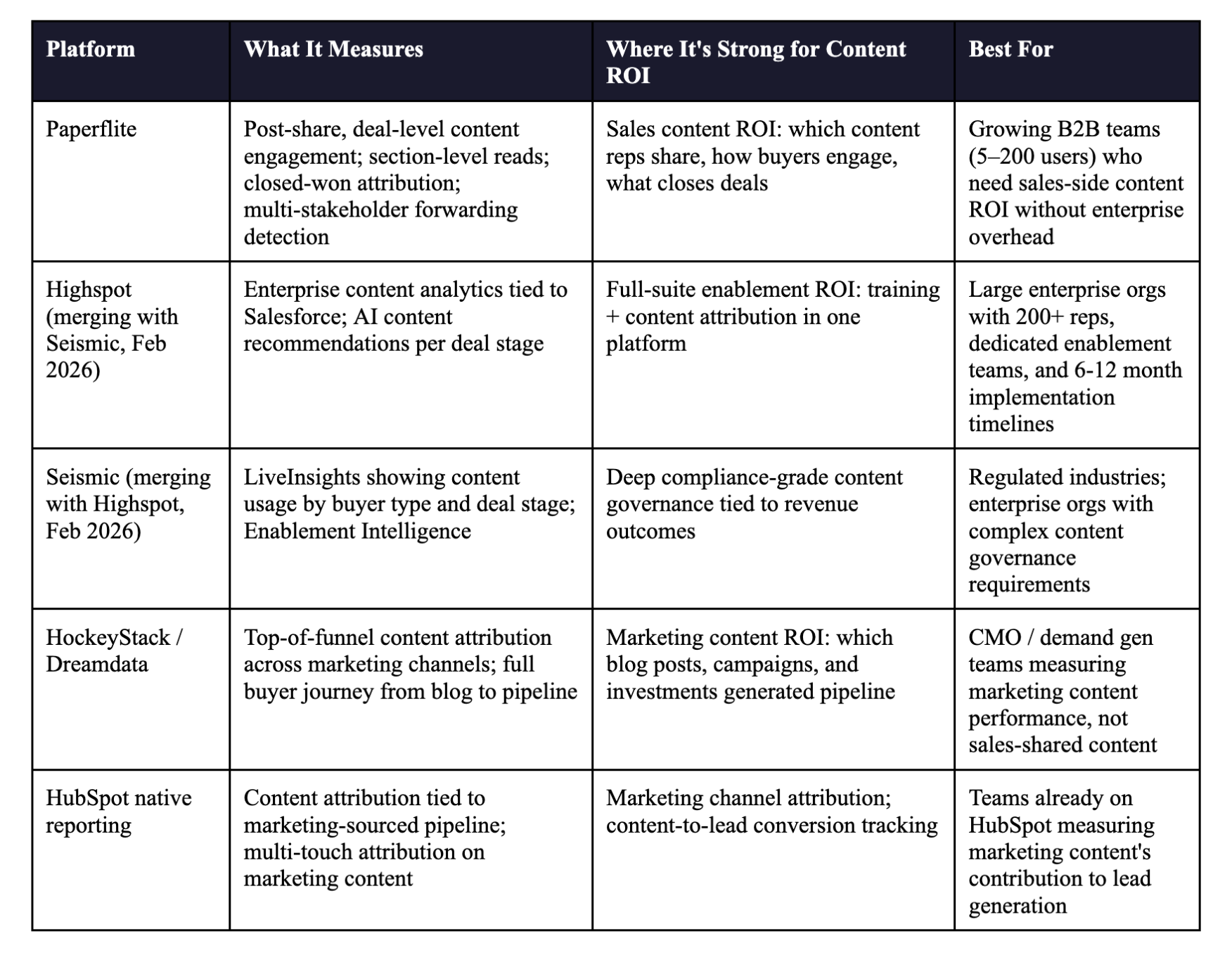
The critical distinction: Paperflite measures what happens to content inside the sales process, after the lead exists. HockeyStack, Dreamdata, and HubSpot native reporting measure what generates leads in the first place. For teams that need both, these platforms typically run in parallel rather than one replacing the other.
7 Key Benefits of Sales Enablement You Can't Afford to Miss and What is Sales Enablement? Tools, Functions and Resources for the broader enablement context.
Conclusion
Paperflite is built specifically to prove content ROI at the sales layer: which content your team shares, how buyers engage with it, and which assets actually show up in the deals that close.
Customers across Capterra, G2, Gartner Peer Insights, GetApp, and TrustRadius consistently describe content ROI visibility as one of Paperflite's primary delivered benefits. The three intelligence layers Content Discovery, Engagement, and Revenue give marketing and sales a clear, data-backed answer to the question they both need answered: is our content working?
The 15-day free trial is the fastest way to run that analysis on your own content, with your own team, before committing to anything.
Sales Content Management Guide for the full content management picture. And Content Hub Tools: What Are They and Why Do You Need Them? for the broader tool landscape.
See Paperflite's content ROI analytics in action with a free 15-day trial - no credit card required.[Book a demo]
Frequently Asked Questions
Is Paperflite good for content ROI?
Yes. Paperflite is built to track and prove content ROI at the sales layer: usage (which content reps share), engagement (how buyers interact with it at the section level), and revenue attribution (which assets appear most in closed-won deals). Customers on Capterra, G2, Gartner Peer Insights, and GetApp consistently cite content ROI visibility as one of the platform's primary delivered benefits. SelectHub's analysis of 406 verified reviews places Paperflite at a 94% user satisfaction rating, with analytics cited as a primary driver.
What analytics does Paperflite provide for content ROI?
Paperflite provides three layers of content analytics. Content Discovery Intelligence shows which assets are being used by reps, searched for and not found, or sitting unused. Content Engagement Intelligence tracks section-level reads, time spent, multi-stakeholder forwarding detection, and return visits on every piece of shared content. Content Revenue Intelligence connects asset engagement to pipeline and closed-won deals, showing which specific assets appear most often in deals that close. Predictive Deal Insights, available on the Advanced plan, add AI-identified patterns from best-performing deals.
What do Paperflite customers say about content ROI?
Verified reviewers across multiple platforms describe Paperflite as delivering visible, measurable content ROI. A Capterra reviewer noted being able to track Content ROI to amplify what's working, with an in-depth view of how content has been consumed, engaged, and helps close deals. A SoftwareAdvice reviewer described understanding the ROI that their content brings through Paperflite's dynamic content hub. Multiple G2 reviewers cite improved follow-up quality, better prospect conversations, and stronger sales-marketing alignment as measurable outcomes from the engagement data.
How does Paperflite's content ROI tracking compare to Highspot or Seismic?
Paperflite focuses on the sales-content layer: deal-level engagement analytics, content-to-revenue attribution, and rep-facing content discovery, accessible to growing B2B teams without enterprise implementation overhead. Highspot and Seismic, which announced a merger in February 2026, offer comparable content attribution as part of broader enterprise enablement suites that also include training, coaching, and conversation intelligence. The choice depends on team size, use case scope, and whether you need the full suite or a focused content ROI tool.
Is Paperflite worth the investment for content ROI?
For teams whose primary goal is understanding which sales content influences deals, Paperflite delivers visible ROI from the first month: reps know which content to share, marketing knows which assets to build, and leadership has a defensible answer to 'is our content working?' The full Content Revenue Intelligence suite is available on the Advanced plan at $60/user/month. For a 10-user team, that's $7,200/year a threshold most B2B sales teams recover in a single influenced deal.
What is Paperflite's Content Revenue Intelligence?
Content Revenue Intelligence is Paperflite's capability that connects content engagement data to deal outcomes. It shows which specific assets appear most often in opportunities that closed, which were present in deals that stalled, and what combinations of content tend to appear in best-performing deals. This gives marketing a revenue-connected content investment signal rather than relying on download counts as a proxy for performance. It is available on the Advanced plan at $60/user/month.
How does Paperflite prove content ROI for marketing teams?
Paperflite closes the loop between marketing's content creation and sales' content usage. Marketing can see which assets reps are actually sharing, which sections prospects engage with most, page by page, and which assets appear in closed deals. This replaces the "we produce it and hope it works" dynamic with a feedback loop that directly informs the content roadmap. Verified reviewers consistently describe shifting content investment based on this data, building more of what works and retiring what doesn't generate engagement in active deals.
Does Paperflite integrate with CRM systems for content ROI tracking?
Yes. Paperflite integrates natively with Salesforce, HubSpot, Pipedrive, Freshsales, and Microsoft Dynamics, available from the Professional plan. Content engagement events which assets were shared, how prospects engaged, which appeared in closed-won opportunities surface inline on deal records without manual data entry. This means content ROI data is visible inside the CRM where sales leaders and revenue operations teams already work, making it actionable rather than confined to a separate analytics portal nobody consistently checks.