How to Gate Content Without Losing Leads (The Decision Framework That Replaces Gut Feel)
To gate content without losing leads: (1) gate only content with genuine exchange value — original research, interactive tools, benchmarks, and detailed frameworks a buyer can't easily find elsewhere; (2) keep awareness content (blogs, infographics, basic guides) ungated to maximize reach and SEO; (3) reduce form fields to four or fewer — cutting from 11 to 4 fields boosts conversions by 120%; (4) use progressive profiling to collect data across multiple interactions rather than demanding everything at once; (5) replace forms with behavioral tracking on ungated content to capture intent signals without blocking access.
Your team spent six weeks building a research report. It's comprehensive, original, and packed with data your audience can't get anywhere else. You gate it. One hundred people hit the landing page. Twelve fill out the form. Eighty-eight leave. You now have twelve leads, eighty-eight people who decided your report wasn't worth their email address, and zero visibility into who those eighty-eight were, what they were interested in, or whether any of them are your ideal customer.
The gating decision is one of the most consequential and least data-driven choices most B2B marketing teams make. Around 80% of B2B content is gated, and yet 71% of B2B tech buyers report feeling let down after downloading gated content. The problem isn't gating itself. It's gating the wrong content, with the wrong form, at the wrong stage of the buyer's journey. This guide covers the decision framework that replaces gut feel with a repeatable, evidence-based approach to knowing exactly which content to gate, what to ask when you do, and how to capture lead intelligence from the content you don't.
The upstream question: How to Generate Leads with Gated Content covers when gating works and when it doesn't from a lead quality perspective.
The Problem With How Most Teams Gate Content
Most teams make the gate/no-gate decision at the content level (is this piece good enough to gate?) rather than at the strategic level (what do I need to learn from this buyer right now, and is the friction worth it?). This produces two failure modes: over-gating awareness content that would generate far more value as ungated distribution, and under-gating high-intent content that could identify serious buyers if configured correctly.
The Over-Gating Failure Mode
Marketing gates blog posts, case studies, infographics, and basic guides that buyers encounter at awareness stage. Forrester's B2B Content Preferences analysis found that ungated top-of-funnel content achieves up to 1,100% higher usage and distribution than the same content gated. The result of over-gating: great content that almost nobody reads, a trickle of low-intent leads who clicked through a paid promotion to get a PDF they immediately forget, and no organic search signal because gated content can't be indexed, ranked, or linked to.
The Under-Gating Failure Mode
In reaction to "gating is bad" demand generation thinking, some teams ungate everything and replace lead capture with "just build brand awareness." The result: growing traffic with no contact intelligence, no way to identify high-intent visitors who read multiple pieces in one session, and no lead handoff to sales that's grounded in anything more specific than a website visit. Ungating everything is not a content strategy. It's a content access policy.
The Root Cause Both Share
Both failure modes stem from the same root cause: treating gating as a binary (gate everything / gate nothing) when the right answer is a portfolio decision. Gartner data shows that 83% of B2B buyers complete 70% of their research before contacting sales. Most of that research happens on ungated content. The buyers who matter most are forming opinions and building preferences long before they ever fill out a form. A content strategy that only captures intelligence through forms is invisible to most of the decision-making that actually determines who wins the deal.
Nurture Leads with Content That Converts covers how lead nurturing and content strategy connect once the gating framework is in place.
The Gating Decision Framework: What to Gate, What to Ungate, and Why
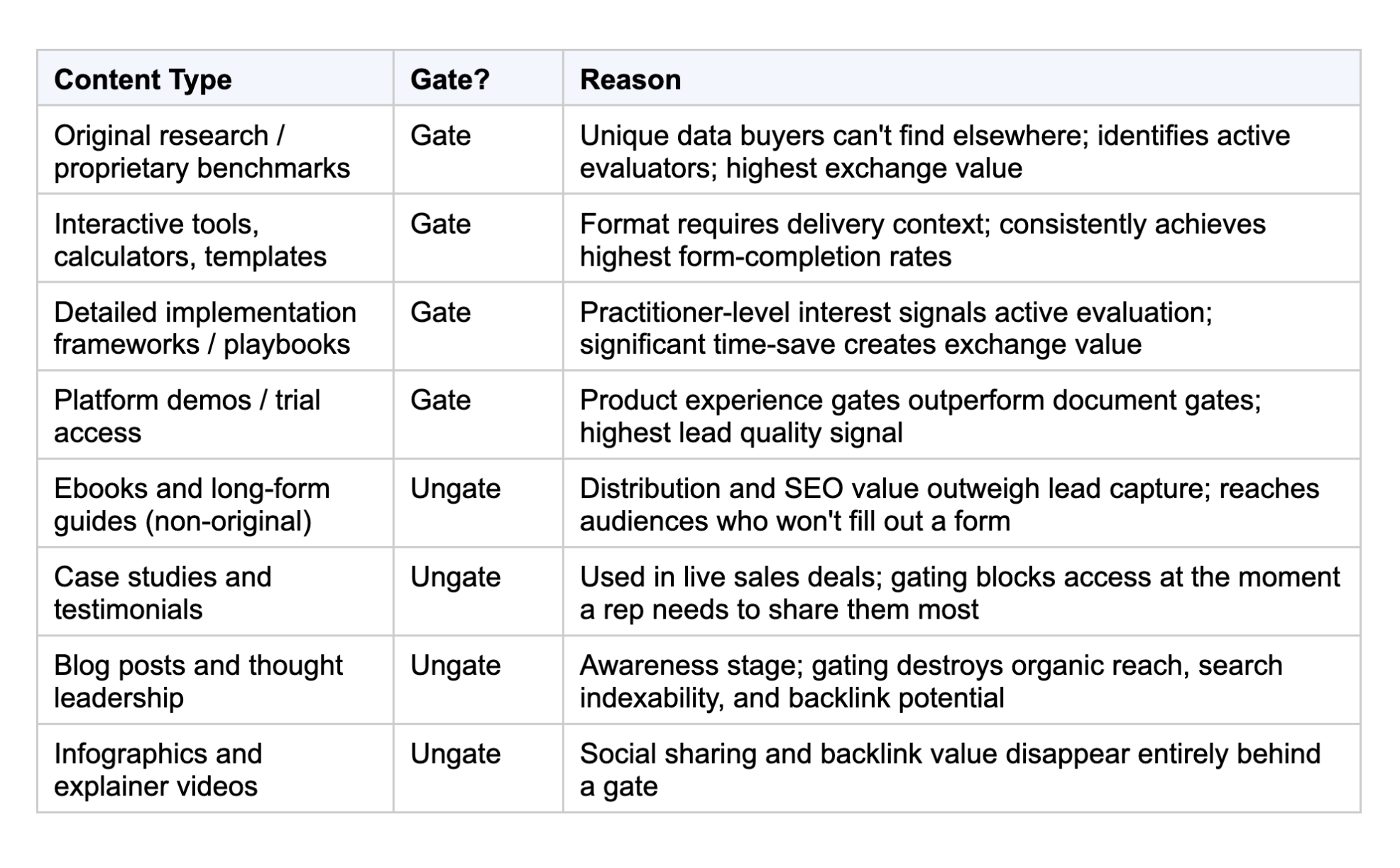
Gate content only when the value it offers is genuinely unique and worth the friction of a form, and when capturing a contact is more valuable to you than maximizing distribution. Gate original research, interactive tools, proprietary benchmarks, detailed implementation frameworks, and product trial access. Ungate blog posts, infographics, case studies used in live sales deals, and ebooks that don't contain proprietary data. The deciding test isn't 'is this piece good?' It's 'is this value unique enough that a buyer will trade their contact information to access it?'
Gate Content That Has Genuine Exchange Value
The gate should feel like a fair trade to the buyer. They give contact information; they receive something they couldn't easily find elsewhere, or that saves significant time compared to building it themselves. When the exchange feels unequal, they abandon the form. When 71% of buyers report feeling let down by gated content, the problem is usually that what was behind the gate didn't justify the friction of accessing it.
- Original research and proprietary benchmarks. Data buyers can't replicate. Willingness to exchange contact information scales directly with uniqueness. A benchmark report built from your own customer base, a buyer survey from your own market research, or a proprietary dataset nobody else has — these are gate-worthy. A compilation of publicly available statistics dressed up as an 'industry report' is not.
- Interactive tools, calculators, and templates. These consistently achieve the highest form-completion rates of any gated content type. The format itself requires delivery to a context — an email, an account — to be useful. An ROI calculator, a budget template, a readiness assessment: all justify the exchange because they do something the buyer values, not just say something the buyer might read.
- Detailed implementation guides and frameworks. Step-by-step playbooks that save significant time and require meaningful expertise to create. These are higher-funnel than most teams assume — a practitioner who downloads a detailed implementation framework is often in an active evaluation, not passive browsing. The download tells you something specific about where they are in the decision process.
- Platform demos and trial access. Product experience gates consistently outperform document gates in lead quality and conversion intent. The buyer who requests a demo or starts a trial has self-selected at a higher intent level than the buyer who downloaded an ebook.
Ungate Content That Builds Reach
Ungate everything that creates reach, authority, and distribution more efficiently than it creates qualified leads. Gating this content costs more in lost visibility than it gains in contact information.
- Blog posts and thought leadership. Gating kills SEO indexability, organic reach, and backlink potential entirely. A single ungated article that ranks and earns 50 backlinks generates more qualified inbound intent than a gated PDF downloaded by 200 people who immediately forget they downloaded it.
- Case studies used in active sales deals. This one surprises most teams. Case studies are most valuable when a rep can share them instantly with a prospect mid-conversation. Gating a case study means every rep has to either ask the prospect to fill out a form to access it, or send them a downloaded copy outside your tracking system. Neither serves the sales motion.
- Infographics and explainer videos. Their value is in being shared. Social sharing, Slack mentions, newsletter embeds, and backlinks disappear entirely when the content is behind a gate. The reach they generate as free content creates more pipeline awareness than the lead list they generate as gated content.
The full gate/ungate decision table:
For how content tracking fits into all of this: What is content tracking? Types, Techniques, and Tools.
When You Do Gate: How to Minimize Lead Loss at the Form
The right form length for a content gate is four fields. Research shows cutting from 11 to 4 fields boosts conversions by 120%. The four fields that maximize both conversion rate and lead quality: email address, first name, company name, and job title or role category. Collect everything else progressively across subsequent interactions rather than at the first gate.
Once the gate/no-gate decision is made correctly, the form itself is where most teams lose additional leads unnecessarily. The gate earns the right to ask. The form determines whether the buyer follows through.
Form Length: The Number That Changes Everything
The average B2B gate form asks for: name, email, company name, job title, company size, phone number, country, industry, budget range, purchase timeline, and source of discovery. That's eleven fields. Research consistently shows that cutting from eleven fields to four fields increases form completion by 120%. The drop-off rate per additional field is steep, and most of what gets collected in fields five through eleven is data that was going to come in through CRM enrichment or progressive follow-up interactions anyway.
The four fields that earn both conversion rate and lead quality:
- Email address (required, is the contact)
- First name (required, enables personalization)
- Company name (required, enables firmographic qualification and CRM match)
- Job title or role category (required, enables persona routing and sales prioritization)
Phone number, company size, budget range, and purchase timeline can all be collected in subsequent interactions through progressive profiling. Asking for them at the first gate is the single most common cause of form abandonment on high-value gated content.
Progressive Profiling: The Form Strategy That Compounds
Progressive profiling collects a small amount of new information at each content interaction rather than demanding everything at the first gate. First download: name and email. Second gated asset: job title and company size. Third interaction: purchase timeline and team size. By the third interaction, the lead profile is richer than a 15-field first-interaction form could have produced, and abandonment at each step was far lower.
The key technical requirement: cookie-based recognition that allows the form to skip fields already collected, so returning visitors don't repeat themselves. HubSpot's smart forms are the most widely used implementation of this in marketing automation. Marketo's progressive field logic is the enterprise equivalent. Both require a properly configured form sequence connected to contact records in the CRM.
Progressive profiling approaches produce a 37% higher marketing qualification rate and 29% shorter sales cycles than equivalent programs using standard hard-gating strategies, per Demand Gen Report research from 2025.
Engagement-Based Gating: Gate After Intent, Not Before
Engagement-based gating presents the gate only after the buyer has demonstrated intent through behavior: five minutes of dwell time on the page, three or more prior pages visited in the same session, or a return visit after initial browsing. Forrester's analysis found this approach increases lead quality by 58% compared to gating the moment a buyer arrives on a landing page.
The logic is straightforward: a buyer who fills out a form after five minutes of engaged reading is qualitatively different from one who filled it out after reading the landing page headline. Engagement-based gating doesn't reduce the number of leads — it filters them toward the higher-quality end of the distribution before the contact even enters the CRM. The trade-off: this requires more technical implementation than a standard form and isn't natively supported in most basic marketing automation setups without custom scripting or a specialized tool.
How to Capture Lead Intelligence From Ungated Content
Three methods generate lead intelligence from ungated content without requiring a form. First, tracked sharing links: when reps share content via tracked links rather than email attachments, every interaction (reads, forwards, return visits) generates contact-level engagement data attributed to a named prospect. Second, named-contact content collections: curated deal-room content shared with a specific buyer generates asset-level engagement data without any gate. Third, IP-to-company resolution tools: identify the organization behind anonymous website visits and convert them to account-level intent signals for outbound prioritization.
The false dichotomy in most gating discussions: gated means you know who they are; ungated means they're anonymous. This was true when ungated meant putting a PDF on a website. It's not true when ungated content is shared through trackable links, personalized microsites, or sales-curated collections where the recipient is already a named contact in the CRM.
Method 1: Tracked Sharing Links (Rep-Distributed Content)
When a sales rep shares a case study, one-pager, or video using a tracked link rather than a direct download or email attachment, every content interaction generates behavioral data: which pages the buyer read, how long they stayed on each section, whether they forwarded the content internally to a colleague, and whether they returned to the document without being prompted. The buyer never fills out a form. The rep and marketing team still know exactly how the content performed with that specific named contact.
This is the intelligence layer that replaces what forms used to provide at the deal stage. At the top of the funnel, forms capture contacts. In active sales deals, tracked sharing links capture intent — and intent signals at the deal stage are more actionable than contact data at the awareness stage.
Method 2: Named-Contact Content Collections (Deal-Stage Content)
When a rep builds a curated microsite or deal room for a specific buyer, every asset in that collection is shared with a named contact already in the CRM. Every interaction generates contact-level engagement data without any gate. Marketing learns which specific assets drive the most engagement in active deals. Which sections of the proposal held the prospect's attention longest. Whether a CFO forwarded the content to procurement before telling the rep they were doing so.
This closes the feedback loop between content investment and deal outcomes in a way that form-based lead capture never can. The gate tells you someone was interested. The tracked named-contact collection tells you what, specifically, they engaged with and for how long.
Method 3: Behavioral Website Intelligence
For truly anonymous web visitors — the 98% of B2B website traffic that never fills out a form, per Leadinfo's 2026 analysis ,identify the organization behind the anonymous visit and connect it to intent signals. The individual visitor isn't identified by name, but the account-level intent signal reaches the sales team for outbound prioritization.
A company whose team has read your pricing page, your case studies page, and your competitive comparison in the same week is a meaningful signal even without a form submission. This is the intelligence layer that ungating awareness content produces when the right analytics infrastructure is in place underneath it.
Organize B2B Marketing Content in 8 Simple Steps for the content library organization that makes tracked sharing sustainable at scale. And What is Content Discovery and why do you need it? for how content discoverability connects to the sharing workflow.
How Cleverstory Captures Lead Intelligence Without Killing Your Content
The three methods described in Section 4 work best when the content itself is designed to generate behavioral signals — not as a static PDF that gets downloaded and forgotten, but as an interactive experience that adapts to the reader, captures engagement at the section level, and gates intelligently based on how long someone has been reading. That's the problem Cleverstory, Paperflite's interactive content creation platform, was built to solve.
Smart gating that fires after engagement, not before it. Cleverstory replaces static PDF lead magnets with interactive content experiences — and replaces hard gates with engagement-based gating that triggers after a reader reaches a certain page or spends a defined amount of time with the content. The result: 2x more content consumption and 45% more leads captured compared to standard hard-gated content, because the reader has already invested in the experience before they're asked for anything.
Progressive data capture built into the content journey. Cleverstory's interactive experiences auto-create micro-personalized journeys based on each reader's patterns. As readers move through the experience, marketers can surface progressive data capture at natural breakpoints — collecting name and email at page three, job title and company at page seven — rather than demanding everything at the front door. Each piece of data is collected in context, at a moment when the reader is already engaged.
Deep engagement signals that flow directly into your MAP. Cleverstory captures the behavioral data that standard download-based gating misses: how long a prospect spent on each section, which interactive scenarios they explored, which pages they returned to on a second visit. These signals push directly into Marketo, HubSpot, and Pardot, layering intent data on top of standard activity metrics. When your MAP receives 'spent 10 minutes exploring the ROI scenario section' instead of just 'downloaded content,' lead scoring starts reflecting genuine buying intent.
Content analytics that show who the anonymous reader actually is. Cleverstory's engagement analytics go beyond page views. Marketers can see time spent per section, reading patterns, interaction sequences, and repeated visits — and the platform surfaces intent signals about who the anonymous reader is likely to be, even before they submit a form. This is the intelligence layer that makes ungated and lightly-gated content as useful for pipeline building as traditional hard-gated PDF downloads.
What the alternatives look like in this space. HubSpot's smart forms and Marketo's progressive field logic are the strongest native implementations of the gate and progressive profiling side of this problem. Both handle form-based lead capture well. Interactive content platforms like Foleon and Turtl offer comparable web-publication analytics. Cleverstory's advantage is its native connection to the Paperflite and HeySales ecosystems — so the engagement signal from a gated Cleverstory experience flows directly into the sales workflow rather than stopping at the marketing dashboard.
Content Hub Operations: Strategies for Managing Effectively and Sales Content Management Guide for the library governance that makes the tracked-sharing intelligence system sustainable.
See how Cleverstory helps you capture more leads from the content you gate, and more intelligence from the content you don't. [Book a demo]
Conclusion
Gating content without losing leads isn't about finding a magic middle. It's about being deliberate: gate only what has genuine exchange value, configure the form to remove unnecessary friction, use progressive profiling to collect data over time rather than all at once, and build the behavioral intelligence layer that replaces what forms used to be the only way to capture.
The teams that do this well don't just have fewer abandoned gates. They have a richer picture of buyer intent from the buyers who filled out the form and from the ones who never did. The 98% of buyers who research extensively before contacting sales are leaving signals across every piece of ungated content they consume. Whether those signals reach you depends entirely on whether you have the infrastructure to read them.
Lead Generation Techniques: Everything You Need to Know for the broader lead generation context. And Nurture Leads with Content That Converts for what happens after the lead is captured.
Ready to replace static PDFs with interactive experiences that capture more leads and more intelligence? [Talk to the team]
Frequently Asked Questions
Should I gate my B2B content?
Gate content selectively, not universally. Gate only when what you're offering has genuine exchange value that a buyer can't easily find elsewhere: original research, interactive tools, proprietary benchmarks, and detailed frameworks typically earn their gate. Ungate content designed for awareness (blog posts, infographics, basic guides, case studies used in active sales conversations) to maximize reach, SEO indexability, and distribution. The gate/no-gate decision should be made at the strategic level: what do I need to learn from this buyer right now, and is the friction worth it?
What content should be gated vs ungated in B2B marketing?
Gate: original research with proprietary data, interactive tools and calculators, detailed implementation frameworks, assessment tools, and platform trial access. Ungate: blog posts and thought leadership (gating kills SEO and reach), infographics and explainer videos (social sharing and backlink value disappear behind a gate), case studies used in live sales deals (reps need to share these without asking prospects to fill out a form), and basic educational guides that serve awareness-stage readers. The deciding test: is the value unique enough that a buyer will trade their contact information for access?
How do I capture leads without a form?
Three methods generate lead intelligence from ungated content without requiring a form. First, tracked sharing links: when reps share content via tracked links rather than email attachments, every content interaction (reads, forwards, return visits) generates contact-level engagement data attributed to a named prospect. Second, named-contact content collections: curated deal-room content shared with a specific buyer generates asset-level engagement data without any gate. Third, IP-to-company resolution tools (6Sense, Leadinfo, Clearbit): identify the organization behind anonymous website visits and convert them to account-level intent signals for outbound prioritization.
What is progressive profiling in content gating?
Progressive profiling is the practice of collecting a small amount of new information at each content interaction rather than demanding everything at the first gate. First download: name and email. Second gated asset accessed: job title and company size. Third interaction: purchase timeline and team size. This approach produces richer lead profiles than long forms that buyers abandon, while reducing friction at each touchpoint. Progressive profiling approaches generate a 37% higher marketing qualification rate and 29% shorter sales cycles than standard hard-gating, per Demand Gen Report research. HubSpot's smart forms and Marketo's progressive field logic are the most widely used implementations.
How does gated content affect SEO?
Gated content cannot be indexed or ranked by search engines. Google cannot crawl content behind a form, which means gated assets generate zero organic search traffic, no keyword rankings, and no inbound backlinks. This is the core reach cost of gating that most teams underestimate. The same research report published openly can generate organic traffic, backlinks, and qualified visitors for months before any lead gate appears on a follow-on tool or premium version. A common approach: publish openly to build authority and traffic, then introduce a gate for downloading a more comprehensive version or accessing a related interactive tool.
What is the right form length for a content gate?
Four fields is the evidence-based conversion sweet spot. Research shows cutting a form from 11 fields to 4 fields increases form completion by 120%. The four fields that maximize both conversion rate and lead quality: email address, first name, company name, and job title or role category. Everything else — phone number, company size, budget range, purchase timeline — creates abandonment without proportional intelligence value at first interaction. Collect those data points progressively across subsequent content interactions rather than demanding them upfront.
What is engagement-based gating and should I use it?
Engagement-based gating delays the gate until the buyer demonstrates intent through behavior: five minutes on the page, three or more prior pages visited in the same session, or a return visit after initial browsing. Forrester research found this approach increases lead quality by 58% compared to gating immediately upon landing page arrival. The buyer who provides their email after five minutes of engaged reading is more qualified than the one who provided it after five seconds of a landing page headline. The trade-off: engagement-based gating requires more technical implementation than a standard form and is less common in basic marketing automation setups.
How do I measure whether my content gating strategy is working?
Track four metrics beyond download count: form completion rate (anything below 10% on a gated landing page signals the form friction is too high or the value exchange isn't clear enough); lead quality rate (what percentage of gated leads are in your ICP as measured by firmographic match); lead-to-opportunity conversion rate from gated content sources versus other channels; and content engagement rate on ungated assets shared through tracked links. The combination of these four metrics tells you whether you're gating the right content at the right level of friction.