The Best Software for Multilingual Sales Content in 2026
Picture this. Your rep has a call with a prospect in Hamburg in eight minutes. They need the case study the one that specifically references European data residency requirements. Your platform has 12 versions of that deck. Three are outdated. Two are in English only. One was translated into German but never got updated when pricing changed in Q3. The rep can't tell which is which from the file names. They share the wrong one. The prospect notices. The call goes sideways.
That's not a translation problem. The translation was done. It's a multilingual sales enablement content problem the content existed in the right language, but no one could find it, trust it, or know which version was current.
Managing multilingual sales content is a different challenge from translating a website. Your reps need the right asset in the right language at the right deal stage, often in the 60 seconds before a call.
This guide covers the tools built to solve that and the important distinction between tools that handle translation versus tools that handle distribution. For more on the types of sales enablement content your teams need to manage across markets, see our full breakdown.
What Makes Multilingual Sales Content Management Different
Multilingual sales content management is the practice of organizing, governing, and distributing sales assets case studies, pitch decks, one-pagers across multiple languages and regions so the right rep finds the right version at the right deal stage. It differs from content localization in that it covers the full lifecycle: organization by territory, access control by region, rep-facing search and discovery, and performance tracking by market.
The problem isn't translation. Translation is table stakes. The harder problem is: once your content exists in five languages, how does a rep in Singapore find the right one in 60 seconds, before a call, without emailing the marketing team?
Three things multilingual sales content software needs to do well:
- Organize content by language and region not just by file name. Region-based access control means a rep in APAC only sees content relevant to their market. They can't accidentally share content built for LATAM pricing.
- Surface the right language variant through natural language search. Ideally without requiring a perfectly applied tag a rep should be able to type a description and get the right asset back.
- Track which language versions perform in each market. So marketing knows whether translating more content for a region is worth the investment, or whether the problem is findability, not volume.
What most sales content platforms don't do is translation itself. They organize and distribute content you've already translated. For the translation workflow, you need a separate layer a Translation Management System (TMS). That distinction is key to choosing the right tool.
The Best Software for Multilingual Sales Content
For sales teams, Paperflite is the most purpose-built option: it organizes content by language and region, uses Seek AI to surface the right language variant through natural language search, and tracks performance by market. For enterprise organizations with complex localization workflows, Seismic's LiveDocs auto-localization and Highspot's 14-language review queue add significant depth.
1. Paperflite Best for Sales Teams Distributing Content Across Markets
If your reps need to find the right language version before a call, Paperflite is built for exactly that situation.
Paperflite is a sales content hub that handles content organization, rep-facing discovery, sharing, and engagement tracking. For multilingual teams, three capabilities matter most.
Region-based collections organize content by territory and market, with access controls that ensure reps only see what's relevant to their region and language. A rep in France doesn't wade through APAC case studies. The content is already scoped to their context.
Auto-tagging means that when a French case study gets uploaded, Paperflite's AI reads it and applies metadata including language, region, and topic tags automatically. No manual categorization required. The asset is immediately findable without someone needing to know to tag it 'FR' or 'French-language.'
Seek AI natural language search means a rep can type 'French healthcare renewals case study' and get the right asset back without knowing the exact file name, folder path, or which tags were applied. Seek doesn't just keyword-match it reasons through the content library to return contextually relevant results.
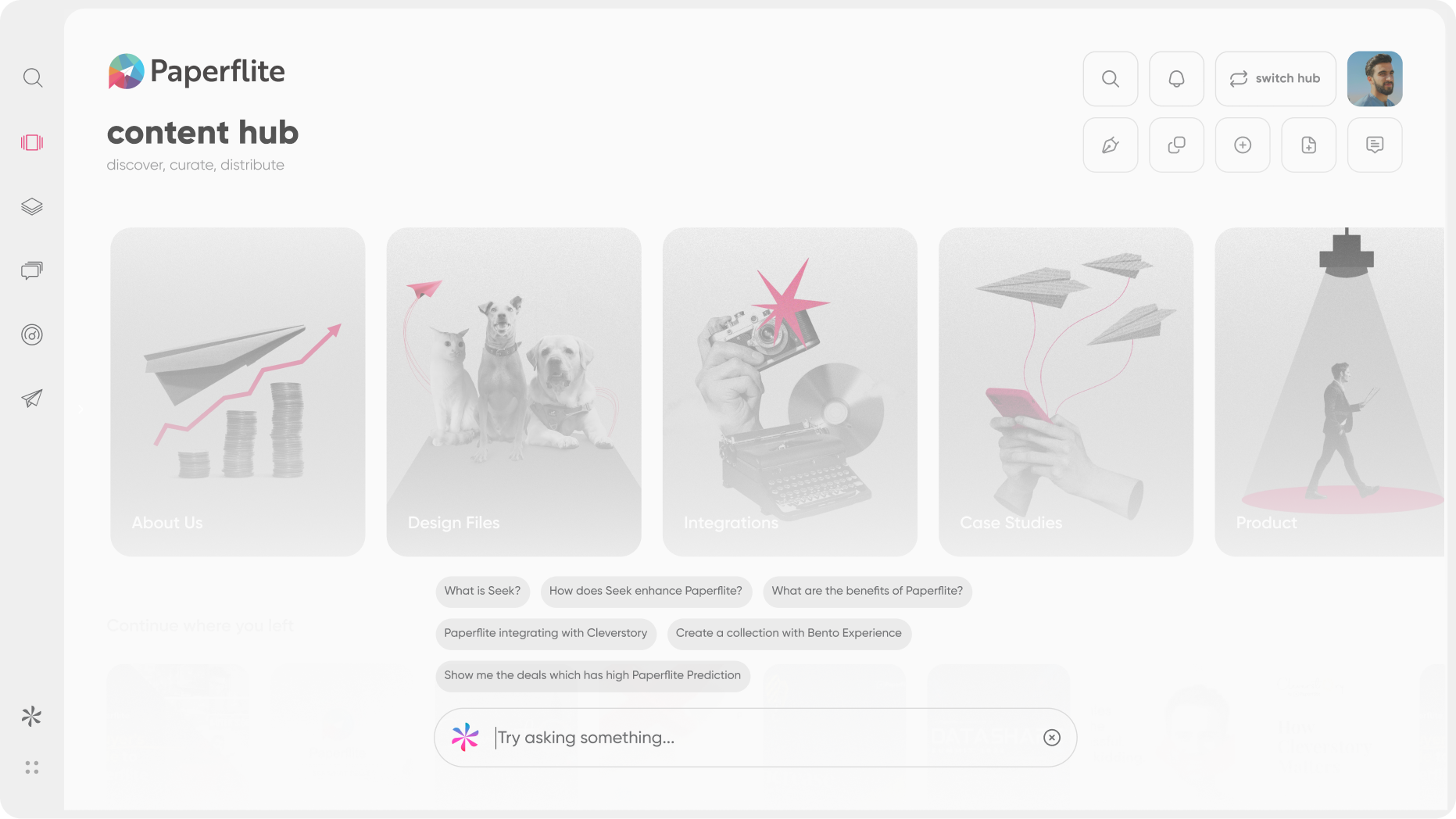
Paperflite is built for mid-market to enterprise sales teams with regional reps who need content in the right language without raising a ticket to marketing. It doesn't handle translation you bring translated content, and Paperflite organizes and distributes it. But for the content lifecycle that happens after translation, it's the most rep-friendly option in this category.
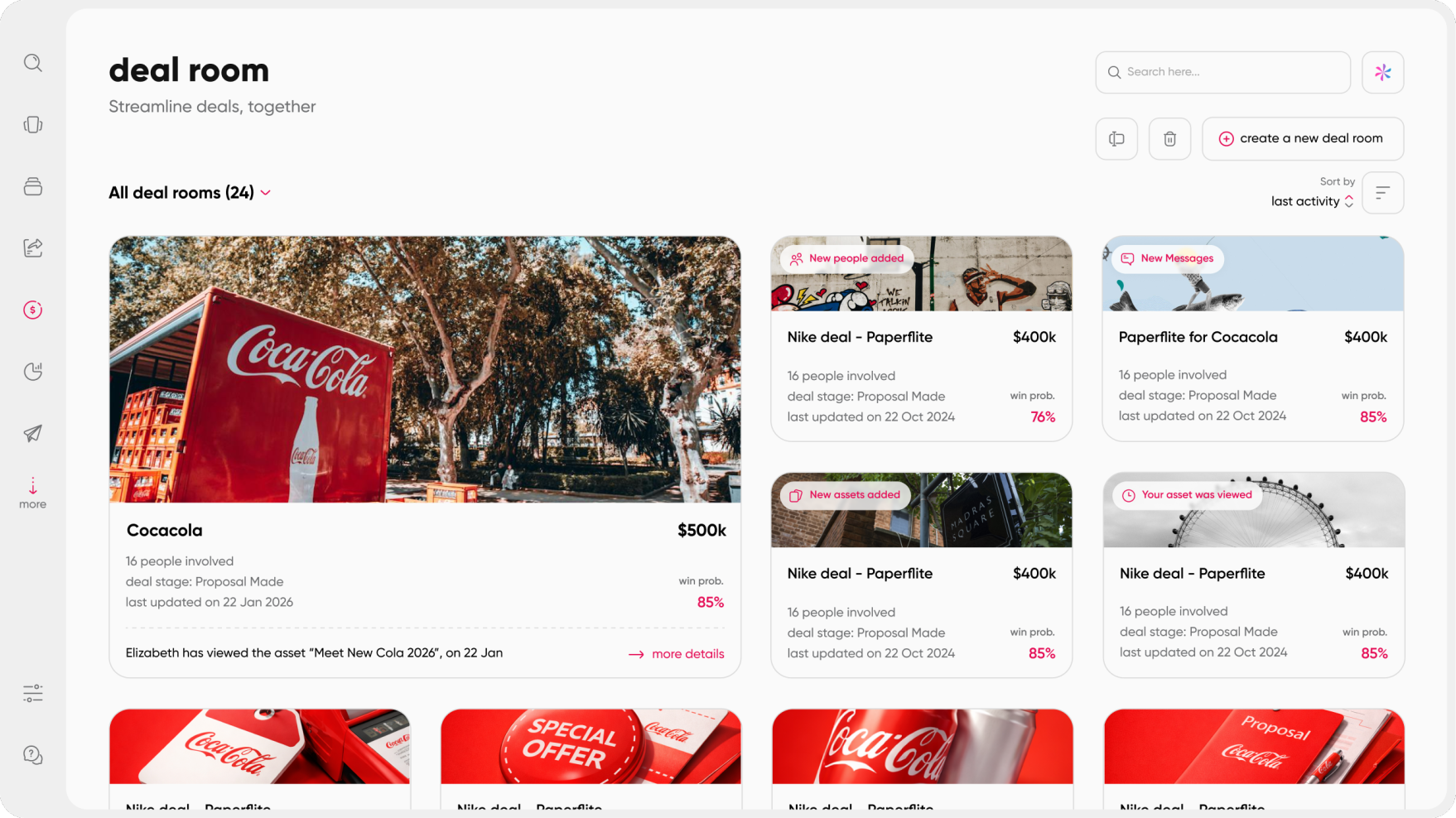
It supports deal collaboration across regions too Paperflite's digital sales room functionality lets reps share curated content directly with prospects in a branded, trackable space. Pricing starts from around $30/user/month.
2. Seismic Best for Enterprise Teams with Complex Localization Needs
Seismic's LiveDocs feature is genuinely differentiated for organizations managing localized content at scale.
LiveDocs auto-localizes dynamic content from a single source asset using machine learning translation with human review checkpoints. When source content changes a pricing update, a new messaging framework the translated versions stay in sync automatically. No one needs to manually re-translate six language versions every time the deck changes.
That's a real solution to a real problem at enterprise scale. If you have 800 reps across 12 countries and a compliance requirement for content accuracy, the value of automatic source-to-translation sync is hard to overstate.
The honest caveat: LiveDocs requires a clean, well-organized content taxonomy to work effectively. Seismic's platform draws G2 feedback for setup complexity and admin overhead it rewards significant investment in a dedicated enablement function. The Seismic/Highspot merger (announced February 2026) adds roadmap uncertainty worth factoring into any long-term evaluation.
3. Highspot Best for Large Teams Needing Structured Translation Review
Highspot supports automatic translation review queues across 14 languages with human-in-the-loop approval before publication. Before any translated content goes live, it passes through a structured review step a strong fit for organizations where brand accuracy across languages is non-negotiable.
The same workflow extends to training and onboarding modules, which matters for organizations localizing rep training in each market alongside external content.
Like Seismic, Highspot's depth is proportional to its complexity. It rewards investment in setup and a dedicated enablement function. For large GTM organizations with global operations and governance requirements, that investment pays off. The same Seismic/Highspot merger note applies both products' roadmaps are subject to change.
4. Smartling Best for the Translation Pipeline Itself
Smartling is a cloud-based Translation Management System built for managing translation at scale. It connects source content to translators, manages translation memory and glossaries so consistent terminology is maintained across language versions, and publishes multilingual output across channels.
What it doesn't do is put that content in front of sales reps. A rep in Tokyo still can't search Smartling for the right Japanese pricing deck. Smartling solves the translation problem; it doesn't solve the distribution problem.
The right architecture for most teams: use Smartling as the translation layer, then feed translated assets into sales enablement tools like Paperflite for rep-facing distribution, search, and tracking.
5. Crowdin Best for Teams with Developer-Led Localization Workflows
Crowdin integrates with GitHub, Figma, WordPress, Jira, and a broad range of developer tooling to keep translations in sync with development and design workflows. It's particularly strong for software localization keeping interface strings, help documentation, and product content consistent across languages as the product changes.
For sales teams, it's not the right tool. Crowdin is not purpose-built for sales content distribution. You can use it to translate your content, but you still need a sales content platform to put it in front of reps in an organized, searchable, trackable way.
6. Phrase Best for Translation Memory and Linguistic Assets at Scale
Phrase is a TMS suite Phrase TMS, Phrase Strings, Phrase Language AI that focuses on translation memory, terminology management, and linguistic asset consistency across large content volumes. If you translate high volumes of content and need consistent brand voice and terminology across six or eight languages over time, Phrase's translation memory and glossary management are genuinely strong.
Same caveat as Smartling and Crowdin: Phrase handles the translation pipeline, not the sales distribution layer. Content discovery, deal-stage organization, and rep-level access control by territory are not what it's built for. It works best as upstream translation infrastructure that feeds a downstream sales content platform.
How to Choose the Right Tool for Your Team
What features should you look for? The three non-negotiables are: region-based access control (so reps only see content scoped to their market), AI-powered search that finds the right language variant without requiring perfect tags, and engagement tracking by market so you know which language versions are actually performing.
Two questions narrow the field immediately.
Do you need translation management, content distribution, or both? Translation management building the multilingual content pipeline, managing translation memory, glossaries, review queues is the TMS category (Smartling, Crowdin, Phrase). Content distribution making sure the right rep finds the right language version before a call is the sales content platform category (Paperflite, Seismic, Highspot). Most teams need both layers, but they shouldn't confuse which problem they're solving first.
What's the size and structure of your GTM team? Under 200 reps with a lean enablement function: Paperflite's speed to value and Seek AI search handle multilingual distribution without heavy setup. 500 or more reps with dedicated enablement resources and complex governance requirements: Seismic or Highspot's depth earns its overhead.
Organizing everything in a central content hub with clear region-based structure is the foundation either way. The platform you choose sits on top of that structure.
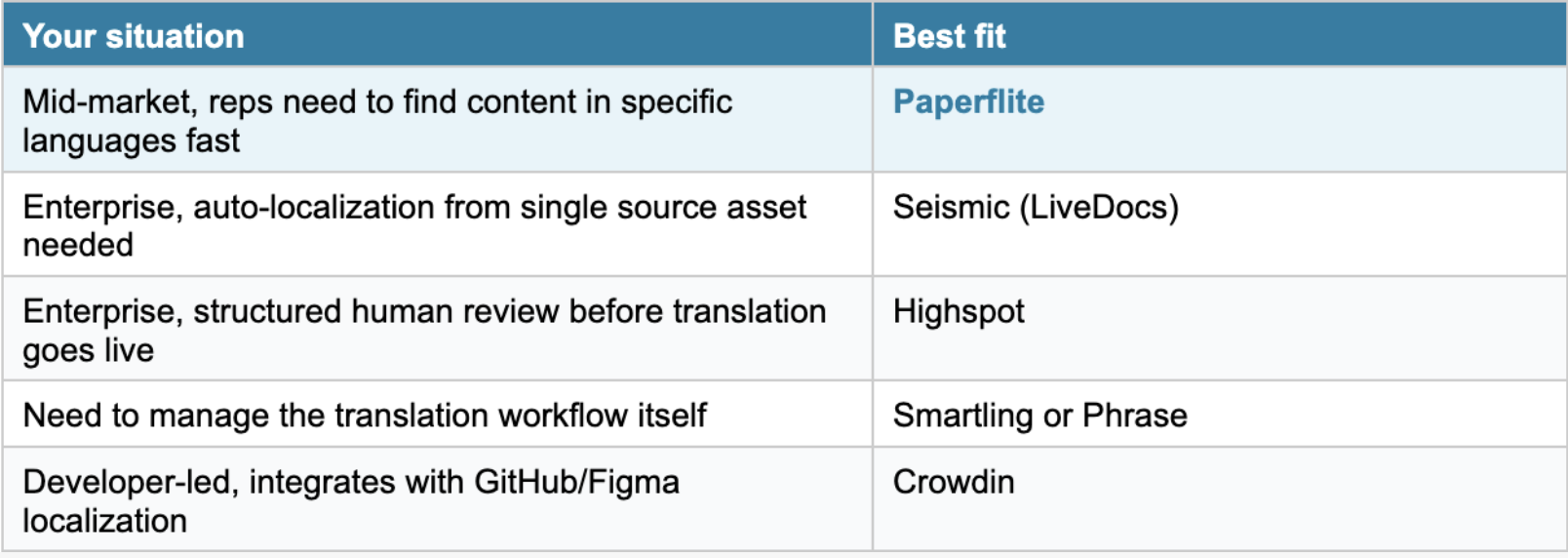
Quick Decision Guide
Getting It Right
Go back to the Hamburg call. The rep couldn't tell which version of the deck was current. Not because no one had translated it. Because no one had organized it, tagged it, or made it findable in the moment it was needed.
That's the problem the right tool solves. Not the translation the organization, findability, and governance of content that already exists in the right language.
If you need to build the translation pipeline, start with Smartling or Phrase. If your reps need to find the right language variant in the moment of a deal, Paperflite handles that region-based collections, auto-tagging that reads content on upload, Seek AI search, and engagement tracking that tells you which language versions are actually landing in each market.
Once you've organized your multilingual content, the next question is which types of sales enablement collateral to prioritize for each market, because not every piece needs to exist in every language from day one.
Frequently Asked Questions
What is multilingual sales content management?
Multilingual sales content management is the practice of organizing, tagging, and distributing sales assets across multiple languages and regions. It covers the full content lifecycle: organizing by territory and language, helping reps find the right version through search, and tracking which language versions perform best in each market. It is distinct from content localization, which covers only the translation step.
What's the difference between a translation management system and a sales content platform?
A translation management system (TMS) like Smartling or Crowdin handles the pipeline for creating translated content connecting source files to translators, managing translation memory and glossaries, and publishing localized output. A sales content platform like Paperflite handles what happens after translation: organizing content by language and region, surfacing it to reps through search, and tracking how it performs in each market. Most teams need both layers.
Can Paperflite manage content in multiple languages?
Yes. Paperflite supports multilingual content management through region-based collections (content organized by territory with access controls that ensure reps see content relevant to their market), auto-tagging that reads uploaded content and applies language and region metadata automatically, and Seek AI natural language search that returns the right language variant when a rep searches conversationally.
Does Seismic support multilingual content?
Yes. Seismic's LiveDocs feature auto-localizes dynamic content from a single source asset using machine learning translation with human review checkpoints. When source content updates, translated versions stay in sync automatically. It is a differentiated capability for enterprise organizations, though it requires a well-maintained content taxonomy and dedicated enablement resources to work effectively.
How does Highspot handle content in multiple languages?
Highspot supports automatic translation review queues across 14 languages with human-in-the-loop approval before publication. The same workflow extends to training and onboarding modules, making it a strong fit for large organizations that require human review before any content goes live in a new language.
Is Smartling good for sales content specifically?
Smartling is built for managing translation workflows connecting source content to translators, managing translation memory, and publishing multilingual output. It is not purpose-built for sales content distribution. Teams typically use Smartling as the translation layer and a sales content platform like Paperflite to organize and distribute the translated content to reps.
What should I look for in software for multilingual sales content?
Three things matter most: region-based access control (so reps in one territory only see content intended for their market and language), AI-powered search that surfaces the right language variant without requiring reps to know the exact file name or tag, and engagement tracking by market so you know which language versions are actually being used and which are resonating with buyers.
How does auto-tagging help with multilingual sales content?
Auto-tagging uses AI to read uploaded content and apply metadata including language and region tags automatically. For multilingual teams, this means a French case study uploaded to Paperflite gets tagged with its language and market without anyone manually categorizing it. Reps can then search for it naturally and find it, even if the file name does not include those words.