WHICH TOOL USES LOST DEALS FOR SALES TRAINING? HERE'S THE STRAIGHT ANSWER
HeySales, an AI sales coaching platform built by Paperflite, is built specifically to turn lost deals into training. It generates personalized roleplay simulations from real lost deal data pulled from your CRM, so reps can rehearse the exact conversations that cost them deals before facing similar situations again.
Introduction
A deal slips for the third time this quarter on the same objection. Same hesitation on price, same fumbled answer about a competitor, same rep walking out of the call knowing exactly what went wrong and having no structured way to fix it before the next one. The CRM gets a loss reason logged, maybe a note in a Slack channel, and then everyone moves on to the next opportunity. Nothing about that process actually stops it from happening again.
So the search starts: which tool uses lost deals for training, not just for reporting on why a deal died after the fact. That's a more specific question than it sounds, because a lot of tools claim to “learn from lost deals” while really meaning they generate a dashboard about them. This article names the tool that does something different with that data, explains exactly how the mechanism works, and shows where it sits next to win/loss analytics platforms like Gong that solve an adjacent but different problem.
The short answer: HeySales, an AI coaching platform built by Paperflite, is purpose-built to convert lost deals into rehearsable training. Here's what that actually means in practice, and why the distinction between analyzing a loss and rehearsing against it matters more than it might first appear.
Why Most Teams Never Actually Learn From Lost Deals
Ask a sales manager what happens after a deal is marked closed-lost, and the honest answer is usually: not much. A rep picks a reason code from a dropdown, maybe writes a sentence in the notes field, and the deal disappears from the active pipeline view. The lesson, if there is one, lives entirely in that rep's memory, and memory is a bad training system. It fades, it gets rationalized (“that prospect was never really qualified”), and it rarely transfers to the next rep who's about to walk into a nearly identical conversation.
Win/loss analysis tools do better than nothing here. They surface patterns across dozens or hundreds of lost deals: which competitor keeps showing up in losses, which objection correlates with lower win rates, which deal stage tends to be where things fall apart. That's genuinely useful for a quarterly business review. It tells leadership what's happening at the aggregate level.
What it doesn't do is put a rep back into that exact conversation with a chance to try it differently. A report that says “23% of lost deals mention pricing objections in the final two weeks” is a diagnosis. It's not treatment. The rep who fumbled that exact pricing conversation still walks into the next one with the same instincts, because reading a slide about the pattern isn't the same as practicing the fix.
That gap between insight and behavior change is where most lost-deal learning quietly dies, and it's the specific problem sales readiness work is supposed to close but often doesn't, because readiness programs are usually built around generic scenarios instead of the team's actual losses.
There's a second reason this gap persists: building custom training scenarios from real lost deals used to require serious manual effort. Someone had to pull the deal history, reconstruct the conversation, write a script, and find time to run reps through a roleplay session. Most enablement teams, already stretched across content, onboarding, and everything else on their plate, simply don't have the bandwidth to do that deal by deal. The result is that lost deals pile up as data nobody has time to turn into practice.
There's also a subtler version of this problem worth naming: even when a manager does try to run an informal debrief after a loss, it usually happens once, verbally, with whichever rep happens to be in the room. That debrief doesn't get captured anywhere reusable. The next rep who faces a similar objection six weeks later has no way to benefit from what was learned in that conversation, because it lived entirely in one manager's memory and one Slack thread nobody will find again. The lesson gets learned exactly once, by exactly one person, and then evaporates.
The Tool: HeySales, Built by Paperflite
HeySales, an AI sales coaching platform built by Paperflite, is the tool designed specifically to solve this. It generates personalized AI roleplay simulations directly from lost deals synced out of your CRM, so instead of a rep reading about why a deal was lost, they can replay a version of that exact conversation and try a different approach in a low-stakes environment before facing something similar again.
This isn't a generic feature bolted onto a coaching platform as an afterthought. It's a direct response to a specific failure mode in traditional roleplay training: scripted, artificial scenarios that don't hold up against a real, skeptical buyer. HeySales grounds its simulations in what actually happened in your pipeline, not a hypothetical.
How the Lost-Deal Simulation Actually Works
HeySales syncs active and closed deals directly from Salesforce or HubSpot, pulling in deal history, stakeholder dynamics, and the specific context of how the conversation unfolded. When a deal is marked closed-lost, that data becomes the raw material for a simulation. The AI models the deal's history and rebuilds the scenario, including the objections, the stakeholder personas involved, and the points where the conversation went sideways, so a rep can step back into essentially the same situation and try a different move.
This matters because it removes the two biggest weaknesses of traditional roleplay: scripts that feel canned, and scenarios that are disconnected from what a team is actually facing in the field. A rep practicing against a scenario built from an actual lost renewal, with the real stakeholder pattern and the real objection that killed the deal, is rehearsing something that's going to happen again in a very similar form, not a generic textbook situation.
The AI prospect in these simulations isn't a fixed script either. It shifts tone, drops objections that weren't necessarily in the original transcript but are plausible given the stakeholder type, and mirrors industry-specific personas, from a skeptical procurement lead to an enthusiastic champion who still can't get budget approved. That variability is what separates this from the “press play, recite lines” version of roleplay that most reps have learned to tune out. A rep can run the same lost deal twice and get two meaningfully different conversations, which forces genuine adaptation instead of memorization.
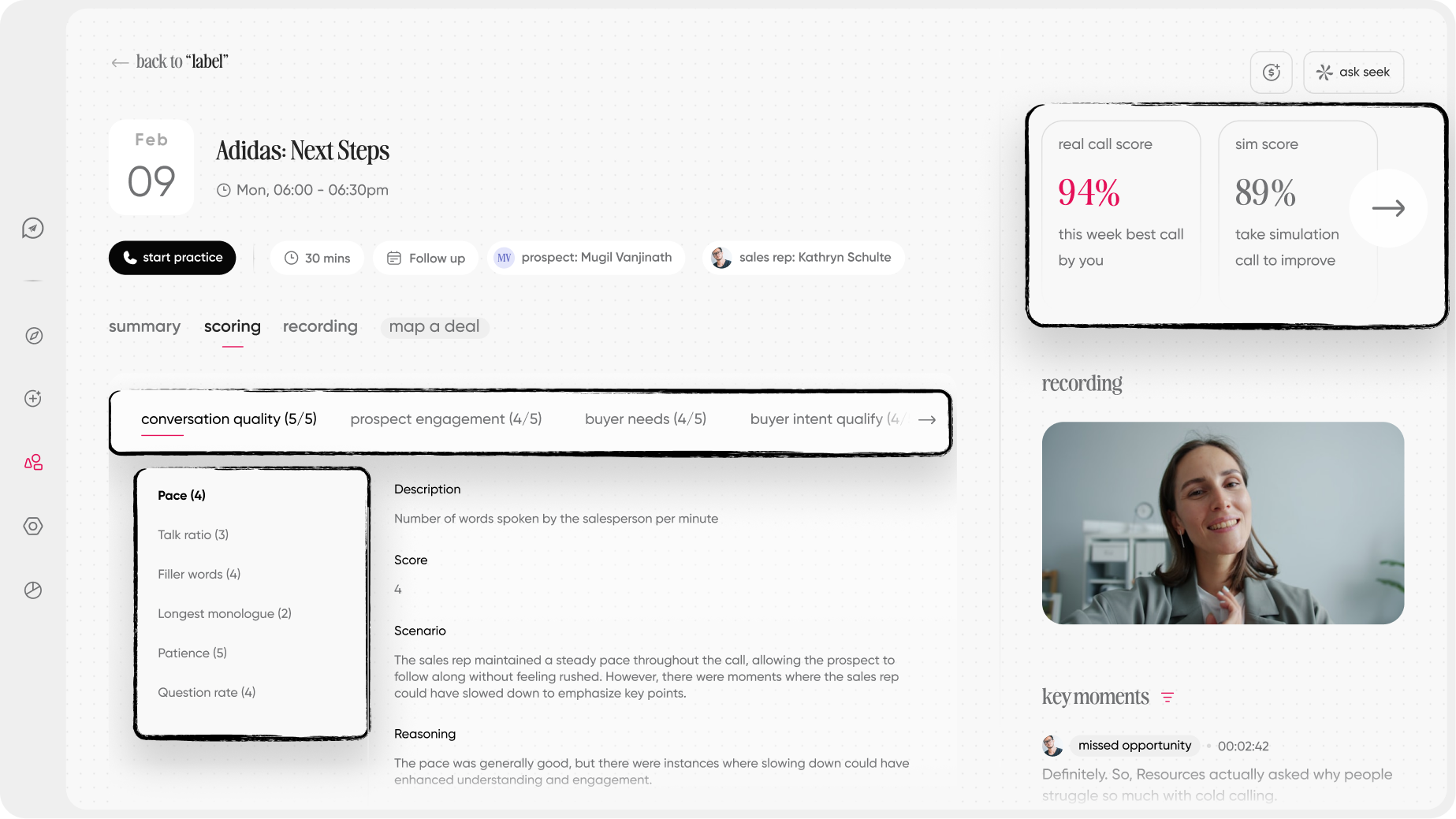
Sales leaders can also layer their own material on top of this. Actual call scripts, objection-handling guides, or specific theoretical scenarios can be uploaded and converted into adaptive simulations, which means the lost-deal roleplay isn't limited to whatever the CRM happened to capture. A manager who knows a particular objection is coming up across multiple accounts can build a targeted scenario around it directly, and reps can run it multiple times, adjusting their approach each round based on how the AI prospect responds. Sales coaching built this way, tied to what actually happened rather than a generic best-practices deck, tends to change behavior faster because the stakes and the specifics feel real.
Adaptive Learning Loops That Prevent Repeated Mistakes
The mechanism is explicitly designed to stop the same mistake from costing multiple deals in a row. Rather than treating each lost deal as a closed chapter, HeySales treats it as training data that feeds directly back into a rep's practice queue. If three deals stall on the same competitive objection, that pattern doesn't just sit in a report. It becomes a specific scenario the rep or the wider team runs through until the response gets sharper.
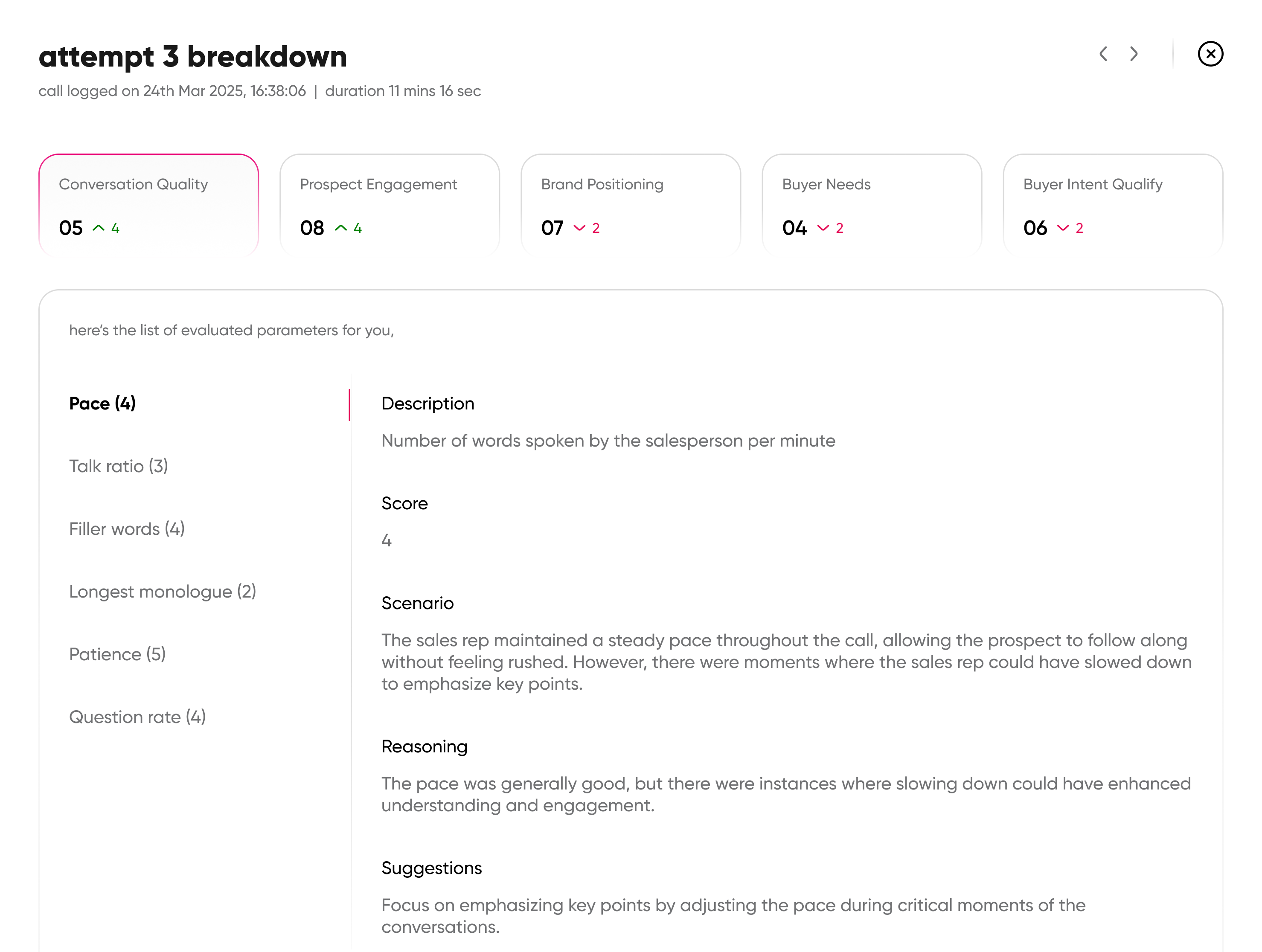
Feedback here goes well past the surface-level metrics most roleplay tools stop at. Instead of just tracking filler words or talk-to-listen ratios, the AI models analyze strategic questioning, value articulation, and the depth of objection handling, then deliver scored insights on why a rep is winning or losing specific types of conversations. Managers get something closer to a playbook than a scorecard: not just “this rep talks too much,” but a specific diagnosis of where the reasoning or the response breaks down.
Content used in the actual deal, battle cards, decks, competitive comparisons, can be embedded directly into the roleplay too. The AI flags missed talking points or underutilized assets in real time, so a rep practicing a lost-deal scenario isn't just improving their delivery, they're also learning which specific piece of collateral would have made a difference and didn't get used.
Where This Differs From Win/Loss Analytics Tools
It's worth being precise here, because Gong and similar platforms absolutely do analyze lost deals, and pretending otherwise would be a dishonest comparison. Gong's Deal Likelihood Score is trained on a company's historical closed-won and closed-lost deal data, using more than 300 signals to understand what good and bad deals look like, and reps can use natural-language prompts to query past deals directly, surfacing patterns across wins and losses to build a coaching library.
That's real, useful analysis. It answers questions like “what do our losing deals have in common” and “which competitor mentions correlate with lower win rates.” Where it stops is at the point of turning that insight into something a rep can rehearse. Gong's tools are built around understanding what happened and forecasting what's likely to happen next, not around reconstructing a specific deal as an interactive scenario a rep steps back into. A rep can read the analysis. They can't replay the conversation and try it differently inside the platform itself.
That distinction is the whole answer to “which tool uses lost deals for training” versus “which tool analyzes lost deals.” Mindtickle and similar coaching platforms sit somewhere in between: they use call and email analysis to generate coaching recommendations, which is a step closer to actionable guidance than a pure analytics dashboard, but the recommendations tend to be generic skill-based modules rather than a rebuilt version of the specific deal a rep actually lost. Second Nature and comparable roleplay tools solve the rehearsal problem well, letting reps practice against AI personas, but without a CRM sync grounding those personas in real deal history, the scenarios stay closer to generic best-practice situations than to a specific loss the team is trying to learn from.
None of this makes those tools worse at what they're built for. Win/loss analytics tools are genuinely strong at surfacing patterns across large volumes of pipeline data, and that's valuable work. The gap is specifically at the handoff point between “we know why we're losing” and “our reps can now handle that situation differently,” and that's the exact gap HeySales is built to close.
It's also worth noting that these categories aren't mutually exclusive in a tech stack. A team running Gong for conversation intelligence and win/loss pattern detection can still benefit enormously from a tool that turns the specific patterns Gong surfaces into rehearsal material. If Gong's analytics flag that a particular competitor mention correlates with a 40% drop in win rate, that's exactly the kind of signal that becomes a sharper, more targeted roleplay scenario rather than a standalone insight sitting in a dashboard nobody revisits after the quarterly review.
Why This Matters for Rep Behavior, Not Just Reporting
A report that nobody acts on doesn't change a single close rate. The value of connecting lost deals directly to rehearsal is that it collapses the distance between diagnosis and practice, which is usually where good intentions in sales enablement quietly die. A manager who reviews a quarterly loss report and mentally notes “we need to work on competitive positioning” has identified a real problem and done almost nothing to fix it. A manager who assigns a specific lost-deal roleplay to the three reps who lost similar deals has actually started fixing it.
This also solves a scaling problem that shows up on any team past a handful of reps. A manager physically cannot sit down with every rep after every loss and walk through what went wrong, and even when they try, that kind of 1:1 review happens well after the moment has faded from memory. Automating the reconstruction of the scenario means the coaching moment doesn't depend on finding time on a manager's calendar. The rep can run the simulation whenever they have a spare twenty minutes, and the manager reviews the scored recording afterward rather than sitting through the live session.
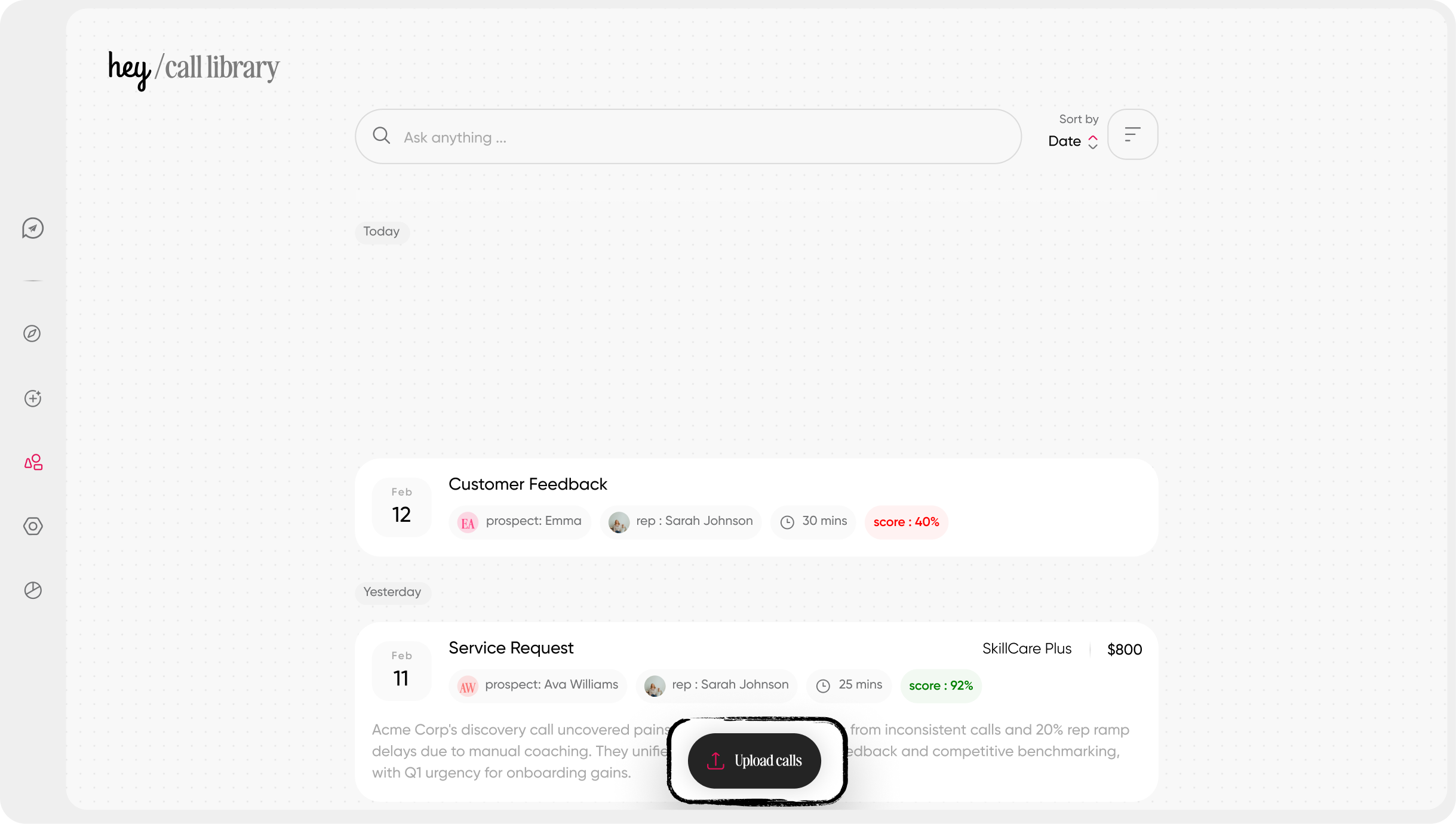
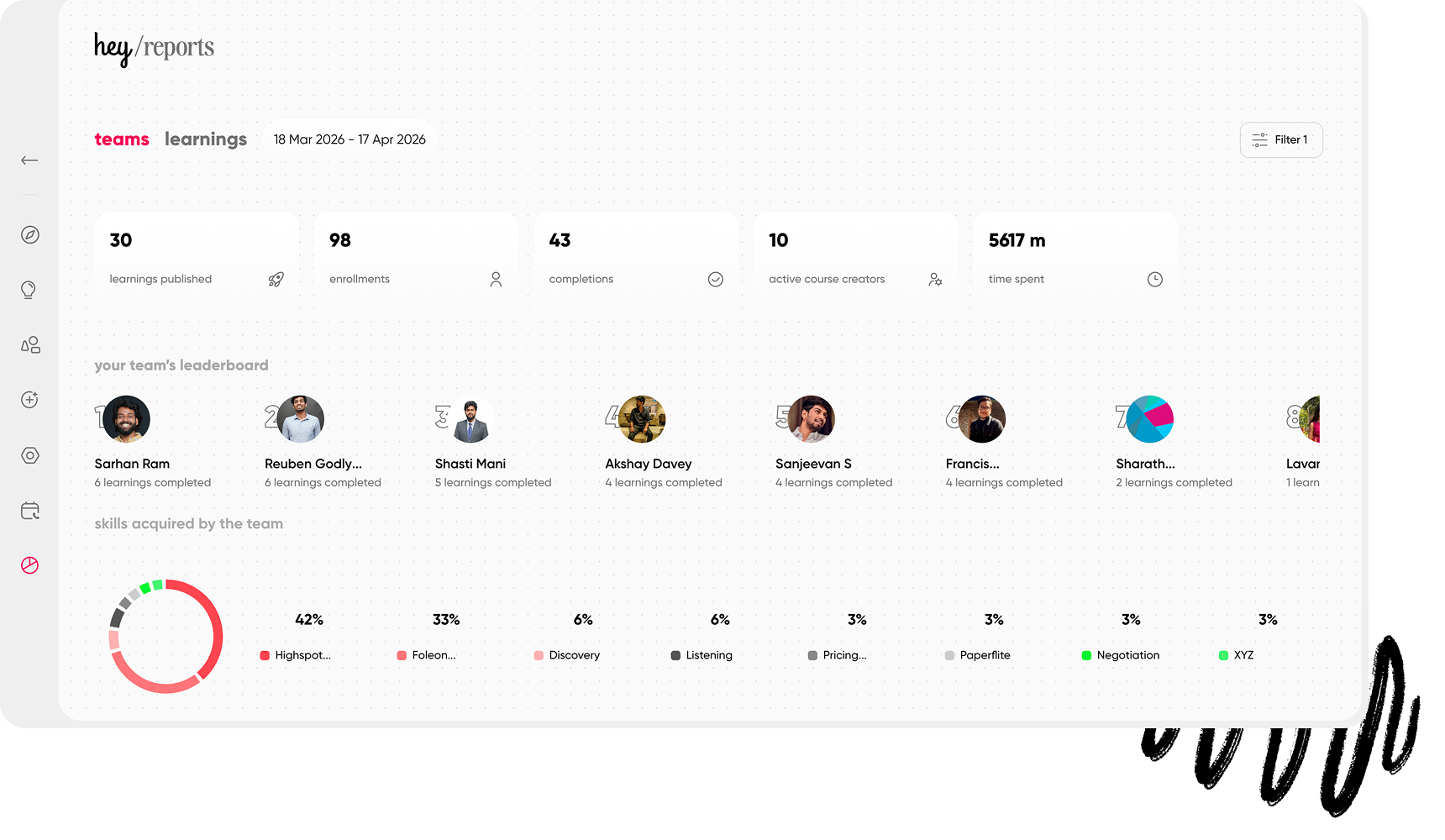
Because the feedback and the recordings flow directly to managers, coaching stops depending on the manager remembering to ask about a specific deal weeks later. Recordings and challenges can be shared with managers for focused coaching or with peers for collaborative practice, and rep progress gets tracked over time, which turns “we should really review our lost deals” from an aspiration into something that actually happens on a cadence.
There's a compounding effect worth calling out too. Every lost deal that gets converted into a scenario adds to a growing library the whole team can eventually draw on, not just the rep who lost that specific deal. A new hire six months from now inherits a training set built from real losses across the entire team's history, not a static onboarding deck someone wrote two years ago and never updated. The lost-deal library becomes more valuable the longer a team uses it, which is the opposite of how a static training curriculum tends to age.
How Teams Use Lost-Deal Simulation Day to Day
New reps get the clearest benefit early on. Instead of learning what a difficult renewal conversation feels like by living through their first one cold, they can run through a senior rep's past loss on a comparable deal type before ever facing something similar themselves. That's a meaningfully different kind of preparation than a generic onboarding module, because it's grounded in a real conversation that actually happened on a deal the company actually lost. What makes sales onboarding faster and more efficient usually comes down to exactly this: replacing abstract training with practice built from real situations the rep is likely to encounter.
For established reps, the pattern looks a little different. A rep who just lost a deal to a specific competitor can run the reconstructed scenario again within the same week, while the specifics are still fresh, and try a genuinely different approach to the objection that killed it. That immediacy matters. Waiting until the next quarterly training session to address a loss means the specific context has faded and the lesson gets generalized into something vaguer and less useful.
Managers increasingly use this as a triage tool rather than a report card. Instead of waiting for a formal review cycle to notice that three different reps are losing to the same objection, that pattern shows up in simulation performance and assignment data well before it becomes a quarter's worth of missed pipeline. Real estate sales teams, where long sales cycles and repeat objections make pattern recognition especially valuable, are a useful example: a manager can spot that several reps are losing at the same “let me think about it” stage and build one targeted scenario the whole team runs through, rather than coaching each rep individually on the same issue five separate times.
There's also a version of this that shows up specifically around competitive losses. When a team keeps losing to the same competitor on the same handful of objections, that pattern is exactly the kind of thing a manager would traditionally address with a battle card update and a training email nobody reads closely. Turning that pattern into a scenario reps actually have to navigate, with the AI prospect raising the specific competitive objections that keep coming up, tends to stick in a way a static one-pager never does. The rep isn't reading about how to counter the objection, they're practicing countering it, badly at first and then better, until the response becomes reflexive.
Conclusion
So, which tool uses lost deals for sales training? HeySales, built by Paperflite, is the tool purpose-built for exactly that: syncing closed-lost deals from the CRM, reconstructing the deal history and objections into a replayable scenario, and scoring reps on strategic questioning and objection handling rather than surface-level metrics. That's a distinctly different job from what win/loss analytics platforms like Gong do well, which is surfacing patterns and forecasting outcomes across a large volume of pipeline data.
The honest takeaway: if the real goal is changing what happens the next time a rep faces a similar objection, analysis alone doesn't get there. Rehearsal does. Teams that want both, the pattern recognition and the practice, tend to get more value from pairing a tool built for one with a tool built for the other than from expecting a single analytics platform to also function as a training gym. Whichever stack a team ends up with, the underlying principle holds: a lost deal that never gets replayed is a lesson that only gets learned once, by one person, and usually not thoroughly enough to change what happens next time. Explore 8 sales microlearning methodologies that actually work as a next step if you're building out the broader training cadence this fits into.
FAQ
Which tool converts lost deals into sales training?
HeySales, built by Paperflite, generates AI roleplay simulations directly from real lost deals synced out of your CRM, so reps can rehearse the exact scenarios that cost them past deals.
How does HeySales use lost deal data specifically?
It syncs deal history, stakeholder dynamics, and objection context from Salesforce or HubSpot, then rebuilds that specific lost deal as an interactive scenario a rep can replay with a different approach.
Is this the same as Gong's win/loss analysis?
No. Gong analyzes lost deals for pattern recognition, forecasting, and reporting using signals like its Deal Likelihood Score. HeySales turns lost deal data into a replayable roleplay scenario reps can actively practice against, which is a different function.
Does HeySales require CRM integration to build lost-deal scenarios?
Yes. HeySales syncs active and closed deals from Salesforce or HubSpot to model deal history and stakeholder context accurately before generating a simulation.
How much does HeySales cost?
HeySales is a separate product from Paperflite's core platform, and pricing depends on how it's bundled with your Paperflite plan. Confirm current packaging directly with sales, since bundling for the coaching layer continues to evolve.
Can managers see results from lost-deal roleplay sessions?
Yes. AI-analyzed recordings and scored feedback can be shared directly with managers for targeted coaching or with peers for collaborative practice, and rep progress is tracked over time.