9 Best Software for Persona-Based Content Recommendations in 2026 (Compared)
Persona-based content recommendation software uses AI to match sales content to a buyer's role, industry, or deal stage automatically, instead of reps digging through shared drives. It typically pairs a tagged content library with engagement and CRM data to surface the next-best asset for each persona in real time.
Three minutes before a call with a VP of IT at a 40,000-person logistics company, you're scrolling through a Slack channel nicknamed #sales-content-please-help. Two case studies sit open in different tabs: one about a startup, one about a healthcare company. Neither matches your buyer's industry. You pick the newer one, hit join, and hope nobody asks a follow-up question about it.
That scramble has a name: it's the exact gap that persona-based content recommendation software is built to close. Instead of a rep guessing which deck or case study fits a specific buyer, the software matches it for them, by role, industry, deal stage, and even how that buyer has already engaged with your content.
It's a real buying category, even though Google hasn't quite caught up to it yet (more on that mess in a minute). Sellers without this kind of recommendation layer spend an average of 10 hours a week just tracking down and revising content, according to Seismic's own enablement research. That's a quarter of a working week spent searching instead of selling.
We compared 9 tools that take a real swing at solving this, from full enterprise suites to lighter, buyer-room-first options. Here's what actually sets them apart.
What Counts as "Persona-Based Content Recommendation" Software
Most of the confusion around this term comes from search engines surfacing the wrong neighbors. Type a version of this phrase into Google right now and you'll mostly find tools that help you build a persona, Storyflow, Delve AI, Xtensio, not tools that use personas to recommend content once you have them. Those are genuinely useful for marketing research. They're also a different category.
The software in this list does something more specific: it sits atop a content library, tracks who's engaging with what, and automatically surfaces the right asset for a given buyer. Think of it as the difference between Netflix recommending a show because of your viewing history and a friend handing you a DVD because they think you'll like it. One scales. The other doesn't. That's the core of AI-powered content recommendations as a category: less guessing, more matching.
How it actually works, in plain terms
Under the hood, most of these tools combine three inputs: a tagged content library, so the system knows what each asset is actually about; engagement signals, who opened what, how long they stayed, what they clicked next; and CRM or deal-stage context, so the recommendation changes as the deal moves. Feed those three things into an AI matching layer, and reps get a next-best-asset suggestion instead of a search bar. Most platforms pair this with AI-powered content discovery too, for the moments a rep wants to search manually instead of waiting on a suggestion.
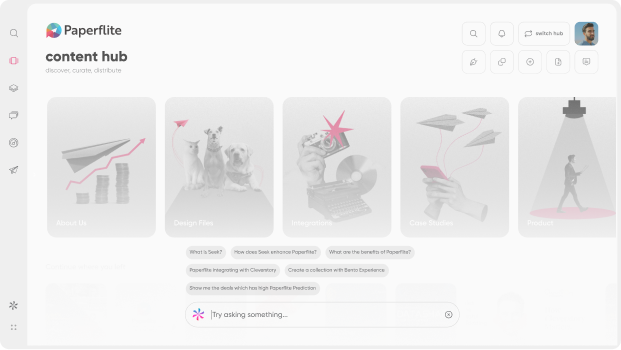
Content recommendation vs. content personalization
These two terms get used interchangeably, and that's where a lot of the buying confusion actually starts. Personalization changes the wording or design of a single asset for one viewer, like swapping a logo or rewriting a headline. Recommendation decides which asset to share with that buyer in the first place. Most modern platforms, including the ones on this list, now handle both.
What to Look for Before You Buy
Before you start comparing logos, it helps to know which features actually separate a real recommendation engine from a glorified tagging system.
- How deep does the persona or segment tagging go? Some tools rely on you manually tagging every asset by persona, which works until your library hits a few hundred pieces and nobody updates the tags anymore. Others auto-tag using AI, reading the content itself to infer who it's for.
- Does it recommend in real time, or in batches? A tool that only refreshes recommendations overnight is fine for top-of-funnel content. It's a problem mid-deal, when a buyer's questions on Tuesday's call should change what gets suggested for Wednesday's follow-up.
- Does it know what stage the deal is in? The best content for a first call and the best content for a final-stage negotiation are rarely the same asset. A recommendation engine that ignores CRM and deal-stage data is really just a smarter search bar.
- Is the recommendation internal-only, or does the buyer see it too? This is the split that matters most. Some platforms only help the rep find content faster. Others extend the same logic to a digital sales room the buyer can browse on their own, preloaded with the content the AI already decided was relevant to their persona. If your buying committee includes five stakeholders who never join a call, the second kind does a lot more work for you.
- Can you see what actually worked? Recommendation without reporting is a guess with extra steps. Look for attribution back to which recommended assets actually moved a deal forward, not just which ones got opened.
The 9 Tools, Compared
Seven of these are sales enablement platforms in the traditional sense. Two lean into buyer-facing deal rooms first and treat recommendation as a feature inside that room rather than the headline. All of them claim some version of "AI recommends the right content." Here's what that actually means in practice, and what it costs as of this writing.
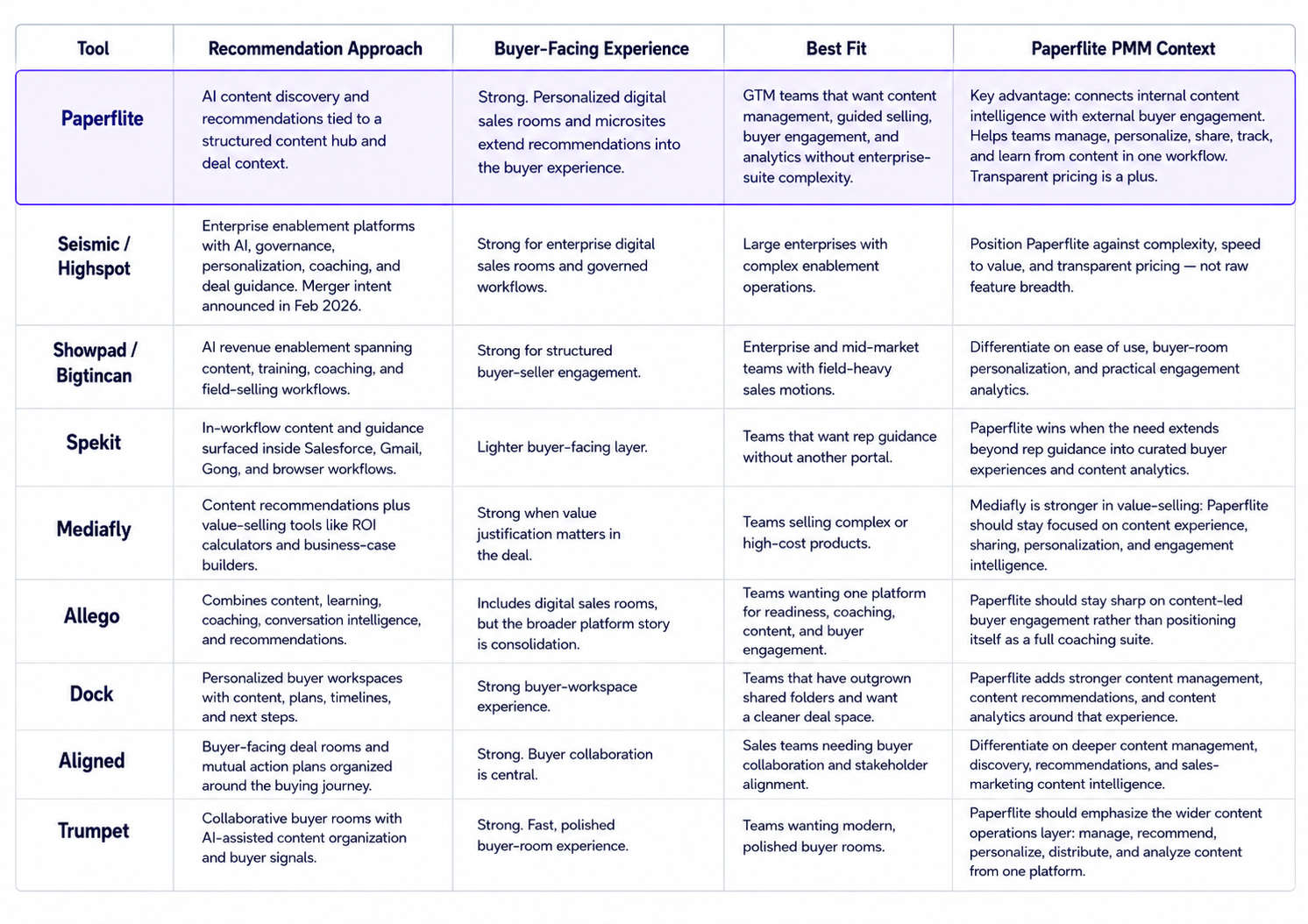
Paperflite
Paperflite pairs AI content recommendations with a buyer-facing digital sales room, so the same persona-based matching that helps a rep find an asset also builds the room a prospect browses on their own. Pricing is published, which is rare in this category.
Seismic (merged with Highspot, Feb 2026)
The two biggest content recommendation engines in this category are now one company. Seismic's LiveDocs handles dynamic content assembly; the former Highspot side, now branded Nexus AI, handles persona and deal-stage matching. Expect the broadest feature set and the longest implementation timeline. See how it compares: Paperflite vs. Highspot.
Showpad (merged with Bigtincan, Oct 2025)
Showpad's recommendation engine leans on video and a guided-selling layout more than most competitors here. The Bigtincan merger adds Brainshark's training tools to the stack. See the side-by-side: Paperflite vs. Showpad.
Spekit
Spekit's AI Sidekick recommends content from inside Salesforce itself, surfacing it in the rep's existing workflow rather than a separate app. Strongest for internal rep guidance; lighter on buyer-facing rooms.
Mediafly
Mediafly bolts value-selling tools, ROI calculators, and business case builders onto its content recommendation layer. Worth a look if your reps need to justify the purchase internally, not just present a deck.
Allego
Allego folds content recommendation into a seven-tool bundle that also covers coaching, conversation intelligence, and digital sales rooms. The pitch is consolidation; the tradeoff is a steeper per-seat cost as you add modules.
Dock
Dock targets teams that have outgrown a shared folder but find suites like Seismic's too heavy for where they are today. It auto-organizes content and generates personalized documents, with a lighter setup than most names on this list.
Aligned
Aligned is built around buyer-facing deal rooms first, with content recommendation as a feature inside that room rather than the headline. A fit for teams whose biggest gap is buyer experience, not internal content search.
Trumpet
Trumpet takes a similar buyer-room-first approach to Aligned, with recommendation logic that adapts the room's content as the deal moves through stages. Pricing for both Aligned and Trumpet wasn't independently confirmed in this research pass, so check current rates directly before including either on a shortlist.
Why the Market Just Got More Confusing
The sales enablement market has been consolidating, which makes vendor comparisons messier than they used to be.
Seismic and Highspot announced an intent to merge in February 2026. If the deal closes, the combined company is expected to operate under the Seismic name. Until then, buyers should treat the roadmap, packaging, and migration story as active evaluation questions, not assumptions.
Showpad and Bigtincan have also been combined under the Showpad brand after Vector Capital’s acquisition. That creates a broader revenue enablement platform, but it also means buyers should ask how existing products, pricing, support, and roadmap priorities will come together.
Gong has also moved deeper into enablement with Gong Enable, expanding from conversation intelligence into coaching, training, and revenue workflow guidance.
None of this makes those platforms bad choices. It just means the category is shifting. For buyers, the practical question is simple: do you want a broad enterprise enablement suite, a buyer-room-first tool, or a content intelligence and engagement platform that connects content discovery, sharing, and analytics without turning implementation into a second career?
Two of the names on that list merged with each other in the last twelve months, and a third merger touched a third. None of this is marketing fluff. It's a real shift in who you'd actually be buying from.
How Paperflite Approaches This
How Paperflite approaches persona-based content recommendations
Paperflite treats content recommendation as part of the larger sales content journey.
The first problem is internal: reps need to find the right asset without digging through folders, asking marketing, or reusing whatever deck is closest to their desktop. Paperflite helps by combining AI-powered content discovery, content recommendations, and a structured content hub so sellers can get to the right material faster.
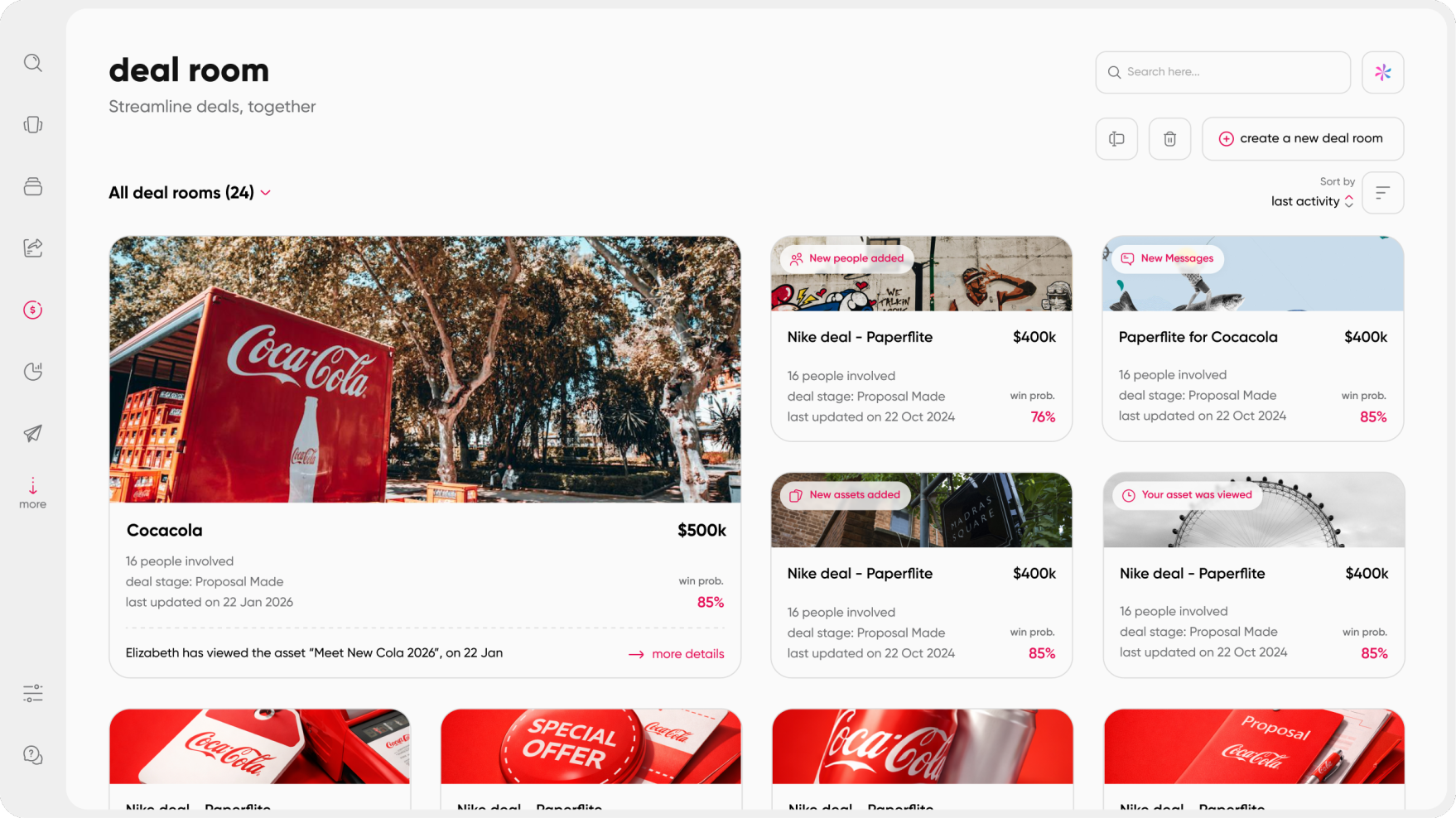
The second problem is external: once the rep finds the content, the buyer still needs a clean place to consume it. This is where Paperflite’s digital deal rooms and personalized microsites matter. The same content that gets recommended internally can be packaged into a buyer-facing experience that is specific to the account, persona, use case, or deal stage.
The third problem is measurement. Sharing content is easy. Knowing whether it worked is where most teams struggle. Paperflite gives teams engagement analytics across content assets, so marketing and sales can see what buyers opened, what they spent time on, and which assets are actually helping move conversations forward.
That combination is the important part. Paperflite is not just trying to be a smarter search bar. It connects content discovery, content sharing, buyer engagement, and performance analytics in one workflow.
Pricing is also unusually clear for this category. Paperflite publishes its plans publicly, with AI-powered content recommendations, content personalization at scale, digital deal rooms, and predictive deal insights included in the Advanced plan.
Pricing is public. Starter runs $30 a month per user, Professional is $50, and Advanced, the tier with AI recommendations, is $60 (or $57 if you pay annually, with a 5-user minimum). You can see the full breakdown on Paperflite's pricing page before you ever talk to a salesperson, which is more than most of the names on this list can say.
Frequently Asked Questions
What is persona-based content recommendation software?
It's software that uses AI to match sales or marketing content to a buyer's role, industry, or deal stage automatically, instead of reps manually searching a shared drive or content library.
How is content recommendation different from content personalization?
Personalization changes the wording or design of one asset for a viewer. Recommendation decides which existing asset to share in the first place. Most modern platforms, including Paperflite, now do both.
Do I need buyer personas already defined before using this kind of software?
It helps, but it isn't strictly required. Many platforms can start recommending content from engagement and CRM data, then get sharper as you layer in defined personas.
Is digital sales room software the same thing as content recommendation software?
They're related but distinct. A digital sales room is the buyer-facing space where shared content lives; content recommendation is the engine deciding what goes into that room for a given persona. Several vendors, including Paperflite, now combine both.
What's the ROI of using persona-based content recommendations?
The clearest published data point comes from Seismic's own enablement research, which found that sellers without a recommendation tool spend an average of 10 hours a week tracking down and revising content manually, time this category of software is designed to claw back.
How much does persona-based content recommendation software cost?
It varies widely by vendor and by whether the platform publishes pricing. Paperflite publishes transparent per-user pricing starting at $30/mo, with AI content recommendations included from $60/mo per user. Most enterprise suites (Seismic, Highspot, Mediafly, Allego) are quote-only, typically landing anywhere from the low five figures to well over $100,000 a year depending on team size and modules.
Did any major sales enablement vendors merge recently?
Yes. Seismic and Highspot announced a merger in February 2026, a combined entity valued around $6 billion, and Showpad merged with Bigtincan in October 2025. Worth factoring into your evaluation timeline if you're considering either.